Her book goes behind film scenes
Award-winning photojournalist Mary Ellen Mark often turns her lens to movie sets and stars. That side job is now documented in her "one commercial book."
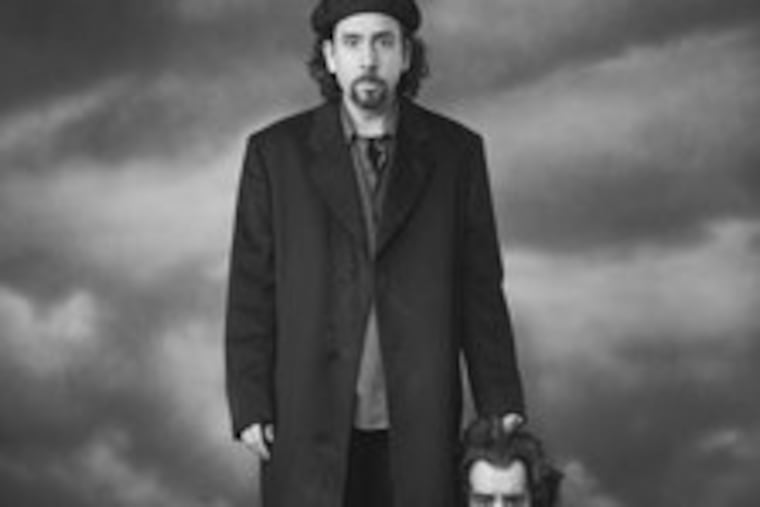
Johnny Depp and Brad Pitt are here. Cate Blanchett and Nicole Kidman. And Marlon Brando, Katharine Hepburn, Sir Laurence Olivier, raised from the dead.
"It's probably my one commercial book," says photographer Mary Ellen Mark, laughing. "All the others were on very obscure subjects. . . . But basically this is all famous people. I was lucky. I was really lucky."
Mark, 68, is on the phone from her New York studio, talking about Seen Behind the Scene: Forty Years of Photographing on Set (Phaidon, $59.95), a coffee-table gem that represents, for Mark, a mere sideline venture: earning money on location, hired by the director or the studio, to shoot stills. François Truffaut recruited Mark for 1969's Mississippi Mermaid, Luis Buñuel for 1970's Tristana. More recently she was in Morocco, capturing Pitt and Blanchett between takes on Babel. And she was in London shooting Tim Burton, Helena Bonham Carter and Depp for Sweeney Todd.
Mark, whose photojournalism has won wide recognition, including the coveted George Polk Award, is a Philadelphia native, raised in Elkins Park. She is a graduate of Cheltenham High ("I was head cheerleader") and the University of Pennsylvania. Her work - studies of the homeless, of disabled children, of twins, of everyday Americans - is insightful, often breathtaking social documentation, raised to the level of art.
Easygoing and self-effacing, Mark will be in town Monday night at the Central Library of the Free Library of Philadelphia, showing and discussing her photographs, particularly the star-studded stuff in Seen Behind the Scene.
"For me, working on a film, it's like photographing paintings in a museum," Mark explains. "You're basically entering somebody else's world and photographing their world. It's nothing that you've actually, on your own, seen and created."
At the same time, though, Mark brings a keen reportorial eye to those artificial worlds, creating, in some of the collection's most arresting images, a sublime juxtaposition of the real and the surreal: a portrait of filmmaker Burton seated alongside one of Charlie and the Chocolate Factory's trained squirrels; Robert Downey Jr. in weird lycanthropic makeup, posing lovingly with his son, Indio, on the set of Fur, or the over-the-top decadent dreamscapes of Fellini's 1969 Satyricon.
"My God, Fellini, well, he was amazing," Mark exclaims. "You couldn't go wrong. . . . All you had to do is point a camera at him, or on his set, you'd get a picture."
For one Hollywood icon, however, it wasn't that simple. Brando, whom Mark first met and worked with on the Montana locations of Arthur Penn's 1976 western The Missouri Breaks, was his famously ornery self.
"I remember, it was really scary, because you had to approach him and ask . . . 'Mr. Brando, can I take your picture?' It was his way of controlling you, more than anything, I think. So he'd either say, 'Yes' or he'd say 'No,' and of course by that time the picture was gone, and there was nothing to shoot.
"I remember trying to talk to him about taking his picture, and he was sitting by a river," Mark says, remembering a day near the end of her time on The Missouri Breaks shoot. "I didn't have any pictures of him, so I said, 'Um, Mr. Brando, I'm leaving, I just wanted to say that I didn't get any pictures of you, but anyway, I'm leaving.'
"And he said, 'You can take pictures now.' He had his ways."
Mark shot Brando again in the Philippines - there's a great, playful portrait of the actor with a big, black beetle crawling across his big, shaved head - during the waning months of Francis Ford Coppola's epic production, 1979's Apocalypse Now. Coppola is among a number of people who contribute essays and reminiscences to Mark's book.
Mark is married to the filmmaker Martin Bell. The pair often work in tandem: For a series on the American prom, Mark and Bell recently crisscrossed the country, she with her heavy Polaroid 20 x 24 equipment, he with his movie camera, to shoot an accompanying documentary. Mark photographed Jeff Bridges and Edward Furlong on the set of Bell's brilliant 1992 indie, American Heart. Some of the photos are in her book.
This week, Mark and Bell are in Stockholm, Sweden, for the opening of her exhibition on disabled children. Bell made a documentary, Alexander, about one severely disabled Icelandic boy and his family.
Defying the movement toward digital photography, Mark still shoots on film, and says so with a bit of pride and stubbornness.
"I'm staying with film, and with silver prints, and no Photoshop," she says. "That's the way I learned photography: You make your picture in the camera. Now, so much is made in the computer.
"But I just like the idea of having a negative. And I just like the way film looks. . . . I think it's a different medium. I mean, I'm not anti-digital, I just think, for me, film works better."
It certainly does. If there remain any doubts, just turn through the brilliant, black-and-white pages of Seen Behind the Scene.