The indirect director: Charlie Kaufman's mind at work
Charlie Kaufman, the mind behind "Being John Malkovich," "Adaptation," "Eternal Sunshine of the Spotless Mind" and "Synecdoche, New York" (opening today) writes offbeat movies.
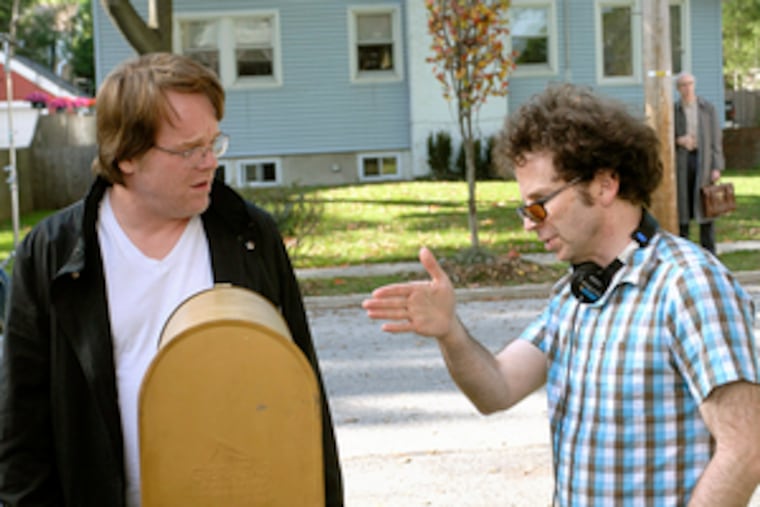
Charlie Kaufman, the mind behind "Being John Malkovich," "Adaptation," "Eternal Sunshine of the Spotless Mind" and "Synecdoche, New York" (opening today) writes offbeat movies.
It's therefore not surprising that Kaufman is a little offbeat himself.
In September at the Toronto International Film Festival, Kaufman arrived for his interview at the Intercontinental Hotel and placed a large, brass knob on the table in front of him - for no real reason. He had gotten it recently and liked it. So he was walking around with it.
If the reporters present thought it was going to help us unlock the secrets of Kaufman's origamilike brain - his plots repeatedly fold into themselves - we were largely out of luck.
But Kaufman did give two insights into his Escher-like life: "I come to think of that time I'm not writing as writing," he said. And "The weekend is exactly the same as any other day."
Oh. OK.
"Synecdoche" was supposed to have been directed by occasional Kaufman collaborator Spike Jonze, but Jonze was busy prepping "Where the Wild Things Are," so the socially awkward Kaufman, who admits to being intimidated by celebrities, stepped in.
He had directed Meryl Streep in a play, so that gave him some confidence, and he'd frequently been involved with the production of films for scripts he'd written, so that gave him some knowledge.
But directing and writing are about as different as two jobs in the same field can be.
"Directing is very social," said Kaufman, "which is different from writing.
"Directing doesn't require self-discipline," he added. "But when you get up on a day to write and don't write, nobody gives a s---."
Kaufman said he spends a long time working on his scripts and one of the many things that troubles him - "Synecdoche" is largely about death - "is the idea that I've been working on this as long as I have."
Asked how he was feeling given the downbeat nature of his movie, Kaufman said, "Right now I feel OK. But it's more of an abstraction. I could be dying."
"Synechdoche" star Philip Seymour Hoffman, who plays a man directing a play about himself over the period of most of his adult life, while casting a man to play him and then casting a man to play the man playing him, was also philosophical about the film's life-death continuum.
"Life is really, f------, f------ strange," he said. "Time seems to move faster as you get older. It's a fact. I think everybody thinks that.
"But," he added, "last night could seem like two weeks ago depending on what happened last night."
And while most of the media present were trying to make sense of the play-within-a-play-within-a-life film, Hoffman didn't get what the problem was.
"I read it once," he said of the script. "One thing follows another. It wasn't confusing."
Co-star Catherine Keener, who also starred in "Being John Malkovich," however, didn't even pretend.
"I don't understand it," she said. "I just go with it.
"I'm not that upset about figuring it out right away . . . or ever," she added. "I don't generally try to see the scope of it. I can't."
But, occasionally, what Kaufman was trying to do would make sense to her, Keener said, and she'd say to herself, "God, that's what you were up to." *