New Recordings
Pop Cook and Archuleta faced off last May in the most intriguing American Idol finale since season two, when Ruben Studdard edged out Clay Aiken. Six months later, with the release of their debut albums, they're still running throat and throat.
Pop
David Cook
(RCA **1/2)
David Archuleta
(19 **1/2)
Cook and Archuleta faced off last May in the most intriguing
American Idol
finale since season two, when Ruben Studdard edged out Clay Aiken. Six months later, with the release of their debut albums, they're still running throat and throat.
Cook's record is a collection of clean, propulsive rockers. His vocal range remains impressive, although to the CD's detriment, he rarely strays from his Nickelback-based formula. Maybe that's what makes the ballad "Permanent," the least guitar-heroic song in the batch, stand out.
Archuleta, he of the sweetly yearning voice and the puppy-dog eyes, delivers a record that is more mature than expected. The opening song, "Crush," for instance, is a lovely ballad suggestive of a Utah version of Ne-Yo.
Most of the songs on Archuleta's album have the markings of songwriting pros: middling verses with soaring choruses. A number of tunes such as "You Can" could work on the country charts with only minor retooling.
Archuleta, who was 11 when
American Idol
debuted, grows sappier as the tracks tick by. But there are some perfectly tailored radio songs here
Both singers, in fact, display good commercial instincts. No surprise. It was apparent from the beginning of the
Idol
season that the two Davids had their eyes firmly on the prize.
- David Hiltbrand
Thr33 Ringz
(Jive ***)
Thanks to T-Pain, everybody on R&B radio sounds like a robot. If imitation is the sincerest form of flattery, then the "rapper ternt sanga" Faheem Rasheed Najm is the most loved man in pop music. The auto-tuned vocal style of which he's the acknowledged master has been overused at this point by everyone from Britney to Kanye. And while it has its soothing qualities, in the wrong hands it's more soul-killing than soulful.
Tallahassee T-Pain himself, however, is a more amusing and crafty robot than most, as he points out on "Karaoke," a song on which he returns to his rapping roots to disparage copycats. And throughout
Thr33 Ringz
, the "Ringleader Man" directs his greatest show on earth with aplomb. He makes use of many a guest - on "Change" (a popular title this year), Diddy, Mary J. Blige and Akon turn up, the latter pledging to end violence by turning "every bullet into a Hershey's kiss" so "we can eat away our fear." Just to prove that there is a soul within the machine, he turns the auto-tune off on "Keep Going," and doesn't sound half bad.
- Dan DeLuca
The Renaissance
(Universal/Motown ***1/2)
Give it up to Q-Tip for tenacity.
As hip-hop's smoothest rapper - he all but invented the notion of "flow" - Q was only one part of A Tribe Called Quest's innovations. Their progressive lyricism was as intelligent and abstract as it was socially aware and humorous. Their intuitive ability to integrate live jazz into hip-hop was revolutionary.
How have we repaid Q? By juggling his solo career from label to label and scrapping one record entirely days before its 2002 release.
That his sophomore effort,
The Renaissance
, is here is a miracle. That it's as charmingly disarming as anything he's made within Tribe is a bonus. Q-Tip still traffics in liquid, with his divinely watery jazz-hop (with aid from guitarist Kurt Rosenwinkel) and his fluid rhyming abilities intact. His lyrics are sensitive and wise as he and duet partner Raphael Saadiq tackle the drama of women and men in wartime on "We Fight/We Love."
Lest you think this a Quest retread, it ain't. It's not as lyrically crowded as Tribe. There are jarring Can samples ("Manwomanboogie") and twitchy club-a-dub electronics found within
Renaissance
's Fender-filled atmospheres. Mostly, Q-Tip's voice sounds more lived-in, with just an edge of doubt.
Maybe he can't believe this thing finally got released.
- A.D. Amorosi
Day By Day
(Mercer Street/Downtown ***)
Very much doing his father Fela proud, Nigerian musician-songwriter Femi Kuti takes Afrobeat to unexpected places on his first studio album in seven years. "Do You Know" starts as a wry tribute to jazz greats and then pursues a leisurely series of extended grooves until Kuti name-checks his dad at the end. "You Better Ask Yourself" has a polished funk sheen, complete with snappy horns and shimmering organ, only to have the lyrics remind us of the vast disparity between Africa's rich natural resources and its impoverished masses. Likewise, the electronics-tinged "One Two" is playful but still focused on injustice. These may be rallying cries, but Kuti's delivery and backing is so alive that you needn't dwell on the political edges unless so inclined.
- Doug Wallen
Country/Roots
Save the Day
(Large River ***)
A daughter of the South, and of a Baptist preacher, Kate Campbell has long used her native South and her Christian upbringing as inspirations for folk-country songs of empathy, grace and universal resonance.
Save the Day
is often concerned with transcendence, whether it's finding liberation in a "Dark Night of the Soul" or, in the title track, pondering where fulfillment lies. Reflecting the organic, acoustic-textured nature of most of the music, she does all this in down-to-earth and never dogmatic fashion. She can make a serious point and not sound smug or clever with a song about both Jesus and the King of Rock and Roll ("Everybody Knows Elvis"), but she also employs humor: "Looking for Jesus," a duet with John Prine, takes a gently whimsical approach to people's urge to believe.
- Nick Cristiano
The Best of Jimmy Hughes
(Fame ***1/2)
Along with Memphis, Muscle Shoals, Ala., was the home office for Southern soul during the style's heyday in the '60s and '70s, and the fabled Muscle Shoals Sound was born with Jimmy Hughes' 1964 classic, "Steal Away." This Hughes collection fittingly marks the relaunch of Fame Records, the label that was a prime purveyor of Muscle Shoals' country- and rock-accented soul.
Hughes' voice doesn't possess the grit normally associated with Southern soul men. The gospel-trained singer's high, smooth tenor is more Sam Cooke than Otis Redding. He proves to be a warm but assertive presence, however, on this mix of punchy R&B workouts and seductive ballads, like "Steal Away." Some of the these performances are on CD for the first time, and
The Best Of
suggests that Hughes' star should have ascended higher than it did.
- N.C.
Jazz
Appearing Nightly
(Watt/ECM ***1/2)
Carla Bley, one of jazz's top composers, gets her inspiration from the 1950s, when she worked as a cigarette girl at the jazz club Birdland.
The main piece, "Appearing Nightly at the Black Orchid," pays tribute to a Monterey nightclub where Bley held forth as a 17-year-old pianist. The 25-minute piece was commissioned by the Monterey Jazz Festival.
The CD, recorded live in Paris, has the freedom of a Fellini film but with burlesque close by. Bley's 17-piece group resembles the Ellington band on steroids. Tin Pan Alley standards weave in and out. The horns swing, smear and go splat, often to a driving beat. The charts are full of verve and color, and humor is never far away, especially with the ever-ardent trombonist Gary Valente. (Earl Gardner, a Temple man, is one of the trumpets.)
Bley herself proves to be a comic along with everything else. Her ditty "Awful Coffee" turns into a food fight, with the players recreating a rooster call and quoting half a dozen food-related songs, from "Salt Peanuts" to "Chopsticks" to "Hey Pete, Let's Eat More Meat."
- Karl Stark
Once Upon a Melody
(Palmetto ***)
There's a place for jazz that relaxes. Tenor saxophonist Javon Jackson conjures up the more positive aspects of Valium on this quartet recording with pianist Eric Reed, bassist Corcoran Holt, and drummer Billy Drummond.
Jackson, a New Jersey resident who matriculated at Berklee College of Music in the mid 1980s and held down the tenor seat in Art Blakey's final Jazz Messengers, knows old school well. The tunes here, including Wayne Shorter's slinky "One by One," seem magisterial, as if Jackson were recording for the Smithsonian. It's fitting that Jackson quotes "A Love Supreme" in his solo on McCoy Tyner's "Inner Glimpse."
Even the soul-jazz stomper "The In Crowd" gets a quieter treatment here, with Reed hinting at "Eleanor Rigby" during his somnambulant saunter through the changes.
Normally, holding back would be an indictable offense, but this quartet is rich in mood like an autumn day. Jackson, who played Philly's Kimmel Center on Nov. 1 with Holt and Reed, blows a big tenor.
- K.S.
Classical
Susan Graham, mezzo-soprano; Malcolm Martineau, piano
(Onyx ****)
An all-French recital extending from Bizet through Messiaen is bound to have passages where every third word seems to be
papillons
or
charment
. But cliches are spectacularly transcended here in a disc arranged in roughly chronological order, each composer represented by only one song. Few are familiar, such as Henri Duparc's anti-war "To the Land Where War is Raging" or Reynaldo Hahn's "To Chloris." The rest explore repertoire even Francophiles may not know about, including composers not normally associated with song, such as César Franck, Édouard Lalo, André Caplet and Albert Roussel.
Virtually every one is a distinctive, significant find, whether Saint-Saens' "Dance of Death" that inspired his later orchestra work
Danse Macabre
, with words examining the egalitarian elements of death, or Honegger's
Three Songs of the Little Mermaid
, whose title character is heard calling out through watery piano figures in distant keys.
Susan Graham has sung French music most of her professional life, and it shows in the way she locates the core musicality of a piece while also characterizing the voices within each song with engaging theatricality. In terms of vocal luster, she's never sounded better - or better framed, thanks to Malcolm Martineau's superb accompaniment.
- David Patrick Stearns
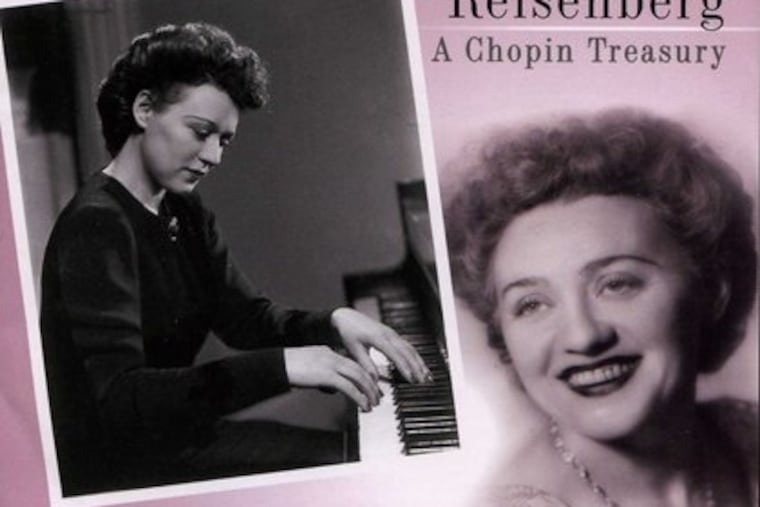
A Chopin Treasury; Studio and concert recordings (1947-1958)
(Bridge, four discs, ***1/2)
Chopin collectors are right to ask where these recordings have been all their lives. Nadia Reisenberg's name isn't unfamiliar: Born in Lithuania, she trained in Russia but was based in New York most of her adult life, where she performed and taught, dying at age 81 in 1983. Most of these Chopin recordings were made for the Westminster label but seem not to have had such a long life beyond their initial release. The
Sonata No. 3
, released here for the first time, is from a 1947 Carnegie Hall recital. Though her other recordings aren't always this distinctive, this collection of Chopin mazurkas, nocturnes plus
Barcarolle
and
Berceuse
ranks with the best.
With her flexible tempos, bright, only-lightly-pedaled sonority, and marvelous variation of touch, she's more temperamentally similar to Alfred Cortot than to Artur Rubinstein. Like many old-school Russians, she's unafraid of "broken chords" (arpeggiated rather than sounded simultaneously) but uses the effect sparingly and with tremendous effect. She captures the different voices in these works but - most distinctive of all - is a master storyteller, giving these pieces a sense of narrative that sounds perfectly natural but is rarely projected by other pianists. The sound quality is good for the era, but there's no mistaking that these recordings are at least 50 years old.
- D.P.S.