On Movies: Kristin Scott Thomas shows another side
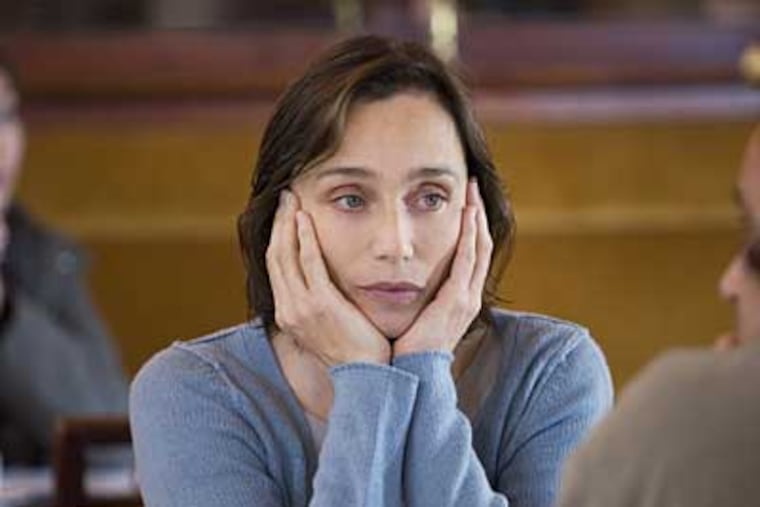
Even Kristin Scott Thomas fans familiar with her dual screen careers - the English-language projects, and the French - will be startled when they come to I've Loved You So Long. No one's seen her like this: so tough, so indrawn, so alone.
Even
Kristin Scott Thomas
fans familiar with her dual screen careers - the English-language projects, and the French - will be startled when they come to
I've Loved You So Long.
No one's seen her like this: so tough, so indrawn, so alone.
A first film from the popular French novelist Philippe Claudel, I've Loved You So Long follows a woman, Juliette, just released from prison after serving a long sentence for a terrible crime. The film was a surprise hit in France and the United Kingdom when it opened earlier this year - a surprise because its emotions are raw, and its central performance, from Scott Thomas, is brutally sad.
Already, the British actress, a longtime resident of France, is being touted for an Oscar nomination. The movie opened Friday at the Ritz Five and Showcase at the Ritz Center/NJ.
"It really pushes those emotional buttons," says Scott Thomas, explaining the film's popularity overseas. "Everyone's so bottled up at the moment with all these anxieties . . . and people really are longing for a place to let it out. This film certainly is very affecting, and I think people need that. They need a safe place to go and shed a tear. And that safe place is a movie theater."
Scott Thomas is on the phone from New York. It's a Monday, ostensibly her day off - she stars as Arkadina, Chekhov's aging, aristocratic actress and mother, in the Broadway production of The Seagull, which runs through December. But today she's doing interviews for I've Loved You So Long.
"I don't think I've ever made a film which has had this much emotional impact on people," says the actress, best known for her work in The English Patient, Four Weddings and a Funeral, and Gosford Park. (She also had a small but plummy part in this summer's sleeper-hit French thriller, Tell No One.)
"Part of that, I suppose, is because it's a French film. In English I have to be - I'm asked to be - more brittle, and more tough. Well, actually, Juliette is pretty tough. But the film penetrates her outer shell . . . you can actually almost see inside her."
Scott Thomas, 48, did not dive deep into the histories of women behind bars to prepare for the part. She did not visit prisons, did not interview former inmates. She wanted this character to come from somewhere inside.
"The film wasn't about the prison, it's about the aftermath," she explains. "Obviously I had to discover a little bit about what she's been through, but I was very afraid of going to prison because I was afraid of my own pity, or my own disgust, or my own anger or my own shock. . . . And I was afraid that that then would make me sand off some of the edges, and make me judgmental, or make me have pity on this character. Where the last thing she wants is pity."
Scott Thomas also asked Claudel to let her do the first take of every scene without direction. If he wasn't happy with her interpretation, she'd do it again, per his instructions. But she wanted to have the liberty to explore.
"It's called acting," she says, when asked how she created this fully formed being, who, for long stretches of the movie, says little.
"I don't mean to sound flip, but it is intuitive. And I did want to play this character from my own imagination and my own instincts. I think we all have horrible dreams about doing something really terrible and irreparable, or dreams where people don't recognize you, or you're abandoned. . . .
"Those fears are within all of us. And I think that's what I was able to explore in accepting this role. And it just sort of happened. It didn't require much plotting or planning or thinking."
Burns center. It's a long way from Philadelphia's Northern Liberties, where Charles Burns keeps his studio (and its scores of Japanese monster toys), to Paris, where the comic book artist and illustrator was asked to create a segment for the sublimely creepy animation omnibus, Fear(s) of the Dark.
"It's normal, listening to crabby cartoonists whine about their jobs and their work," says Burns. "But I'm walking through the most beautiful parks, a perfect spring day in Paris, and I'm thinking, you know what, I will never complain about this. There is nothing to complain about!"
A collection of six interlinked animated pieces, the French-produced Fear(s) of the Dark showcases work by comics artists and graphic novelists Blutch, Marie Caillou, Lorenzo Mattotti, Richard McGuire and Pierre di Sciullo. It opened Friday at the Ritz at the Bourse.
Burns, 53, celebrated for his noirish fables of sex, mutation, disease and dating (see the graphic novel Black Hole), drew and directed the segment about a meek, gawky college kid who becomes involved with a beautiful, vivacious gal. Things are not as rosy as they seem, however: There are mood swings, to say the least. And insects, and a metamorphosis that would do Kafka proud.
Between illustration projects and his comics, Burns worked on his portion of Fear(s) of the Dark "on and off for two years." He was the only one of the six artists who stayed home, making periodic transatlantic commutes to the French animation studio. Burns, a West Coaster who has been in Philadelphia for the better part of three decades, had never worked in animation before.
"When I was growing up, there was this idea that if you are a cartoonist, or you're interested in comics, the final end of that must be that you want to have your work animated," he says.
"And even though I did a few experiments when I was a kid with my 8mm camera and stop-action [animation] for my own amusement, I never had the feeling that, someday, if I could only have an animated movie.
"This is something that just offered itself, that came up, and the timing was perfect and the people involved were great. So I took it on."