Art: Solemnity in neon light
Allentown retrospective examines Stephen Antonakos' mastery of the medium.
Relatively few artists have done much with neon tubing, which was first used in advertising signs. Stephen Antonakos not only has produced a formidable body of neon art, he has also used neon in ways that elevate it above gimmickry.
Antonakos' conceptual mastery of neon is the core of a revealing retrospective exhibition at the Allentown Art Museum.
There are other aspects to his art, developed over more than 60 years, particularly his fascination with geometric mark-making such as arcs and angles. He also has combined geometry and neon in about 50 public commissions around the world.
One of these crowns an apartment building along Hamilton Street between 20th and 21st Streets in Philadelphia's Spring Garden neighborhood. In this sculpture, which wraps around the south and east facades, Antonakos has "drawn" partial squares and circles in red, yellow, green and blue neon.
The commissions are represented in the exhibition by a brief video program, but the galleries contain other examples of how the artist uses neon to both articulate space and create a mood of religiosity.
Like the late minimalist sculptor Dan Flavin, who used fluorescent tubes, Antonakos demonstrates how colored light can alter perception of space by creating complex illusions. In the show, he does this with three installations in which neon tubes generate diaphanous envelopes of vivid color.
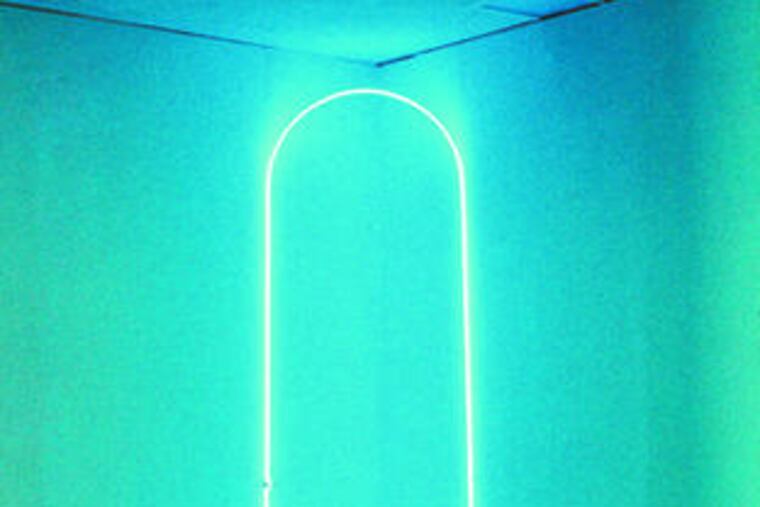
One piece consists of a capsule-shaped loop of blue neon set into an interior corner; a related piece substitutes a red neon X. In both, the colored light flattens the right angle and causes the illuminated symbol to appear levitated. The glowing clouds of saturated color seem to possess mass and depth.
The third installation is a cubic "meditation chapel" bathed in a blue-violet aura that emanates from horizontal neons and a broken circle set at shoulder height around three walls of the chamber.
This cubic enclosure recalls, on a smaller scale, the meditative atmosphere that Mark Rothko sought in his multiple-painting, nondenominational chapel in Houston. Four years ago, artist Olafur Eliasson projected washes of color inside an oval chamber at Arcadia University to create a similar sensation of color as a physical presence.
Antonakos'
Corner Meditation Room
exemplifies a distinctive approach in exploiting colored light: He tries to achieve spirituality through modernist tactics. This is more apparent in what might be characterized as illuminated paintings, in which a central panel is framed by a colored halo of neon light.
These are inspired by Orthodox icons - the artist is Greek-born, but has lived in this country since he was about 4. Gold leaf, frames and titles such as
Mary Magdalene
and
Saint Anthony
establish the connection. However, these pictures are completely abstract, and in a rigorously geometric way. The neons are set behind the projecting panels, which appear to float on the colored light.
This strategy is most effective when the central panels are pierced or fractured, allowing colored light to spill out, as in the paintings
Respite, Declaration
and
Departure.
In these the light becomes more integral to the composition, and consequently more persuasive as a suggestion of spiritual rapture.
There's considerably more to the exhibition than neon - reliefs, drawings and collages, most of which employ geometric notation such as arcs, squares, circles and vectors. Several colored-pencil works that suggest fractal impressionism are especially sublime, and technically impressive.
This show of about 120 pieces, organized in Greece and guest-curated in Allentown by Robert S. Mattison of Lafayette College, clarifies the artist's progression from early assemblages and collages of found objects to more refined, intense and calculated visual thinking. That progression resulted both in the public neon pieces and in a series of chapel designs, represented here by models that integrate art and architecture in a coherent and pleasing way. The
Chapel of St. Nicholas,
with its red and blue windows, is particularly inspired.
More than meets the eye.
It's unusual to encounter a work of art whose shadow is more "real" than the object itself, but such is the case with
Incident,
an installation by Linda Yun at Arcadia University.
As you come upon
Incident,
which sits on the floor behind a free-standing wall, it's remarkably unprepossessing, just a white metal frame to which long strips of shiny gold Mylar have been attached. A fan ruffles the shimmering strands like hair blowing in the wind.
As you move toward the other end of the room,
Incident
disappears behind the wall, but its presence persists through the hum of the fan and flickering shadows cast on a wall. These suggest either the reflection of sunlight on flowing water or flames dancing in a fireplace.
This ethereality represents the essence of
Incident.
It's all a matter of perception, and of the viewer's position within the room. Change position and, except for the hum,
Incident
all but disappears.
That single experience comes close to encapsulating the theme of "A Second Look 7," a show featuring four artists and one artist team who have appeared in one of Arcadia's regular works-on-paper shows. This edition was curated by Sheryl Conkelton, director of exhibitions at Tyler School of Art.
At fewer than a dozen works, it might seem a little sparse until you consider the conceptual underpinnings of each piece. Visitors must recognize how perception and interpretation can be affected by such factors as the character of light, the viewer's position relative to the work, and the layers of ambiguity a particular work might contain.
For instance, Canadian artist Lucy Pullen has installed three hanging sculptures, each a thin strip of bent ash configured in a Möbius double loop. From any point in the room, the figures traced in the air look different, yet the structures are identical.
Most art involves illusion on some level, and Phillip Adams' imposing charcoal drawings convey that truth with striking immediacy. Each is a portrait of a young person (two men, one woman) wearing reflective sunglasses. They are drawn from photographs, with a high degree of verisimilitude.
Superficially, they might be appreciated as photorealism, but reflections in the sunglass lenses add a level of slightly surreal complexity by injecting narrative or descriptive content, such as a lawn party or a scene with buildings. The reflected scenes suggest another dimension of reality, or of memory.
James Johnson's
House
requires the viewer's imaginative input. It's a wall pierced by four tiny windows and a door at floor level. Inside you see not a furnished interior, but the guts of a deep stud wall, accessorized by bits of boards and lumber. The interior glows pinkish from a neon sign proclaiming, "I can get you anything you want." If you want a real house, you have to imagine it.
Like all the artists in the show except Pullen, Marcia Kocot and Tom Hatton are Philadelphians. They have been exhibiting in the city for years, most recently with pieces that try to make tangible the state of awakening.
They do this at Arcadia with a suite of 16 digital images, each recording the time on a particular date when one or the other of them photographed a bedside digital clock while semiconscious. What you see are mostly smears of bright green light on a black ground, time represented not only as ephemeral but as substantive.
Kocot and Hatton devised this method to depersonalize process, to eliminate any trace of the artist's hand. However, the concept of
Night/Time
identifies it as ineluctably theirs. Like every other work in the show, it tests one's perceptual acuity, powers of ratiocination, and perhaps even of tolerance for art that makes the viewer work for a reward.
Art: Neon Spirituality
The Stephen Antonakos exhibition continues at the Allentown Art Museum, 31 N. Fifth St., through Jan. 11, 11 a.m. to 5 p.m. Tuesday to Saturday and noon to 5 Sundays. Admission for this exhibition is $11 general, $9 for visitors 60 and up and students with ID, $8 for visitors 6 to 12. Free Sundays. 610-432-4333 or
» READ MORE: www.allentownartmuseum.org
.
"A Closer Look 7" continues in the gallery at Arcadia University, 430 S. Easton Rd., Glenside, through Dec. 21. Hours are 10 a.m. to 3 p.m. Tuesday through Friday, to 8 p.m. Thursday, and noon to 4 p.m. Saturday and Sunday. Closed Nov. 26 through 30. Free. 215-572-2131 or
» READ MORE: www.arcadia.edu/arts
.