Dionne Warwick is now an author
There's something odd about Dionne Warwick's life story. Something unfamiliar. The singer, who turns 68 this month, is perfectly coherent. She's sweet, patient and very polite as she talks over the phone about growing up in North Jersey in the '40s and '50s.
There's something odd about Dionne Warwick's life story. Something unfamiliar.
The singer, who turns 68 this month, is perfectly coherent. She's sweet, patient and very polite as she talks over the phone about growing up in North Jersey in the '40s and '50s.
"Sterling Street, that was my street [in East Orange]. It was virtually the United Nations - every race, color and creed lived on that street," says Warwick, who recently published her first children's book,
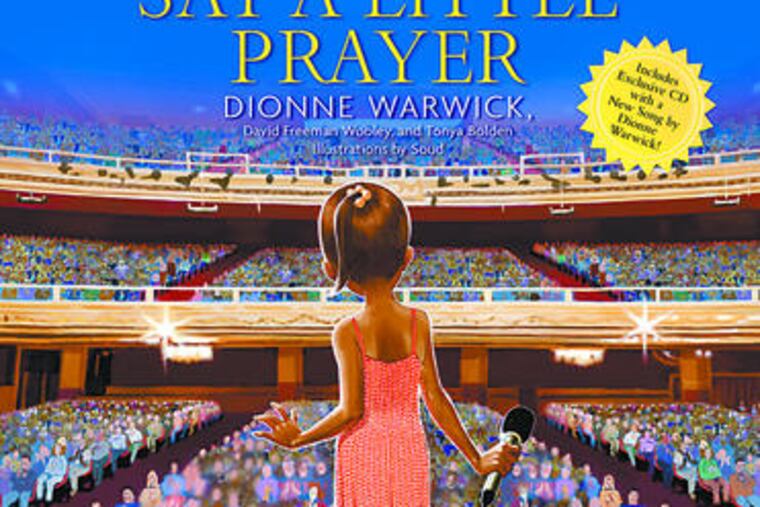
Say a Little Prayer
. It's a very simple (and at times a bit simplistic) autobiographical tale about Little D, whose grandfather helps her discover her passion - and prodigious talent - for singing.
Warwick, who in 1968 became the first African American solo female artist to win a Grammy, says Sterling Street was a haven for people of all races. She says she "didn't see much racism there" or during her years at Hartt College of Music in Hartford, Conn.
Then it hits you: Warwick has no horror stories about her childhood or her family. Hers is an idyllic story - the opposite of the standard-issue tales of traumas, injustices and misery daily poured out by celebrities on Oprah, Ellen and
The View
.
"I'm a boring person," Warwick quips. "I come from a very stable, happy family. I don't drink or do drugs, and I wasn't bashed around."
Warwick says she's turned off by celebrities who use the media to air their personal problems, hang-ups, phobias and addictions.
She says she wrote
Prayer
as an answer to publishers who have approached her over the years to write a sensationalistic memoir.
"So many publishers have asked me to write that kind of book. They're obsessed with celebrity tell-alls," she says. "I'm not capable of doing it: None of the things they wanted to know about has happened to me."
So, what did happen to her? Blessing after blessing, Warwick says. (It's hard not to be suspicious about the vocalist's unrelenting positivity.)
Born Marie Dionne Warrick (a typo on her first single identified her as Warwick, a name she decided to keep), she scored her first Top 20 hit in 1963 with "Don't Make Me Over." She has since had 55 other Billboard Hot 100 hits.
That song, the first of many written for her by the famed composer-lyricist team of Burt Bacharach and Hal David, established Warwick's reputation as a cool, sophisticated chanteuse who sang complex songs in a unique style that wasn't quite pop, jazz or R&B.
The diva's career took a detour - if not exactly a dive - in the 1980s with her highly publicized involvement with the Psychic Friends with Dionne Warwick telephone service. But Warwick seems to be thriving again. Her gospel album,
Why We Sing
, was released this year to good reviews.
Warwick, who was in Philly this fall as a cohost - and honoree - at the 20th annual Rhythm & Blues Foundation's Pioneer Awards Show, says if it weren't for her grandfather and his church, she would never have become a singer.
"My grandfather was a minister . . . at St. Luke's A&E Church in Newark," Warwick says. He encouraged her to embrace her talents and pursue her dreams, she says, no matter how many obstacles she met on the way. At the age of 6, Warwick performed her first song, "Jesus Loves Me," at her grandfather's church.
Prayer
, which ends with Little D's first public performance of the same song, features a CD of Warwick reading the text and singing the song.
Warwick says she wants the book to impart a simple lesson to kids, the same lesson she learned from her grandfather: "If you can think it, you can do it."