Take a bow: A look back at the Walnut as it nears its bicentennial
DURING AN 1821 performance at the Walnut Street Theatre, British actor Edmund Kean - playing his signature role of Hamlet - did something that was then unheard of.
DURING AN 1821 performance at the Walnut Street Theatre, British actor Edmund Kean - playing his signature role of Hamlet - did something that was then unheard of.
After feigning a dramatic death on stage, he emerged from behind the dropped curtain and stood before a cheering audience to take a bow. Then another. And another. The applause only got louder. It was at that moment that the curtain call - now a theatrical tradition around the world - was born.
The theater's manager at the time later wrote in his journals that he thought the curtain call was a "ludicrous" idea. But the audience loved it, so it stuck.
Now approaching its bicentennial, the Walnut Street Theatre has always prided itself on being a "theater for the people," said current artistic director Bernard Havard.
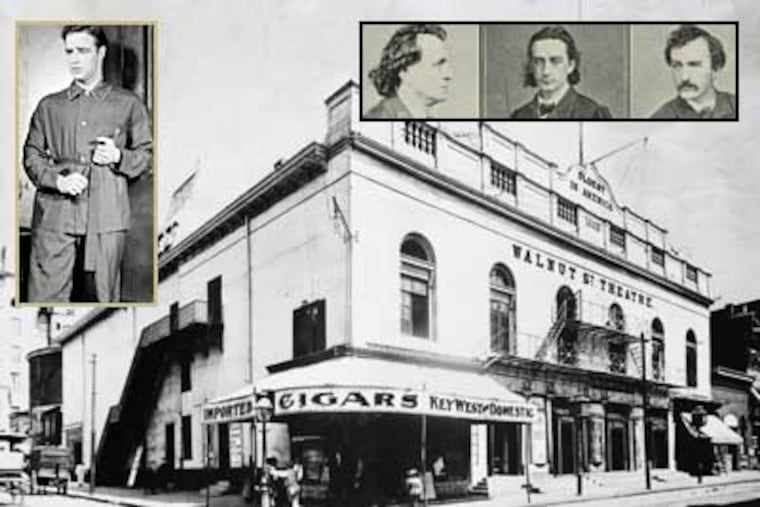
Originally built as an equestrian circus, America's oldest theater opened on Feb. 2, 1809, with a dirt riding ring where the stage stands today.
In 1812, it was converted into a legitimate theater. President Thomas Jefferson brought French general the Marquis de Lafayette as his guest to the theater's opening night performance of "The Rivals."
Among the many famous actors who performed at the theater during the 19th century was Edwin Booth, son of Junius Brutus Booth, whose brothers, Junius Brutus Jr. and John Wilkes, were also well-known actors. In 1863, Booth and his brother-in-law, John Sleeper Clark, purchased the Walnut Street Theatre.
Two years later, John Wilkes Booth assassinated President Abraham Lincoln at Ford's Theatre in Washington, D.C., devastating the nation and throwing the Booths into the national spotlight.
Clark was arrested on suspicion of conspiracy and later released. The Walnut Street Theatre was briefly closed as Edwin Booth grappled with the public stigma against his family.
"Luckily, he was such an extraordinary actor and lived such an exemplary life that he was able to rise above what his brother had done," Havard said, noting that Booth and Clark continued to manage the theater for many years and organized some of its more extensive interior renovations.
In 1941, the theater was purchased by the Shubert Organization and turned into a space for pre-Broadway tryouts of plays. Broadway hits such as "A Streetcar Named Desire," starring Jessica Tandy and Marlon Brando, and "A Raisin in the Sun," starring Sidney Poitier, were seen first at the Walnut Street Theatre.
Audrey Hepburn and Gregory Peck performed at the theater when they were still relative unknowns. Playwright Arthur Miller debuted his first Broadway play, "The Man Who Had All the Luck," at the Walnut. And Jane Fonda appeared in her first major stage role at the theater.
In 1969, hit hard by financial troubles, the Walnut was rescued from destruction by the Haas Community Fund and renovated to become a performing arts center. It hosted the first presidential debate between Gerald Ford and Jimmy Carter in 1976 and concerts by the Police and the Clash in 1979.
In 1982, Havard founded the Walnut Street Theatre Company and turned the performing arts center into a nonprofit, entirely self-producing regional theater. Its first season included productions of "A Flea in Her Ear," "Oliver!", "Morning's at Seven," "A Perfect Gentleman" and "The Taming of the Shrew," featuring mostly local actors.
The theater, which was the first in the country to install gas footlights and air-conditioning besides introducing the curtain call, is still creating firsts, said Havard.
"We have more than 56,000 subscribers," he said. "We're the most-subscribed theater company in the world."
For its bicentennial season, the Walnut Street Theatre Company is staging a number of shows written by American writers, from John Waters' "Hairspray!" to Mel Brooks' "The Producers." Temporarily hanging in the theater's lobby are more than 100 photographs and Playbills commemorating important moments in the theater's 200-year history.
Havard said that he thinks the key to keeping the theater open for another 200 years is in its original slogan: "Vox populi," a Latin phrase meaning "the voice of the people."
"Whenever this theater has not stayed true to itself, whenever it's abandoned its goal of serving the public as opposed to serving some selfish artistic vision, it's failed," he said. "People have really responded to our recent programs."
He mentioned last spring's production of "Les Miserables," which ran for 12 weeks at 94 percent capacity every night, as being a landmark for the company.
"The cast was extraordinary," he said. "They were mostly all Philadelphians, and it was like they wanted to prove to the world that they were just as good, if not better, than anyone else - and they were. People came from around the world to see the show, and many said it was the best version of 'Les Miserables' they'd ever seen." *