Losing its luster: Philly's remaining shoeshine professionals are finding it a tough go
MEN'S SHOES OF various colors and labels clutter the shelves at Fuller's Shoe Shine in Germantown. Long-gone brands of polish occupy a soiled container alongside the common drugstore variety.
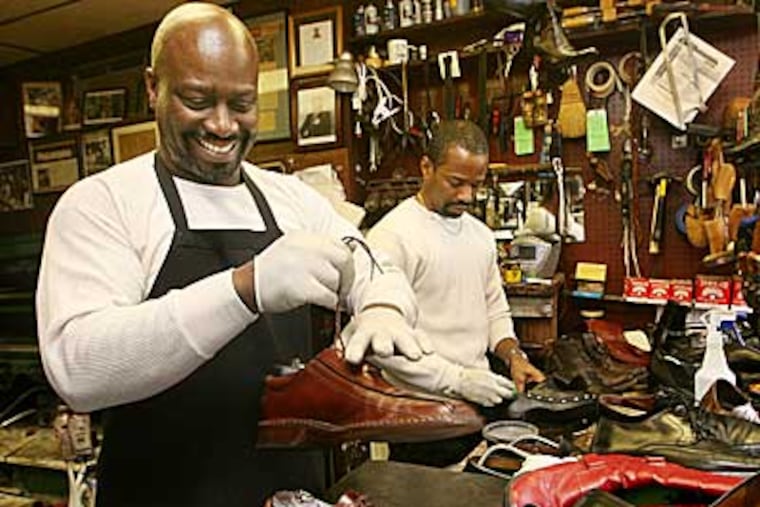
MEN'S SHOES OF various colors and labels clutter the shelves at Fuller's Shoe Shine in Germantown. Long-gone brands of polish occupy a soiled container alongside the common drugstore variety.
No one is using the old five-seat stand with plush leather seats, oak wood and brass footrests.
Inside, owner Gilbert Fuller, 77, chats with two friends about the good old days. It's a slow day, but that's not rare for Fuller, whose shop has been struggling for years to stay afloat.
In an age when people turn up their noses at the thought of shining shoes, preferring casual clothes and inexpensive footwear, Fuller's and a handful of shoeshine parlors are what remain of a once-bustling industry in Philadelphia.
The Daily News today spotlights three of the surviving parlors, where proud bootblacks use skills that have been passed through generations.
"It's not as busy as when we entered shoeshine," said Fuller. "People aren't getting shoes shined as much as in the '40s, '50s and early '60s. What really hurt the business? Timberlands and sneakers."
"The problem is finding people who are willing to do the work," said John McLoughlin, who volunteers as president of the Shoe Service Institute of America, a shoe-repair-industry group. "There are a lot of jobs in this market.
We're not attracting younger people."
Still, it's a craft that diehards in the business find difficult to leave, despite the industry's steadily fading existence, only compounded by the sluggish economy.
'A luxury kind of thing'
The lofty perch of the stand, the sound of the brush, the intoxicating smell of the polish, the popping of the rag and the glint of a renewed surface amount to a largely forgotten experience in the United States.
But for many, shoe-shining still holds an allure.
"It's a luxury kind of thing. Like getting your nails done," said Jim McFarland, a former SSIA board member.
To some, it's demeaning. Others regard it as sacred tradition.
Still, a professional shoeshine is one of the few pleasures left in Philadelphia that is reasonably priced. The average cost for the service here ranges from $3 to $5, bootblacks say.
Considered a subset of the shoe-care-and-repair industry, shoe-shining services typically are offered in airports, train stations and hotels.
A significant number, however, are freestanding vendors or mom-and-pop stores, said McLoughlin.
They're the select few who still treat a shoeshine formula like a family heirloom, and who spend hours perfecting a shining technique.
That was the reality before buffing machines, "throwaway shoes" and store-bought shoe polish replaced the personal touches of a shoe-shiner.
Despite the bleak forecast of the business, McLoughlin said, those who've remained are hopeful - perhaps imprudently, some say - that it will return to glory.
"The industry will not die out," he said. "[Shoe] repair has evolved over time. It goes back to our Founding Fathers."
A West Philly institution
Even now, Cliff's Shoe Shine Parlor is a rare bright spot in a fading industry.
In a storefront on 40th Street between Sansom and Chestnut near the University of Pennsylvania, Cliff's is a West Philadelphia institution. It has serviced comedian Bill Cosby, the late mayor Frank Rizzo and, more recently, Mayor Nutter, according to Cliff Burrell, 41, who has run the shop with older brother Jerry since 1981.
The Burrells insist that business is good - so good that they opened another shop in Jenkintown run by a third brother, Eric.
They'll tell you it's the secret formula invented by their late grandfather, Cliff Franklin, that's been the lifeblood of the family business for almost 70 years.
The other day, in their grandfather's cubicle, the whirring of the high-powered electric brush did little to drown out the laughter of men crowded in the parlor waiting for a shine, including Gary Lassiter, 60, who has been coming to the shop for almost 40 years.
"I went through grandfather, father and now great-grandkids," Lassiter says of the enterprising family, as Cliff Burrell buffs his black leather boots to a high sheen.
Moments later, Lassiter descends from the high stand to survey his glowing shoes. He nods with satisfaction. "I won't have to come in for another year," he says.
Just what the Burrell brothers like to hear. "We love to see the beautiful work [and] making [a] customer satisfied," says Jerry Burrell, 49.
Jerry didn't aspire to be a shiner, but grew to love the craft as a youngster working in the shop, a refuge from the streets.
"It kept me out of trouble. I learned to appreciate the value of a dollar, made me independent," says the bald-headed shiner.
The experience was so rewarding that he has passed the legacy on to his children, who now shine shoes alongside him in the summer.
Inside Reading Terminal
"Shine 'em up for three dollars!" Teddy Lee Scokley shouts, pointing at the shoes of passers-by, some of whom glance in his direction.
One man hesitates, and Scokley tries to persuade him to get a shine as he picks at invisible dirt on the man's left shoe. But no luck: The man smiles, shakes his head, then walks away.
"We could be here all day and not have nobody come," says Scokley, a nearly toothless 59-year-old shoeshiner.
Tucked away at the rear of the historic Reading Terminal Market near an area where food is stored, the Shoe Doctor stand has been operated under one name or another since the terminal's inception more than a century ago, Scokley said.
Brushes with crushed bristles, lumpy bootblack polish - some stored in juice containers - and even a bottle of vinegar are placed between the feet of the two seats, still with their original red-and-green-leather seat cushions.
Scokley said he's the only regular employee at the stand, although other shiners stop in periodically. Business has steadily declined, he said.
"When I was coming up, we had shoeshines all over the world," he said. "Now how many we got? . . . And they're not making nothing, really. I think it's the economy. It's not easy."
He has been doing this work for 50 years, he said.
"Shining shoes is an honest living," he said. "Anything you want to buy, you can buy honestly. You don't got to steal, you ain't got to sell no drugs or nothing like that."
A gray cap covers most of his gray-peppered hair, a black apron hangs over a gray argyle sweater. His calloused fingers intertwine, and his head shakes without permission.
"Eventually, this is going to die out," he says. In the meantime, he says, he enjoys exposing the craft to younger generations.
"I get a kick out of little kids [who] come here and say, 'Oh, mama, see a shoeshine,' " he says, imitating some of them. "I mean, it's an honor for kids to get on the stage and get their shoes shined."
'This is my first love'
Fuller, the Germantown bootblack, is determined to keep his business going, relying heavily on word of mouth.
He resurrected his shoeshine service 12 years ago in a nondescript storefront on Germantown Avenue near Johnson Street.
Regulars prefer to drop off footwear instead of sitting for the traditional shine, he says, pointing to a large plastic bag full of shoes.
He started shining at age 8, when his father taught his two brothers and him on a makeshift shoeshine box in their home in the city's Yorktown section.
As a young adult, he tried to perfect his craft by shadowing Cliff Franklin, the West Philly bootblack whom Fuller describes as "one of the best in the city."
Years later, he left the business after closing his shop in 1969, to work first as a hairdresser and later for the city as an assistant safety officer, before realizing that shining was his true calling.
"This is my first love," he says.
Wearing a denim apron, Fuller stands slightly hunched, a sign of years of backbreaking work. As he smokes his third cigarette, he laments what he believes is a lack of respect for the trade.
"What young people don't know is that some of our men supported families doing this," he says. "In our period, men kept their shoes shined. You don't have that today."
He gestures toward a basket of chemicals, ingredients he includes in his secret formula.
Shining isn't child's play. "There's an art to shining shoes," says Fuller. "Not everybody can shine shoes. You have to study the shoe that you're shining."
He says he'll stick around his shop as long as he can. If not to give a good shine, then to offer a word of wisdom. "It's a good place to get a great education," he says. "That's why we're left here." *