Interpreter of two worlds
Author Temple Grandin says her autism has given her a powerful connection to the way animals think. Her book urges us to be nicer to them.
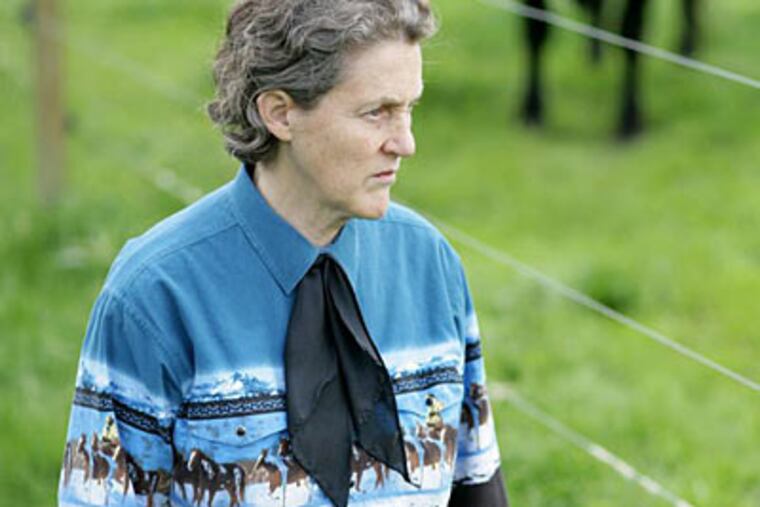
When news came that Temple Grandin was coming to my house for an interview, I was scared.
Grandin was coming to discuss her new book, Animals Make Us Human: Creating the Best Life for Animals, which continues her quest to explain animals to people and people to themselves. She had been giving a reading nearby, in New Jersey, and said, why not?
She is perhaps the best-known person with autism in the United States. Even without that distinction, hers is a singular story: Ph.D. in animal behavior; professor at Colorado State; writer of the autism memoir Thinking in Pictures; influential author about animals (Animals in Translation); and consultant to everyone from McDonald's to the federal government on how to treat animals in the wild and in industrial settings such as corrals and slaughterhouses.
Grandin, 61, has become not just a voice from the world of autism, but also an interpreter between animal and human worlds. There is simply no one like her.
But when she entered my door, would she take one look at my dogs, Rocky and Esco, and ask, "Just what are you doing to these poor beasts?"
In fact, no. When Grandin came in, tall, even stately, but low-key and direct, Rocky and Esco went to her; she connected with them in a St. Francis second. She liked them, and they her.
Then she sat down and talked about Animals Make Us Human (Houghton Mifflin, 288 pp., $26), which argues that we should give animals a decent life.
Many of us try. But whether in a house or in a zoo, or even in designing policies for wildlife management, we mess up: Sometimes with the best intentions, we force animals into abnormal situations, which in turn force them into abnormal behaviors that indicate pain or stress.
Grandin's coauthor, Catherine Johnson, suggested the framework on which the book is built: the "core emotions" of seeking, rage, fear and panic. These are primal, primary emotions we share with animals - along with the need for things such as care and play.
What makes for a decent life? In Animals Make Us Human, Grandin writes that "a good life requires three things: freedom from pain and negative emotions, and lots of activities to turn on seeking and play."
Grandin characteristically gives a concrete example: the modern zoo, whose designers have created a big, "natural" habitat for its polar bears. But something's wrong. "The polar bear, all he's doing is pacing back and forth," she says. "All day. That's not normal. Polar bears are seekers. He may be doing it to comfort himself, but all I know is, that's abnormal."
In her book she tells of Gus the polar bear, at New York's Central Park Zoo, which broke this cycle. Play and seeking were the key: Zookeepers put floating barrels into the pool, and the polar bear played joyously with them all day.
She has seen needless stresses among wolves in a wolf shelter, in gerbils in captivity, and in domesticated dogs.
"I think a lot of dogs today have a horrible life," she says. "In my town, Fort Collins, [Colo.], we have draconian leash laws. If you walk down any residential street in Fort Collins, dogs are whining in half the houses. Dogs need to have a doggy social life, a life off the leash. When we were kids and all the dogs ran free, a lot of dogs were killed by cars, and that was bad, but we also had a lot of happier dogs. Now that we live in such a controlled world for dogs, you need to spend some time with your dog - an hour or so of good play, a walk in the park." Or give your dog a pal. "If two dogs get along well, that helps."
And what's her take on Cesar Millan, host of the National Geographic Channel show Dog Whisperer, in which he advocates a tough, dominant approach to dog training? Grandin, clearly not crazy about this, is reserved as she says: "I suppose it works in the artificial environment we've created for dogs. We need to make sure that puppies, adolescents, and adult dogs get socialized with humans and other dogs."
Why do we do so poorly with animals? What do we lack? "Most of us have just never looked at things from an animal's point of view," Grandin says. Many people resist the idea that animals even have emotions. But, as her book contends, the scientific evidence now overwhelms the skepticism.
Grandin has said repeatedly that her autism has given her a powerful connection to the way animals think. "It began when I realized I think in pictures, not verbally," she says. "Animals, lacking the verbal aspect, see everything in terms of what they see, feel, hear."
Even tiny animals such as ants may think in pictures: "Some research shows that when ants go out foraging, they take visual snapshots of landmarks and compare what they see on the way back with what they remember."
Thinking in pictures - and keeping those core emotions in mind - can, Grandin believes, help us make better, more humane decisions.
Ranging from wildlife management to pet training, Animals Make Us Human urges a new way of thinking about animals - and our own role in shaping their behavior. It was once thought that grazing animals destroy the environment; now it's clear that the harm arises from poor human use of grazing herds.
In California, mountain lions have begun to attack human beings. Why? People now are living closer to the lions' habitat, and the lions have begun to see people as prey. People oblige by acting like prey, running or bicycling. All of which suggests ways we can change our behavior where animals are concerned.
Interview concluded, she pronounces Rocky and Esco "happy," prompting relief. She gazes at Rocky, a 13-year-old Lab, and volunteers this feeling: "As for end-of-life treatment, I'm really against these heroic measures to keep animals alive. It has the effect of prolonging suffering in many cases. And the animals don't understand."
For Temple Grandin, animals are an opportunity to do our best. In doing our best for them, we do our best for ourselves. A pretty good way to be human.
.