Art: Smaller is better than bigger
Tyler will bestow the richest prize on a single artist. The Wests have a brighter idea.
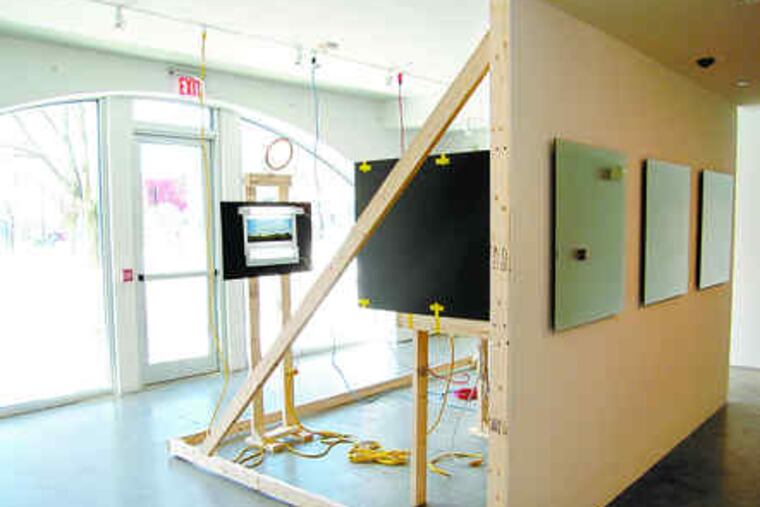
Jubilation erupted in Philadelphia's art community last month when Tyler School of Art announced that retired property developer Jack L. Wolgin had given the institution $3.7 million to endow a $150,000 annual art prize.
The competition for this prize, now the largest of its kind, will be international. Besides the cash, the winner will exhibit his or her art at Tyler's new facility on Temple University's North Philadelphia campus.
Local art administrators contacted by Inquirer reporter Amy S. Rosenberg rhapsodized about how the prize would enhance the city's stature as an art center and would attract international attention to the city.
There was only one dissenting voice among the art insiders whom Rosenberg was able to contact. Robert Storr, former curator at the Museum of Modern Art, consulting curator at the Philadelphia Museum of Art, and dean of the Yale University School of Art, thought Wolgin's gift should have been dispersed in a way that benefited more artists and institutions.
Storr observed that prestigious art prizes tend to be awarded to established artists. "What we have is a web of higher-end prizes," he said. "The underserved among us are the artists who are less well-known."
His comment nails the problem with the Wolgin prize. Whether it's grants, residencies or prizes, art-world rewards too often go to artists who already have been rewarded.
It's not surprising that art administrators would enthuse over the Wolgin International Prize in Fine Arts, which is to be awarded for "work that transcends traditional boundaries and exemplifies the highest level of excellence in painting, sculpture, printmaking, photography, ceramics, metals, glass or fibers."
It's interesting that the prize omits two growth areas in contemporary art, installation and video. In any case, presumably it will create a lot of work for administrators processing applications, selecting jurors, organizing the jurying and the exhibition and sending out hundreds of rejection slips.
Tyler and Wolgin himself are the other main beneficiaries. By establishing the world's richest art prize and naming it for himself, Wolgin has bought a modicum of immortality.
Tyler will be able to score recruiting and marketing points, regardless of whether the winners turn out to be artists of merit or, as with Britain's Turner Prize in recent years, sensations of the month.
But what about artists? They get a chance to participate in an international lottery, winner take all. One artist pockets $150,000, while everyone else goes hungry.
One also might ask if a huge bag of cash is really the most meaningful way to evaluate art. There is a more meaningful method, which the West Collection in Oaks, Pa., has chosen. It's purchase.
The West collection of contemporary art, housed at SEI Investments in Oaks, was assembled by company founder Al West and his daughter, Paige. Last year the Wests established an annual prize competition totaling $125,000; the winners have recently been posted on the collection's Web site,
» READ MORE: www.westcollection.org
.
The West Prize is also international in scope; in 2008, 3,600 artists from 73 countries participated. Why haven't you heard about it? Because in its inaugural year, the West Collection spread the word mainly through the Internet, particularly blogs, and by word of mouth.
Besides total value, the Wolgin and West prizes differ in several other significant ways. First, the West competition distributes its $125,000 among 10 finalists, one of whom will be tapped next month for a top prize of $25,000 cash.
Second, the West Prize is a purchase competition. From each of the 10 finalists, the West collection purchases, at market rates, art up to a total value of $10,000. For the first year, the collection bought 36 works.
Third, the West competition is directed at artists on the lower rungs of the career ladder, who are not represented by galleries or agents or who have only recently become represented.
The West winners also get an exhibition; the 2008 finalists will show at SEI next month, and also at an adjunct of the Chicago Art Fair, the NEXT Art Fair, in April. Once their work enters the collection, it may travel in loan exhibitions to museums and SEI offices around the world.
Philadelphia artists have a better chance to benefit professionally and financially from the West Prize than from the Wolgin. Two of the 2008 finalists, James Johnson and the Dufala brothers, Steven and Billy Blaise, are locals. The financial reward may be much smaller, but the West Prize confers the most meaningful recognition for an artist - purchase - and a chance to be exposed to an audience beyond Philadelphia.
Let them eat Tastykakes.
As the city government wrestles with a staggering projected budget deficit, the folly of moving the Barnes Foundation from Merion to the Benjamin Franklin Parkway becomes even more egregious.
Here is the Nutter administration trying, with one hand, to cut $8 million from the budget by closing libraries while with the other spending 10 times that in public money to move the Youth Study Center, twice, to accommodate the relocation of a private art collection.
The scheme to capture the collection for the city germinated when a rosy economic climate promised limitless prosperity, or at least the illusion of it. Now the city finds itself so strapped that it wants to eliminate basic services. This is hardly the time to subsidize a new "tourist magnet" museum. In fact, it's irresponsible to do so.
Patrons of the 11 neighborhood libraries that Mayor Nutter seems determined to close are storming the barricades to preserve a cherished amenity, access to knowledge. How many taxpayers are demonstrating in favor of supporting a new, improved Barnes Foundation?
Libraries not only nurture two basic life skills, reading and intellectual curiosity, they also function as community centers, and as natural generators of community spirit and cohesion.
The mayor might argue that the Barnes move and the library closings aren't directly related. Yet when one juxtaposes them, one begins to question the administration's value system.
If the Barnes relocation is such a great idea, then the Pew Charitable Trusts and the Lenfest and Annenberg Foundations, which are making it happen, should pick up the entire tab. These elites can afford such extravagance. The city cannot.
Art: Prize-Worthy Art
The West Prize exhibition of art by the 2008 finalists will be on view by appointment at SEI Investments, One Freedom Valley Drive, Oaks, Pa., from Feb. 1 to March 15. Arrangements to visit Mondays through Fridays between 9 a.m. and 6 p.m. can be made through West collection director Lee Stoetzel at 610-883-7368 or by e-mailing
» READ MORE: lee@westcollection.org
. Further information about the prize is at
» READ MORE: www.westcollection.org
.