Buffed-up training for skin-care specialists
The massages, facials and waxings booked in posh spas and salons aren't just luxuries for the self-indulgent. These days, they are a growing need for many.
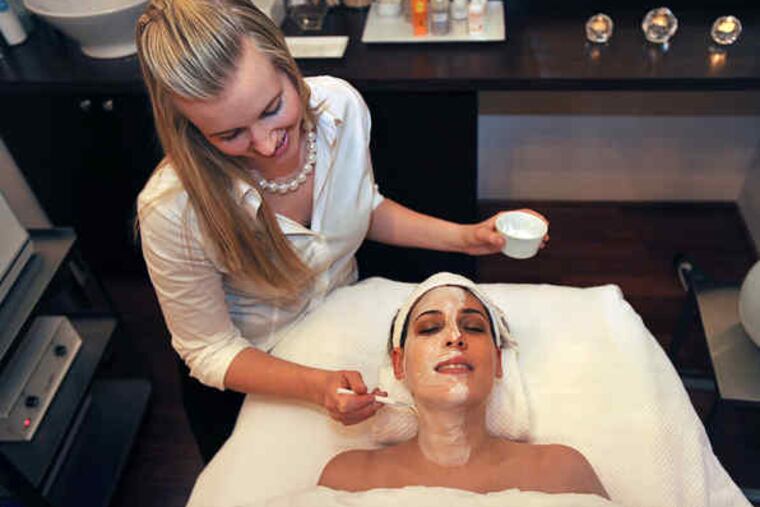
The massages, facials and waxings booked in posh spas and salons aren't just luxuries for the self-indulgent. These days, they are a growing need for many.
The simple reason, says Danuta Mieloch, owner of Rescue Rittenhouse Spa, is that it makes people feel better at a time when life feels hard. "I grew up in Poland where we stood on bread lines, but we always had our eyebrows tinted and lipstick - it's the feel-good factor. All you have is your health, how you feel and look."
The problem, salon owners say, is that at the very time the industry is growing, students are graduating beauty school absent of needed skills.
It takes a mere 300 hours to become a licensed aesthetician, an umbrella term for skin-care specialist, in Pennsylvania, compared with other states, where the minimum is at least 600 hours. The curriculum leaves little room for learning the art of communicating with clients, something essential for such high-end service.
"Graduates don't know how to speak to clients or wax appropriately, let alone get hired in this industry," said Linda Harding, senior aesthetician at Rescue Rittenhouse in Rittenhouse Square.
Stan Gordon, director of marketing for the Center City-based Jean Madeline Aveda Institute, said they wouldn't consider hiring an aesthetician with only 300 hours of training. "You have to be knowledgeable to give a high-quality service. You need continued training."
That's why Harding, who is transitioning from aesthetician to full-time instructor, created Hit the Ground Running, an eight-hour, ongoing course that began Jan. 11 and will continue based on enrollment. The course picks up where schools leave off, teaching preparation for interviews, how to maintain client relationships, and proper behavior in the workplace. It also shows students how to wax with demonstrations on a model.
Lorraine Britta, manager of Ame Spa in Wayne, recommended that a few of her aestheticians take Hit the Ground Running after she learned that schools were no longer teaching waxing.
"This is a lucrative skill, but you need the utmost confidence when you're doing it," she said.
Jennifer Chicano, a Jean Madeline Institute graduate, says she took the course because getting a job in the beauty industry is a catch-22. Employers hire only people with portfolios and experience, but recent graduates can't get the experience if no one is willing to hire them. Chicano wants to work in a high-end atmosphere, and she said this course made her feel confident about going to interviews and getting the spa manager's attention.
"You go in with what you think you know, or what you picked up from other places, but Linda showed us exactly how to talk to people," Chicano said. "It was worth it."
Most of the time, a customer's evaluation of her treatment is based on her experience with the aesthetician. After all, it's hard to sit through a waxing if the person applying the wax isn't able to put you at ease. Bobbi Mason, a client of Mieloch's, is a devotee of Rittenhouse because of its service.
"I only go to Rescue for anything to do with my skin. [Mieloch] is an expert. She makes you feel her treatment is going to help. I wouldn't be inclined to get a less expensive service somewhere else when it comes to my skin."
This trust is essential and it's not easily built. Harding says she keeps her 300 clients returning by giving exemplary service. "When I have a client who has come back from a spa in Dubai, I want [their experience] to be seamless when they see me. I talk to them about it and visit other spas. When I can improve on something, I do."
When people don't have these skills, it costs them clients. Sometimes, it causes injury.
"I went to a place for a brow wax, and they still haven't grown back after two years," said Bernice Clyatt. "I was burned, had to see a dermatologist, and the technicians talked to each other like I wasn't even there. When I called to complain, they told me to pray over it."
Harding's classes would aim to prevent situations like these, as well. Of course, the end goal is training more people who can give clients exactly what they need during hard times: pampering perfection.
"I think massage is a necessity. I look at my budget, and work it in so I can do it monthly," said Clyatt, a 10-year client of Old City's holistic day spa Terme Di Aroma. Clyatt, a registered nurse, says massage helps her do her job.
"In order for me to care for others, I need to care for myself. I have a 12-hour shift tomorrow; this helps me mentally prepare."
Jim Leemon, a psychologist and owner of Terme Di Aroma, sees the spa as a community hub. "People need spas to get centered and feel better."
Take the Class
To sign up for "Hit the Ground Running," call Rescue Rittenhouse in Rittenhouse Square at 215-772-2766 or e-mail linda@lindatheskindiva.com.
EndText