Bringing music out of the silence
Don Kinnier is considered one of the top silent film accompanists in the Northeast.
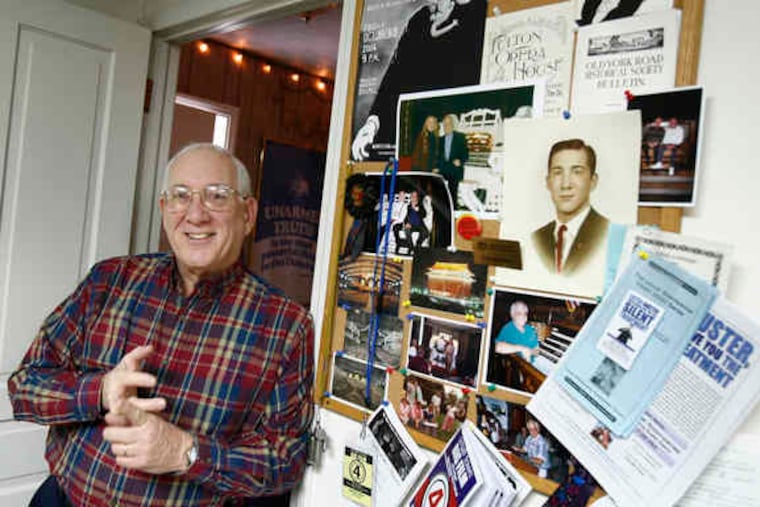
Something magical happened to musician and composer Don Kinnier in 1963, the year he began his love affair with silent film.
It wasn't a grand, mystical epiphany - replete with a Spielbergian fanfare. But there was a pipe organ involved . . . a phantom . . . and opera.
Kinnier, 64, considered one of the premier silent film accompanists in the Northeast, was an engineering student at the Drexel Institute (as it was then called) and was following - rather reluctantly - in the footsteps of his father, a successful engineer and Drexel alumnus.
Kinnier said one day he came across "a couple of electrical engineers who had rebuilt a theater organ" on campus and who asked Kinnier to test it out. "I had a pretty good time playing," said Kinnier, who will perform at a screening of a half-dozen short silent films organized by the Secret Cinema tomorrow night at Moore College of Art and Design.
"So they asked me if I wanted to try my hand at accompanying a silent movie - at which point I said, 'What's that?' "
He found out on Halloween, during a screening of the 1925 production of
Phantom of the Opera
starring Lon Chaney. Kinnier accompanied the film with music from Charles Gounod's
Faust
. Kinnier said his vocation became clear to him "right at that instant." He dropped out of school and went into music.
"Looking back on it," he says, that night "saved me from a life of absolute misery. I would not have been happy as an engineer."
Secret Cinema founder Jay Schwartz says he considers Kinnier a master of a "virtually lost art."
Schwartz said tomorrow's program, "Early Educational: Classroom Films of the Silent Era," a selection of instructional films including
Modern Basketball Fundamentals
(1925) and
First Aid: Control of Bleeding
(circa 1932), will give Kinnier a chance to flex his creative muscles.
"Don will be seeing all these films for the first time, and he'll improvise the music in real time," said Schwartz, who has used Kinnier's services for Secret Cinema's silent programs for 10 years. "He just has a vast reservoir of themes and forms that he can draw upon."
Kinnier said the most challenging thing about his job was to find the right balance between his own voice and that of the film: "If I disappear during the show, it means I'm doing my job right." But the music is not merely background; it is as essential to the film as light and motion. "My job is to take the emotions and the actions on screen and see if I can support them musically . . . by adding the emotional edge that you might not get only visually."
Joseph Eckhardt, founder of the Betzwood Silent Film Festival at Montgomery County Community College, said it was easy to forget the importance of music in appreciating silent films.
"In the very early days, films were shown without any sound. . . . But by the 1920s, filmmakers had realized that the music was fully half the experience," he said. "The film could really be enhanced by the music - or, conversely, it can be destroyed by it, too. Critics would talk about how a potentially good film was ruined by the musician."
Eckhardt, 64, who lives in West Point, near Lansdale, founded the Betzwood festival 20 years ago as a way to showcase the films of Philly-area film pioneer Siegmund Lubin.
Eckhardt said the reputation of silent films was ruined in the 1950s and 1960s, when they were revived on TV because "out of sheer ignorance," producers paired virtually all the films with that "annoying, rinky-dinky, Tin Pan Alley piano sound" most of us associate with silents.
During the silent era, he said, the music was far more diverse, and the better accompanists drew upon a large variety of genres, including classical, jazz, pop and blues.
Kinnier said the best films allow him to explore a multiplicity of styles and moods. He said he especially loves
The Beloved Rogue
, a 1927 swashbuckling adventure starring John Barrymore.
"It has all kinds of substories . . . and lots of characters and character development," which he loves because it allows him to use rich thematic leitmotifs to distinguish individual characters and situations."
It's also a moving film. "It's one of the films that will just about bring me to tears while I'm playing it," he said.
Gary Coller, vice president of the Susquehanna Valley Theatre Organ Society, says he's known Kinnier for 30 years and appreciates the emotional authenticity of his music. "Don has a way of getting into the minds of the director and the actors to understand what it is they are presenting on screen" and to "draw like emotions" from the audience, he said.
"About 10 years ago, he played the Chaplin movie
City Lights
on this grand pipe organ . . . and he had the audience in tears," said Coller.
Kinnier, who founded the 13-member New Reading Theater Orchestra in 2006 to explore orchestral arrangements for silent films, also performs regularly with his wife, vocalist Judy Townsend.
"Over the years we have done re-creations of what Vaudeville used to be like with a lot of audience participation," says Townsend, who taught music for 17 years at the Interboro School District.
Kinnier, who lives in Lititz, Lancaster County, and will celebrate his 25th wedding anniversary in June, says he'll always be thankful for that fateful day at Drexel.
"This is one of those great good fortunes to have discovered that I like to do this and that I'm fairly good at it. To be able to do something over a 40-year period and be happy with it . . . I have no desire to retire from this."
If You Go
Early Educational: Classroom Films of the Silent Era
from Secret Cinema features half a dozen short instructional films shown in schools during the 1920s and early 1930s, with live musical accompaniment by Don Kinnier. Tomorrow night at 8 p.m. at Moore College of Art and Design, 20th & Race Streets. $7. Information: 215-965-4099 or
» READ MORE: www.thesecretcinema.com
.