History in every scene change
What you see in the auditorium of the Walnut Street Theatre's main stage is the result of makeovers across two centuries. What you don't see - behind, above and underneath the seating area and the stage - is history intact inside the National Historic Landmark.
What you see in the auditorium of the Walnut Street Theatre's main stage is the result of makeovers across two centuries. What you don't see - behind, above and underneath the seating area and the stage - is history intact inside the National Historic Landmark.
The most notable historic piece in the nation's oldest working theater affects every show on the main stage: It's a system of scenery pulleys with sandbag counterweights that must be filled to the proper weight for each piece of scenery that drops into view in every show.
Modern theaters use a simple system of lead counterweights attached to a theater wall on one end and wires that pull scenery on the other. The weights are easily changed to balance different scenery, much as weights are added or removed for different levels of resistance in gym workout equipment.
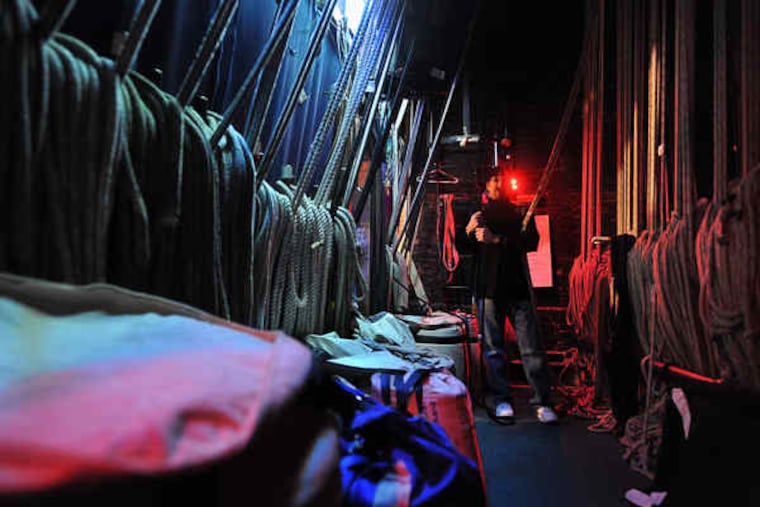
The Walnut, though, is one of America's few remaining "hemp houses" (along with another Center City stage, Plays & Players on Delancey Place) - theaters whose scenery drops and lifts the old-fashioned way.
A "hemp house" uses stagehands and sandbags to raise and lower set pieces attached to thick ropes made of hemp, the only fiber strong and stable enough for the purpose. Each time the huge Walnut scenery shop builds a piece of scenery that isn't on stage throughout the play and that doesn't move onstage from the wings, it must be raised and lowered by the hemp system.
Here's how it works: Every piece of scenery that drops is weighed and tied with hemp and stored high above the stage. The other end of that hemp is tied to a heavy canvas bag filled with an amount of sand determined by the weight of each piece.
For instance, a backdrop for the number "I Can Hear the Bells," in the Walnut's
Hairspray
production this winter, needed a bag containing 400 pounds of sand so that stagehands could raise and lower it smoothly.
Finding theatrical sandbags - which generally can hold between 200 and 500 pounds - nowadays is like locating typewriter ribbons; there's no market for them, so the Walnut must have them custom made.
For "I Can Hear the Bells," stagehands - working on their narrow deck along the stage-left wall, three stories above actors - waited for their cue. When it came, in a flash they untied a hemp rope from the deck's railing and guided its counterweight sandbag over the rail, allowing the bag to rise as the piece of scenery came down into the audience's view.
When the scene was over, they hoisted the scenery rope and it rose out of sight as the sandbag descended to the deck. The stagehands caught it, brought it aboard and tied it securely to the rail. They did this for 14 set pieces, some of which appeared, were lifted off, and reappeared later.
If this seems like a shipboard rigging job, it is - and with some of the same terms and knot work. In the 1800s, sailors helped develop the hemp system that many theaters used backstage until later in the century. Sailors also worked in port as stagehands, essentially doing the same thing they did aboard ships - but with different timing.
A backstage operation as large as the Walnut's would take enormous refitting (and funding) to change over; the Walnut has 50 different places for mooring scenery along that fly rail.
"We're doing Broadway shows with the oldest system we have," says Sal DiNapoli, who as the Walnut's head flyman is chief of the hemp operation, which demands timing and precision. One false move, and ropes could twist, bashing sandbags or scenery, or sending sandbags into stage lights that could singe the hemp. Scenery weighing as much as 650 pounds can inflict rope burns on a stagehand or even pull one over the rail. Or a stagehand could lower scenery to the stage with a thump that startles the actors and sends a cloud of dust into the orchestra pit.
There are few false moves at the Walnut, where stagehands feel deeply how rooted in the past their jobs are. "This," DiNapoli says, "is history in action." They are well-trained at handing that history down to one another; when two sandbags collided and one burst during last season's
Peter Pan
, the stagehands kept them out of sight, cleaned up and, during intermission, repaired the rip without the audience ever knowing what had happened.
High above the rear of the stage - so high that you walk up all the stairwell levels until all that's left is a movable staircase that takes you under a low-hanging top-level joist - you can see a series of five huge wooden wheels just under the ceiling. They were used as part of a winch to raise or lower massive scenic backdrops, and were probably put out of service in 1920, during one of the theater's major renovations, when someone decided that removing them wasn't worth the cost.
Directly at your feet, you'll see an ancient loft where old costumes live under that wheelwork. The labels on metal pipes where the hundreds of garments hang tell the story of the Walnut's variety of fare. "Poncho capes." "Priest cassocks." "Long dresses." "Fancy coats." One section is labeled "Les Miz," for last summer's production. Another, full of fake fur, is "Cats." Hundreds of pairs of shoes sit on shelves that line the loft floor - all sorted by sizes posted on handwritten signs, as if in a flea market.
Far below all this, an H-shaped tunnel sprawls under the main-stage seating floor - a 19th-century cooling unit. It's a breezeway, once used to bring cool air under the audience and into the theater. The breezeway comes together under the orchestra pit and can still be effective. Ask the musicians for
Hairspray
; on the coldest nights of the run, all that scrappy music from the pit came from people wearing coats.
On the Walnut Street side of the theater, the breezeway comes to an end near the bare-walled office of Rob Neece, who manages Barrymore's Cafe, an intermission spot for desserts and snacks. In his little basement office by the cafe, Neece is literally up against the history of the building: His bare office wall is the original foundation.