Bringing home the Iraq war, and one of its dead
Ross Katz figured the last thing the world needed was another movie about the Iraq war. But when he read Lt. Col. Michael Strobl's account of escorting the body of a young Marine named Chance Phelps home to his family in rural Wyoming, the story got its hooks into him but good.
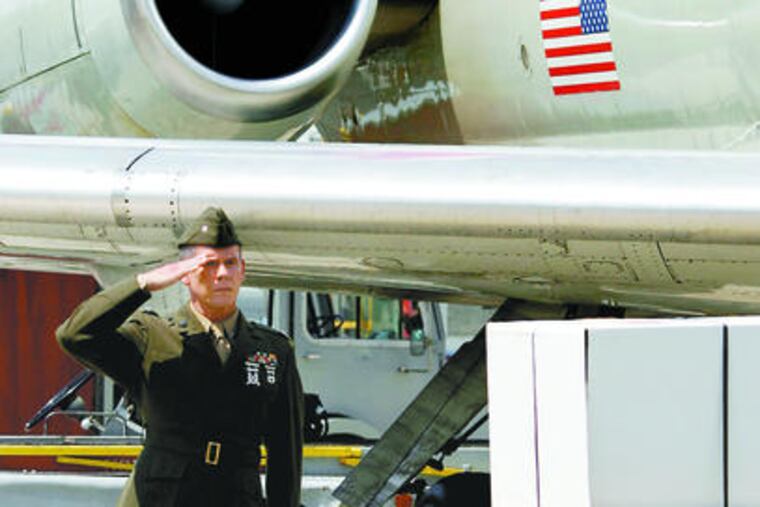
Ross Katz figured the last thing the world needed was another movie about the Iraq war. But when he read Lt. Col. Michael Strobl's account of escorting the body of a young Marine named Chance Phelps home to his family in rural Wyoming, the story got its hooks into him but good.
"I was sort of avoiding it," Katz said, "and then I read it one day and I couldn't shake it."
Havertown native Katz, 37, started out as a DJ on Christian station WZZD-AM (990) under the name Ross Andrews. He worked briefly at WYSP-FM (94.1) before heading to Los Angeles to break into the movie business. Starting out as a grip on Reservoir Dogs, he worked his way up to producing Lost in Translation, Marie Antoinette, and In the Bedroom, among others.
He makes his directing debut with Taking Chance, the story of Strobl's cross-country journey. The film, starring Kevin Bacon as Strobl, premieres on HBO on Saturday.
Katz had been looking to turn director for some time, but he hesitated when executives at HBO sent him Strobl's autobiographical essay. "I didn't want to make an Iraq movie," he recalled in Park City, Utah, a few days after the film's premiere last month at the Sundance Film Festival. "I figured, 'It's 2006. If you don't know how you feel about the war, you've been living in a hole.' "
But a short while later, Katz was watching the latest casualty report on CNN and realized to his horror that the news of Americans killed in combat left him unfazed.
"I sat there, and I didn't feel anything, and I was very disturbed and angry with myself for not feeling anything," Katz said. "I had an intellectual response, but there was no emotion. I remember walking outside in New York City and saying, 'Everything's normal. Some parent just got a knock on their door saying their child is gone. Shouldn't something happen?' "
In Taking Chance, something does happen. As Strobl travels from the mortuary at Dover Air Force Base to Philadelphia International Airport (the first stop for all airborne remains) and westward from there, the people around him stop in their tracks to pay their respects. Construction workers doff their hard hats, baggage handlers gather on the tarmac, and cars on a two-lane highway turn on their lights to form an impromptu funeral procession. Without being told, they seem to know the nature of Strobl's task, and the sacrifice made by the man whose body he carries.
Despite the strong feelings the war and its attendant loss of life provoke, Strobl said he sensed no whiff of partisanship. "Just the sheer number of people that responded, you have to assume they represented the full spectrum of beliefs about the war," Strobl said. "But they never conveyed any of that when they were conveying their sympathy and their gratitude."
"Something changes when you are proximate to a body," Katz said. "The war is no longer abstract. People drop their ideology at that moment, and the humanity comes out."
Strobl, who recently retired after serving 24 years in the Marine Corps, is lean and soft-spoken, his white hair cut close to the scalp. He speaks easily, but with an undercurrent of reserve. After the film's premiere, when an audience member asked if he had shown the film to Phelps' family, the only outward sign of the feelings the question provoked were the few seconds that Strobl took before stepping to the microphone.
Although Phelps' family had approved the making of the film, they had never read the script, or even the story on which it was based. So when they saw Taking Chance in December, it was the first time they had gone through Strobl's journey from start to finish.
"It was very intense," Strobl said in an interview later. "When it was over, it took us a few minutes to catch our breath. And then we started talking about Chance."
The fact that Marines aren't given to tearing up made it all the more important to cast an actor of Bacon's stature, Katz said, one who can convey emotion almost unconsciously.
"I could see from spending time with Mike that he had a tremendous amount of feeling around this experience," Bacon said. "He could communicate it, but it was being held inside. With a character like this, who doesn't wear his heart on his sleeve, it's important to trust that my interpretation of what he was feeling is going to read in my eyes, without having to say, 'I feel this.' "
Through the process of writing the script, which he coauthored with Strobl, Katz talked with numerous Marines, including a casualty notification officer from Philadelphia whose job it was to inform families that their loved ones had been killed in action. "He told me that what saved him from breaking down was the protocol, the needing to hold firm, to be a Marine," Katz said.
He also met with the general under whose command Chance Phelps had served, who told him how he would restore order after suffering a casualty.
"He said when you're in the field and someone goes down, he would tell his men, 'Take a minute. Everybody say something about him, and then we're going back to work.' You take that emotion, which is bursting inside of you, and you put it in your pouch. At some point, when you get home, way down the road, you open that thing up and there's a lot in there to deal with."
To convey that sense of discipline, the production had Marine advisers on set to ensure that even the smallest details were correct. Katz recalls one adviser berating a Marine extra for wearing his ribbon badge "literally one centimeter" to the side. But one crucial detail was fudged in the name of paying tribute to Katz's hometown. When Strobl, who lives in northern Virginia, bids goodbye to his children, he stuffs Tastykakes into their knapsacks.
"My prop master was, like, 'I can get clearance on Twinkies and Yodels,' " Katz said. "But I was like, 'No - Butterscotch Krimpets. Has to be.' "