Disorder on the tube
Showtime’s “United States of Tara” focuses on a woman with multiple personalities.
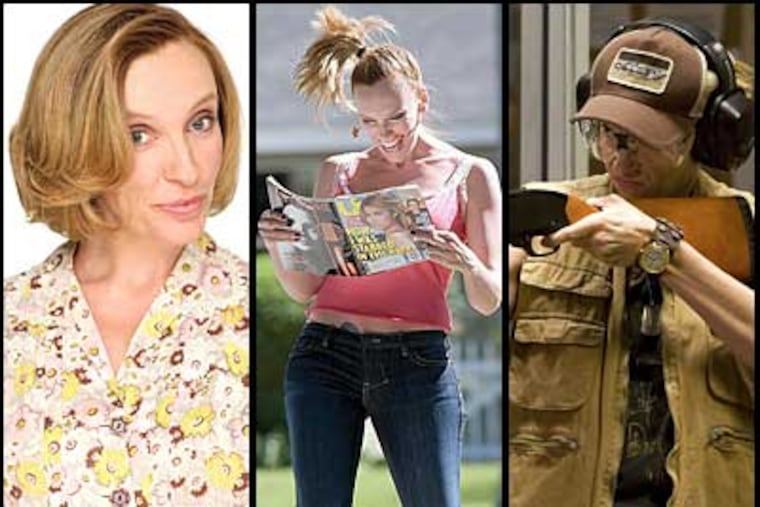
Multiple personality disorder is all the rage.
And, judging by Showtime's new dramedy, United States of Tara, it's fun to be a multiple.
Tara, which features an amusing turn by Toni Collette as a woman with three different alters, has brought the disorder - dissociative identity disorder, as it is officially known, or DID - once again into the harsh light of pop culture.
How accurate is Tara's depiction of the disorder? And why has Western culture - from the two-faced Janus in Roman mythology to Batman's nemesis, Two-Face - been so enamored with tales about the split self?
Executive producer Alexa Junge says Tara, which is the brainchild of Juno creator Diablo Cody, "is a comedy with a darker, crunchy center, as we say in Hollywood." It uses humor to illuminate DID in a way that is fun, yet sympathetic and dignified.
The series, which premiered last month to mixed reviews, follows Tara Gregson, a smart, strong-willed artist, as she tries to navigate among her relationships with her super-supportive husband, Max (John Corbett), and her sarcastic teenage kids, Kate (Brie Larson) and Marshall (Keir Gilchrist).
Then there are her three memorable alters: Alice, a cake-baking 1950s-style hausfrau who is so proper she makes June Cleaver look like Jenna Jameson; T, a hyper-sexualized teenage tease; and Buck, the paradigmatic Joe Sixpack who loves to bowl, shoot, and visit strip clubs.
Junge says Tara tries to present an Everywoman whose split self mirrors "all the expectations of what it takes to be a mother, wife and career person" today. "At the same time, we want to be presenting what it's like to be living in the world with this particular disorder."
The show avoids two cliches: It doesn't portray people with DID as helpless victims or psychotic killers. The Three Faces of Eve (1957) and the 1976 TV drama Sybil are melodramas featuring emotionally scarred victims. And the killer, of course, is a mainstay in thrillers including Hitchcock's 1960 classic Psycho, Brian De Palma's Raising Cain (1992), and 1996's Primal Fear.
Temple University psychiatry professor Richard P. Kluft, who is a technical adviser on Tara, says at first he was shocked that such a tragic condition was being used for laughs.
"I'm incredibly sympathetic with people who say comedy is inappropriate" for DID, says Kluft, who has a private practice in Bala Cynwyd.
Kluft, whose books include Clinical Perspectives on Multiple Personality Disorder, says DID, which studies suggest may affect as many as 0.5 percent of the population, develops in adults who suffered chronic childhood abuse.
He explains that the abused child, who can't escape overwhelming traumatic situations, instead takes flight in his or her imagination. By dissociating, the child ascribes the trauma to an imaginary character and forgets the abuse. Over time, such episodes calcify and alternate personalities develop. The coping mechanism becomes a problem because it fragments the person's life.
According to Kluft, Tara deviates from typical cases because she has only three alters. "On average, there are eight or nine alters in a male with DID, and around 16 with women," he says. (Junge promises that next season we will meet more of Tara's alters.)
Kluft says Tara's alters are better-defined than usual. "Most alters only differ from each other in very subtle ways," he says, adding that only 5 percent of DID cases have such alters. Kluft says he's concerned that Tara is so open, even cavalier, about her disorder. Most patients, he says, work hard to keep their condition secret - after all, they developed their alters as a way to hide past abuse.
"I sometimes still wince at some of the stuff" in the show, he says. But he has been pleasantly surprised by the show's overall sensitivity. He says the show has a unique perspective because it focuses "much more on the bittersweet relationships" in Tara's life than on her inner struggle.
Bob Carolla of the National Alliance on Mental Illness, a Virginia-based advocacy group, says the jury is out on Tara.
He says NAMI has received mixed comments from viewers. Some "praise it for helping to reduce stigma. . . . Others see it as insensitive, using a serious condition" as fodder for comedy.
For some experts, the question of accuracy is overshadowed by a larger controversy.
"I don't believe [DID] is an illness," says University of Pennsylvania psychiatrist Steven Siegel, who has written extensively about the neurobiology and treatment of schizophrenia. "It's fabricated by the psychiatric establishment and propagated by people who hear about it" from pop culture.
"The tiny percentage of people diagnosed with DID probably suffer from borderline personality disorder," he says, a more common condition that also is rooted in a chaotic, sometimes abusive childhood. He asserts that DID often is used by patients "to move the locus of their own responsibility . . . onto other personalities."
Lina Hartocollis, director of the doctorate program in clinical social work at Penn, says that while dissociation is a real coping mechanism, its effects are open to interpretation.
She argues that pop products such as Sybil, The Three Faces of Eve - and Tara - provide patients and doctors alike with a whole language that helps them come up with labels for emotional pain.
"People [with DID] are in real distress, but they start to understand themselves using . . . idioms of distress that define their experience" in terms of splitting, says Hartocollis, who questions the wisdom of talking about alters as if they were real people, rather than metaphors.
Metaphors about mental illness are stock-in-trade for Peter Logan, author of Nerves & Narratives: A Cultural History of Hysteria in 19th-Century British Prose.
Logan, who teaches English at Temple, says tropes such as the doppelgänger have pervaded Western literature for centuries.
Traditionally, the concept was defined in terms of a Christian moral framework to symbolize our struggle with good and evil.
"Renaissance psychiatric literature talked about the idea that everybody had an angel and a devil in them. When a split occurs, it means the person has been possessed by a second devil," Logan says.
By the late 19th century, he says, there was an "intense psychiatric interest in the phenomenon." That intersected with an explosion of literature about doubles and multiples, including E.T.A. Hoffmann's The Devil's Elixir (1816), Edgar Allan Poe's story "William Wilson" (1839), Robert Louis Stevenson's Dr. Jekyll and Mr. Hyde (1886), and Oscar Wilde's The Picture of Dorian Gray (1890).
Logan says that although these stories retained a moral dimension, by the early 20th century the split self was defined more in therapeutic terms: Jekyll can be read as a tale about the struggle between good and evil, or as a metaphor for drug addiction.
The alter in modern literature is no longer an evil force, but "a more modest, more innocent or primitive" aspect of life, Logan says. This primitive self is often feral, violent and dark - but it's a part of nature and no longer condemned as evil.
In fact, in Tara the alters symbolize the increasing number of social roles we each have to play in a postmodern world oversaturated with information.
"Everybody has various facets to their personality. Certain facets are worn in social situations - it's an essential part of functioning in life," Logan says. "But we're also faced with the choice of which facet we want to develop more.
"All of those facets are real," he says, "and yet none is."