When the alma mater of your dreams says no
At this time last year, Lower Merion High School senior Brett Redmond thought he was headed to the school of his dreams - the University of Maryland.
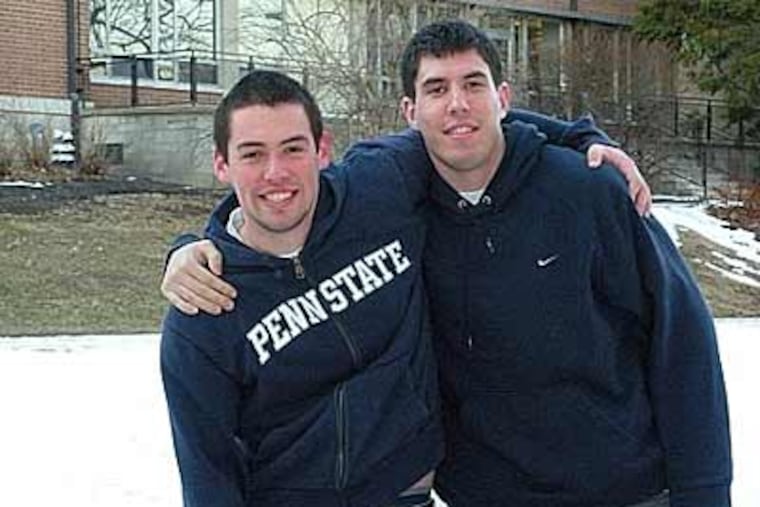
At this time last year, Lower Merion High School senior Brett Redmond thought he was headed to the school of his dreams - the University of Maryland.
"I lived in Maryland for summers and weekends my whole life," he said. "I was a big sports fan and I watched all their basketball games. I just always wanted to go there." According to his mother, Sue, he'd want to stop and get a Terps hat or shirt every time they went out on their boat in the Chesapeake. "That's all he wanted."
Brett's grades were good, his test scores were good, and more important, he had participated in a weeklong, highly competitive summer engineering program that required students to go through an application process similar to college admissions. Everything pointed to yes.
But last February, Brett learned that Maryland had rejected him. "I saw it online and I was shell-shocked," he said. " . . . I didn't know what I was going to do after that point."
Brett's experience will echo that of many high school seniors this month as they begin to receive word about their college applications. Because this is one of the largest high school graduating classes in 30 years - and these students on average send out between six and 10 college applications - there will likely be a record number of rejections. Plus, the recession means that even those students accepted by their favored school may have to say no because of finances. The result: a very stressful time in an already very stressful process.
"There's a myth that you have to be good at everything ," said Ken Ginsburg, a pediatrician who practices social adolescent medicine at the Children's Hospital of Philadelphia. He said that pressure to excel is creating a generation of students more subject to stress from college admissions than ever before. Yet the pressure can be alleviated if families can focus more on the college experience than on the college name.
Ginsburg believes parents need to teach their children that ultimate success will be based on their love of learning, how they work with people, and their resilience. Plus, what we originally believe is our best option doesn't necessarily turn out that way. Brett Redmond, who wanted only to go to Maryland, ended up going to Penn State, pledging a fraternity, and changing his career focus. He says he loves it: "Everything happens for a reason."
Ginsburg, author of Less Stress, More Success: A New Approach to Guiding Your Teen Through College Admissions and A Parent's Guide to Building Resilience in Teens, has his own admissions story. An undergraduate student at the University of Pennsylvania, he planned to attend Penn's medical school. "My father went to Penn Med, my grandfather went to Penn Med. I didn't get in to Penn Med. So I went to New York and on the train I met my wife. Now I teach at Penn Med."
Cigus Vanni, who has been a guidance counselor at Cherry Hill High School West for the last seven years, used to work in admissions at Swarthmore College and now gives free lectures on college admissions. The source of the students' stress sometimes is parents, he said. "They don't understand the college landscape. They think it's either too competitive or it's the same process it was 30 years ago. Neither of those extremes is true."
Many parents have the perception that they're going to fail their children if they can't help them attain a better lifestyle. "Parents feel their children will not be more successful than they are unless they go to the best college," Ginsburg said. "And there are professional parents who define their success by the bumper sticker on their car."
Both Ginsburg and Vanni suggest looking for colleges that are the best fit, not necessarily the most prestigious. Acceptance into college is a rite of passage, says Ginsburg, and "if we promote the myth that success is dependent on which envelope arrives, that's harming the child because they're beginning initiation into adulthood with failure."
But how do you handle the student who still believes there is only one true fit? Joe Havlik, a guidance counselor at Harriton High School, gives students the "relationship" talk. "I tell them applying to college is a lot like courting. Love is out there - but if you fall in love and it doesn't come true, be prepared to have your heart broken and keep your options open."
This year's combination of a large graduating class and a large number of applications per student results in what guidance counselors are calling "the perfect storm."
"You can do absolutely everything that is expected and simply not be admitted because admissions is a quilt, not a blanket," Vanni said. "Admissions offices put together a series of patches. There are athlete patches and legacy patches - up to 50 percent of the patches are taken up by specialty cases. By the time they finish all the patches, there might not be space for you."
Then there's the economy. The average investment portfolio has lost between 20 percent and 40 percent of its value in the last six months, according to Tom Belisari, a certified financial planner at Key Financial in West Chester. The 529 college saving funds managed by Pennsylvania also were down an average of 30 percent, and those losses are already affecting the ability of currently enrolled students to pay tuition.
"We're hearing, informally and anecdotally, there has been an increase in unpaid bills at colleges," says Barmak Massirian, associate executive director at the American Association of Collegiate Registrars and Admissions Officers.
If your child has been accepted into a program you can no longer afford, Ginsburg advises a straightforward discussion. "When you talk about finding the right match, that match includes the realities of life's circumstances," he said, adding, "It doesn't do good to shield them from reality."
Ginsburg is involved in Challenge Success (www.challengesuccess.org), an outgrowth of the Stressed Out Students project at the Stanford University School of Education. The Challenge Success mission statement aims to expand the definition of success for children to include character, health, and creativity, as well as achievement.
Resilience is another key ingredient for success, according to Ginsburg. And students can, and will, bounce back. Brett Redmond's advice: "Don't stress about it. That's the worst you can do. You'll end up fine."