Monday at the museums with Paul
50 Cezanne scholars hit the high points at the Art Museum and the Barnes.
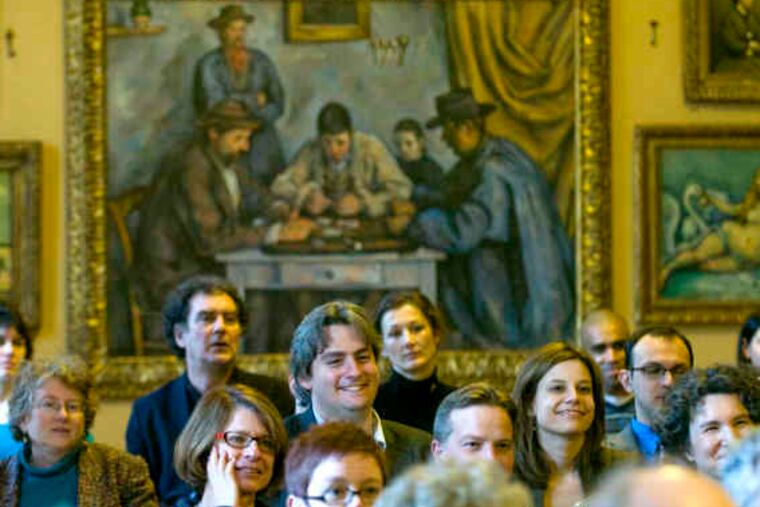
If ever there was a ready-made audience for "Cezanne and Beyond," the new show opening at the Philadelphia Museum of Art today, these people were it. They didn't need the audio tour - each one was an audio tour, with a uniquely informed view.
The nearly 50 Cezanne specialists and modern-art scholars who assembled at the Art Museum on Monday morning were part of a "study day" jointly organized by the museum and the Barnes Foundation. Given their overlapping collections, a visit to both was imperative (and will be easier when the Barnes moves from its Lower Merion home to the Ben Franklin Parkway in early 2012).
Between them, the Art Museum and the Barnes have more than 80 Cezannes - more than there are in Paris, as the exhibit's principal organizer, Joseph J. Rishel, curator of European art before 1900, points out. Accordingly, the day was divided in two: morning at the Art Museum, afternoon at the Barnes.
And while the discussion was mostly as elevated as one might expect ("Is anybody else getting an Ingres vibe?"), it also was at times not much different from what the average visitor might engage in - maybe more so.
Michael R. Taylor, curator of modern and contemporary art at the museum, while speaking to the group about Arshile Gorky's extremely Cezanne-like 1928 still life Pears, Peaches and Pitcher, noted the opinion of one of the scholars present, London-based Renoir expert John House:
"John House said it's crap."
"No, I didn't," House retorted. "I said it was 'scary.' "
"Well," Taylor said, " 'crap' was in there somewhere, John."
That didn't mean that House, who is working on a Mellon-funded research project at the Barnes, wasn't enthralled by "Cezanne and Beyond."
"It's Cezannes not just by themselves, but in juxtaposition," he said. "That's something you don't get very often."
The show comprises 150 works. About one-third are by Cezanne, the rest by 18 other artists influenced by him, including Picasso, Braque, Matisse, Mondrian, and Giacometti, as well as some who may not come to mind as readily, among them Ellsworth Kelly, Jasper Johns, Jeff Wall, and Brice Marden.
Barnaby Wright of London's Courtauld Gallery (possessed of its own important Cezanne cache - they loaned one of his famed versions of Mont Ste.-Victoire to the show), noted that while "the show deals with the issue of Cezanne's being the 'Father of Modern Art,' the surprising juxtapositions are not so much in subject, but relationships more subtle, having more to do with the handling of paint."
Rishel set the easygoing tone, gathering his charges after morning coffee. "The drill of the day," he said, was looking for "impressions, opinions, new thoughts." After noting that the museum shop was open (no free catalogs, but a discount on the $65 tome), he led the way.
Like any other museumgoers, the scholars bunched up in the first two galleries before spreading out. Initially the talk was about endowments, the mechanics of organizing a show, arrangements of paintings. At least one picture of a new baby was shared.
But soon they were deep in discussion, serious and not so.
Looking at Picasso's The Dream, someone recalled that its owner, casino mogul Steve Wynn, had famously put his elbow through the canvas, leaving a two-inch gash.
It was difficult to see any sign of damage or repair, even with the sensational lighting that makes the familiar image such a revelation in this show.
"I bet if we turned it around, you could see it," Gloria Groom of the Art Institute of Chicago told Wright. (They didn't, and don't you.)
For the esteemed Mondrian scholar Joop Joosten, viewing the artist's Tree (which he hadn't seen since 1981) side by side with the more muted Composition No. II, 1913 brought out stronger colors than he had noticed before.
Charlotte Eyerman, modern-art curator at the St. Louis Art Museum, said the show provided a fresh look at a familiar work, Matisse's Bathers With a Turtle.
"I feel like I'm seeing it for the first time - I've installed it three times, but in this context" - in a gallery with Cezanne's Large Bathers and Picasso's 1956 bronze grouping based on Cezanne's work - "it's really a revelation." For one thing, she said, the Matisse is hung about two feet higher than it was in her museum. "The turtle gets more of a starring role."
After the group had wandered out to fetch folding stools for discussion, things dug deeper.
University of Texas art historian Richard Shiff made a case for one corner of the show, containing Cezanne's Chestnut Trees at the Jas de Bouffan, Mondrian's Composition With Grid 4: Lozenge Composition, Cezanne's watercolor Study of Three Trees, and Francis Alÿs' provocative After Cezanne (a Cezanne painting, Still Life With Apples, swathed in bubble wrap).
"What's remarkable is the visual connections," Shiff said, noting the way the geometric Mondrian played off the trees. "What Cezanne would not get out of Mondrian, we get."
As for Alÿs' bubble-wrapped piece, Shiff said, "This is the way that people who didn't like Cezanne in 1891 thought he looked." And, of Jasper Johns' painted collage Map, "If Cezanne had lived another 50 years or so, he could have painted something like that."
Yve-Alain Bois of the Institute for Advanced Study in Princeton, looking at the relationship between the Matisse and Cezanne bathers, made the point that "one of the things Matisse took from Cezanne was daring to reveal the process" of creation.
Bois asked if anybody wanted to talk about the Picasso sculpture. "It's the elephant in the room," Rishel said.
Nobody did.
In the afternoon, the scholars took a bus out to the Barnes, where things took on a more formal tone. They gathered on folding chairs in the main gallery (under the third version of The Large Bathers) for an introduction to the collection by the Barnes' Martha Lucy, co-organizer of the event.
Lucy noted the "nonlinearity" of the Art Museum's show and its kinship to the Barnes' "ensembles" of Southwestern pottery, African sculpture, and forged ironwork.
When the scholars split into smaller groups to tour the galleries, the connections were immediate.
One group gathered before Cezanne's Bathers at Rest, a striking counterpart to The Bather, in the Art Museum's show on loan from the Museum of Modern Art.
Angelica Rudenstine of the Mellon Foundation said it should be easy for museumgoers to connect the Barnes with "Cezanne and Beyond" - "They can't help but connect it because there are so many of the same artists" presented in a similar manner, "not institutionally crafted."
Or, as House put it, both the Barnes, with its idiosyncratically arranged galleries, and the Art Museum are "going against museum practice."
Wright, who had never been to the Barnes, said he wasn't "quite prepared for the experience."
"No other museum would put a van Gogh in a corner," he said. "I have mixed feelings about it."
Still, he said the Barnes - like the Cezanne show - creates an internal dialogue between the artists within its walls, and provides "a level of intimacy unlike any other museum."