Unlocking 'America I AM': There's something for all tastes at Tavis Smiley's black history extravaganza
TAVIS SMILEY'S sweeping view of African-American history will travel the nation for four years, but its first stop is Philadelphia's National Constitution Center, where "America I AM: The African American Imprint" opened last month. A more appropriate venue can hardly be imagined.
TAVIS SMILEY'S sweeping view of African-American history will travel the nation for four years, but its first stop is Philadelphia's National Constitution Center, where "America I AM: The African American Imprint" opened last month. A more appropriate venue can hardly be imagined.
"The Constitution itself tells the story of how African-American people rose up to where they are today in America," said Steve Frank, the Constitution Center's vice president of education.
Broadcaster and author Smiley has said the exhibition seeks to answer the question poised in 1903 by black scholar and activist W.E.B. Du Bois: "Would America have been America without her Negro people?"
More than 200 artifacts assembled in 12 galleries provide the unequivocal answer.
Visitors to "America I AM" experience a journey from struggle to triumph, starting in Africa, across the Middle Passage to the New World, through the horrors of slavery, Civil War, segregation, the fight for civil rights and the culminating history-making inauguration of Barack Obama as our first African-American president.
Viewed in this way, Frank said it's obvious that African-American history and American history cannot be separated.
"The message is really a part of the American story. It's more than an imprint - it's really about how African-American contributions to history and culture have made history today.
"One of the most powerful aspects in the exhibit is the amazing collection of the artifacts. It's a once in a lifetime opportunity to see these icons gathered in one place, telling one story.
"It's a good exhibit to see with friends and family because it's the kind of exhibit that you want to talk about," he added.
History buffs will of course want to visit "America I AM" before it leaves Philly in early May, but those with other interests will find plenty to excite their curiosity. We've scoped out the exhibit and uncovered these "don't miss" displays.
KID-FRIENDLY FINDS
* Listen. Actor Wendy Staton's interactive monologue, "She Went to War," brings military segregation to life through storytelling.
* Speak. Children record what they think their "imprint" is on America. The recordings will be added to this video project, creating a massive oral collection that will travel around the country with "America I AM" for four years.
* Move. In the exhibit's last gallery, children can get up and dance during the video presentation "Triumph," which celebrates African-American achievement. They'll boogie to the music of Ray Charles and Tupac Shakur, and cheer for the first African-American president.
POP CULTURE VULTURES
* The satin robe worn by Muhammad Ali at the "Rumble in the Jungle." Ali defeated world heavyweight champion George Foreman in an eight-round knockout in a historic bout fought in Kinshasa, Zaire, (now the Democratic Republic of the Congo) on Oct. 30, 1974. For Ali, this fight redeemed him in the eyes of the world and earned back the title he was stripped of for refusing induction into the U.S. Army in 1967.
* Prince's guitar. The bright purple, one-of-a-kind guitar that Prince used when he performed at the halftime show of the 2007 Super Bowl.
* The typewriter Alex Haley used to write "Roots." Written in 1976, this novel spans seven generations of Haley's African-American family. The novel was adapted into a TV mini-series seen by 130 million people when it aired on ABC in 1977.
FOR
PHILLY-PHILES
* Ballot box, Mother Bethel African Methodist Episcopal Church. This ballot box was used to elect church trustees, and since many voters could not read or write, they dropped marbles into holes next to the picture or symbol of a candidate. Mother Bethel was founded in 1816 by Richard Allen, who was born into slavery in 1760. The church is still active, located at the corner of 6th and Lombard streets.
* Philadelphia Negro League Jersey. The Jersey worn by a member of the South Philadelphia Freight team, one of the Negro leagues formed in the 1920s that toured the country and even played in South America and the Caribbean. Hall of Famer Jackie Robinson began his career in the Negro League.
* Altar Table, The African Episcopal Church of St. Thomas. The original wood altar from the Philadelphia church founded by Absalom Jones. In 1794 the congregation became part of the Episcopal denomination and remains a socially active church today, located at 6361 Lancaster Ave.
FOR THE CIVIL RIGHTEOUS
* Birmingham Jail Cell Door Key and Stool. The jail cell where Martin Luther King Jr. wrote "Letter from a Birmingham Jail" is recreated with the actual door key and stool. King was arrested in 1963 during a sit-in at an Alabama lunch counter. His letter was an eloquent and impassioned response to local white clergy who thought that blacks should be patient and fight for civil rights through the courts, not with protests and demonstrations. The letter was smuggled out of the jail in pieces and was published in several magazines. Realizing the historic significance of King's imprisonment, a jail employee set the stool aside for preservation.
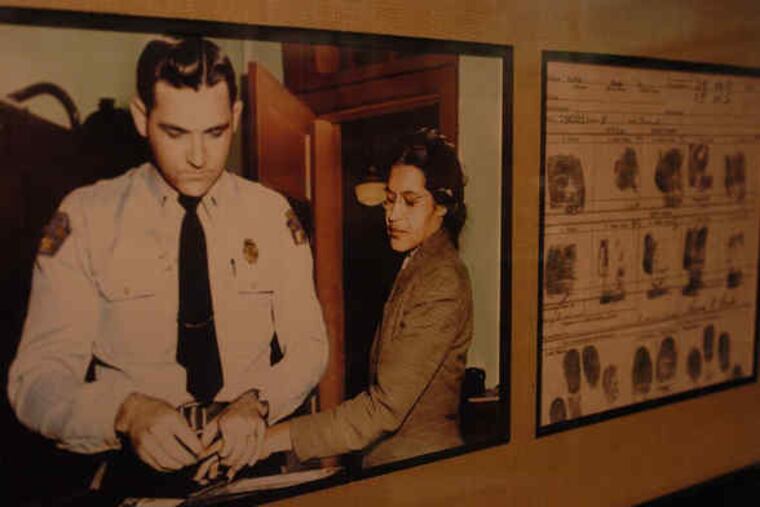
* Rosa Parks' Fingerprint Card. Being arrested and fingerprinted in 1965 for refusing to give up her seat on a Montgomery, Ala., bus, earned Rosa Parks her iconic title of "mother of the civil rights movement." Parks said of that day: "People always say that I didn't give up my seat because I was tired, but that isn't true . . . No, the only tired I was, was tired of giving in."
* Program from the March on Montgomery. Led by Hosea Williams and John Lewis, this 1965 Civil Rights march from Selma to Montgomery, Ala., was a part of nonviolent campaign to encourage voter registration. Police reacted violently, beating marchers with billy clubs and spraying them with tear gas. A few weeks later, 3,200 people met in Selma to march again, this time peacefully. When they arrived in Montgomery, the group had swelled to 25,000.
FOR OBAMA GIRLS
(AND BOYS)
* Barack Obama's Race Speech at the Constitution Center. It was a pivotal moment of the 2008 presidential campaign when then-Sen. Obama delivered his speech on race at the National Constitution Center. The original, autographed speech - heralded as one of America's most inspiring examples of political oratory - was given to the center by the candidate. Pay attention to our president's signature - there's a smiley face in the "O!" *
"America I AM: The African American Imprint," National Constitution Center, 525 Arch St., 9:30 a.m.-5 p.m. Monday-Friday, 9:30 a.m.-6 p.m. Saturday, noon-5 p.m. Sunday, through May 3. Tickets: $17.50, seniors $15.50, children 4-12 $9, active military personnel and children under age 3 are free. 215-409-6700, www.constitutioncenter.org, www.AmericaIAM.org.