Art: The Cezanne stimulus
The Art Museum's beautiful and exciting new exhibition starts with the master and reaches out to his inspired scions.
Paul Cezanne is back in town, sort of.
The Cezanne exhibition that set an attendance record at the Philadelphia Museum of Art in 1996 offered an elegantly straightforward history lesson. It traced his evolution as an artist from a somewhat clumsy Salon painter-manqué into the revered fountainhead of modern art. The story was logical, easy to follow, and satisfying in its denouement.
"Cezanne and Beyond," which opened at the Art Museum on Thursday, is not only a more complex and provocative exhibition, but also edifying in a different way. While Cezanne remains the focal point, the show is not really about his career, but about the reverberations of his aesthetic innovations through the 20th century.
Unlike the retrospective, this beautiful and exciting show, exclusive to the Art Museum under the sponsorship of Advanta, offers multiple facets and entry points. If there are many ways to savor it, there also are more opportunities to agree or disagree with what the curators have put on the walls.
Yet regardless of how one responds, "Cezanne and Beyond" is a magnificently stimulating experience. The organizing concept is simple: Cezanne not only established a firm foundation for modern art (if such a foundation can be credited to one person), he also profoundly influenced several generations of artists, primarily painters, down to the present day.
Influence in this context doesn't mean only stylistic imitation but also fundamental thinking about how artists see, what art might be, and how it can be made.
To demonstrate that Cezanne was one of those rare artists who single-handedly trigger a tectonic shift in aesthetic thinking, curators Joseph J. Rishel and Katherine Sachs, assisted by two colleagues, Michael Taylor and Carlos Basualdo, have chosen 16 artists as prime beneficiaries of Cezanne's pathfinding.
Most became prominent in the first half of the 20th century, and, except for four contemporary artists, the majority are Europeans. Their careers range from cubism to postmodernism, yet the most obvious links to Cezanne, at least visually, occur in painting before World War II.
"Cezanne and Beyond" is mainly an exhibition of painting, with some sculpture and drawing and, to establish a postmodern connection, several large illuminated photo-murals by Canadian Jeff Wall.
The other 15 Cezanne legatees, each represented by a number of works, are Henri Matisse, Pablo Picasso, Georges Braque, Piet Mondrian, Fernand Lèger, Max Beckmann, Marsden Hartley, Charles Demuth, Liubov Popova, Giorgio Morandi, Alberto Giacometti, Arshile Gorky, Ellsworth Kelly, Jasper Johns, and Brice Marden. (Two other contemporary artists, Sherrie Levine and Francis Alys, are included with single works.)
Why those 16? Why were other prominent artists who also responded to Cezanne left out? Why, for instance, did the curators include Demuth but not John Marin? The curators address this question - and their reasons for considering, then eliminating, artists such as Juan Gris and Diego Rivera, both of whom benefited from Cezanne's labors - in the catalog, not in the hanging.
The massive catalog, heavy as a tombstone, is a vital accessory for this show because the viewer can't appreciate the conceptual nuances of its program just by looking. Yet the show contains so many exceptional works of art that it can be thoroughly enjoyed without delving into the organizers' rationales, if one so chooses.
Cezanne influenced the thinking of so many other artists that ultimately it doesn't matter who's in and who's out. The important thing is how various artists responded to his fracturing of form, his flattening of space, and his repeated examinations of familiar motifs such as Mont Ste.-Victoire.
At its core, "Cezanne and Beyond" wants us to recognize that most art is derived to some degree from art that came before. As Picasso once famously quipped, "Good artists copy, great artists steal."
So we should accept the 16 and move on. The exhibition is installed more or less thematically, by subjects - single figures and portraits in one room, still lifes in another, bathers here, landscapes there, even a separate alcove for trees. The Cezannes are distributed evenly throughout, juxtaposed against works by the other artists, to illuminate the consonances.
And what a feast of consonances we are given here. Some are obviously stylistic, some refer to particular compositions by Cezanne, some are essentially conceptual. And some similarities, especially in the pieces by the four artists still working - they are, after all, several generations removed from Cezanne - are difficult to discern.
An example of the obvious: a portrait of Madame Cezanne in a red armchair next to Picasso's mildly erotic portait of his then-paramour Marie-Thérèse Walter, also in a red armchair (The Dream). Nearby is Matisse's Woman in Blue, sitting on a red cushion against a red wall.
Other conjunctions involve a particular subject or pose or even a single element from a Cezanne painting. In the last gallery, for instance, Kelly's monochrome blue painting Lake II extracts the blue shape of the sea from Cezanne's view of Marseille harbor and expresses it as an unmodulated solid blue wedge. In the same room, Marden's three-bar abstraction Grove Group V echoes the foreground/middle ground/background stratification of a Cezanne Ste.-Victoire on the wall opposite.
The discovery of and delight in such felicitous juxtapositions constitute a level of enjoyment in themselves, without going deeper. You're bound to feel a tingle of excitement, for instance, when you come across three Giacometti bronze busts of the artist's brother, Diego, displayed in front of four paintings of male figures by Cezanne and one by Hartley.
Similarly, a group of six bronze bathers by Picasso counterpoints three paintings of Cezanne bathers in a room devoted to nudes.
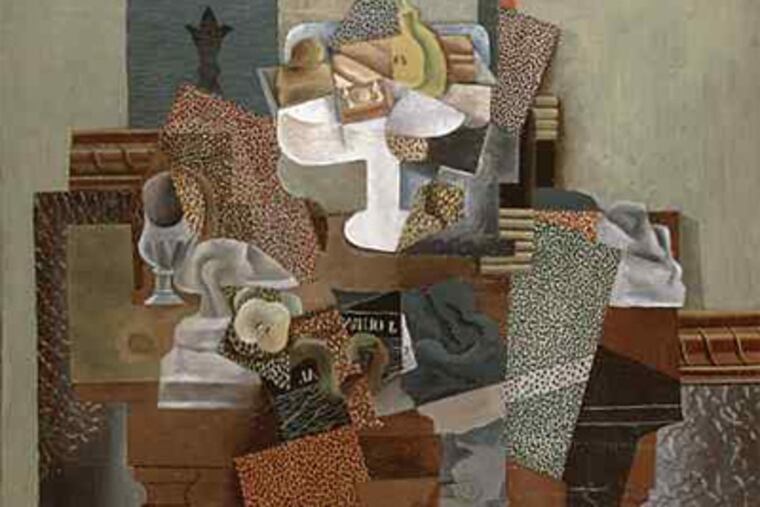
Cubism is the most familiar example of how Cezanne inspired audacious creativity in others, so naturally the show provides abundant examples through paintings by Picasso and Braque, the inventors of cubism; the Russian avant-gardist Popova; Demuth; and even Mondrian, whom one might not immediately identify with that movement.
Yet the Mondrians offered, in a small gallery devoted to images of trees, are persuasive. In his earlier works such as Tree of 1912, Mondrian was indeed beholden to Cezanne. Eventually he developed the purest strain of the latter's impulse toward abstraction.
One artist, Gorky, is striking for his complete dependence on Cezanne (and later, Picasso) for teaching him to paint. Like students copying Old Masters in the Louvre, Gorky unabashedly mimicked Cezanne in paintings such as Pears, Peaches and Pitcher and Staten Island. Yet in Crooked Run, one recognizes the advent of what would become Gorky's independent style in the 1940s.
The viewer can compare the 16 artists not only to Cezanne, but also to one another in the ways they responded to his example.
The artists still working (Kelly, Johns, Marden and Wall) are more difficult to identify with him in purely visual terms. How can we be sure they really are connected to Cezanne? Mainly, we must accept their testimony in the catalog, which contains essays on each of the 16, most by guest contributors.
Beyond the theorizing about influence, the most elemental stratum of "Cezanne and Beyond" is the artist himself, introduced iconically by the magisterial figure of a male bather in the show's entrance foyer.
About one-third of the exhibition's approximately 150 works are his, which is enough for a modest retrospective. Coming from the United States, Canada, Europe, and Russia, these are important, cream-of-the-crop Cezannes.
It doesn't matter that they aren't hung together, because whenever you encounter one or more as part of a group they capture and hold your attention immediately. Putting Cezanne in the company of these other artists confirms his significance as a key figure in the history of Western art.
At its heart, the show reminds us that truly original art is the exception, that most artists through history have built on the work of predecessors. In some Asian and African cultures, that's considered to be a virtue. So Picasso, Braque, Matisse et al. hardly seem diminished by their debt to Cezanne.
He, on the other hand, emerges as the last Old Master, like Rembrandt and Raphael before him a prodigious creative force who continues to grow in stature with each passing generation.
Art: Cezanne's Legacy
"Cezanne and Beyond" continues at the Philadelphia Museum of Art, 26th Street and the Parkway, through May 17. Exhibition hours are 11 a.m. to 5 p.m. Tuesdays through Thursdays, 11 a.m. to 8:45 p.m. Fridays, and 10 a.m. to 6 p.m. Saturdays and Sundays. The show will be open Monday, May 11, from 10 to 5.
Ticket prices, which include general museum admission, are $24 general, $22 for visitors 65 and older, $20 for students with ID and visitors 13 to 18, and $14 for visitors 5 to 12. Tickets for visits through March 31 are discounted $2. Tickets can be purchased at the museum, through www.philamuseum.org or by calling 215-235-7469. Information: 215-763-8100, 215-684-7500 or www.philamuseum.org.
EndText