A little bit angsty, a little bit dreamy
There's a long and noble history of rock and roll bands whose entire career sounds as if it's one long song. And then there are bands like Gomez, who vary mood and tempo, shape and color, and yet never manage to separate one song from the next.
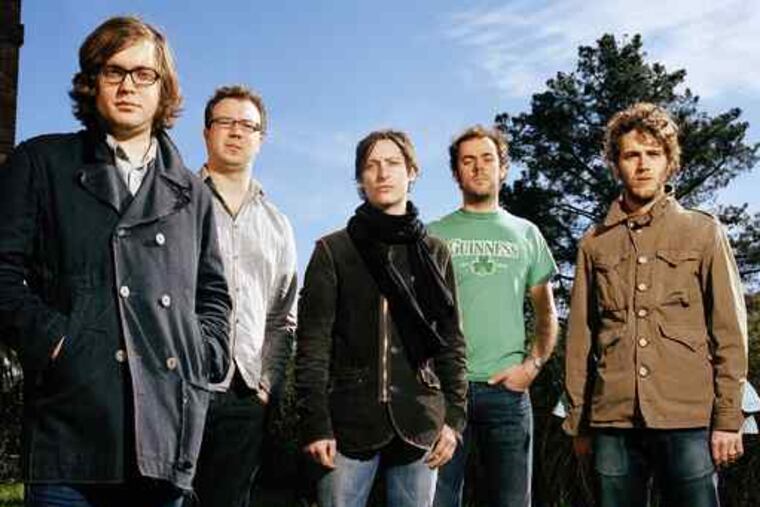
There's a long and noble history of rock and roll bands whose entire career sounds as if it's one long song. And then there are bands like Gomez, who vary mood and tempo, shape and color, and yet never manage to separate one song from the next.
Their 90-minute set at the TLA Saturday night was energetic and well put-together, moving from the spare, Pixieish snarl of "Shot Shot" to the epic crash of "Sunset Gates." But it still felt as if, were it not for the venue's no-reentry policy, you could have popped out for a smoke at any moment without missing much of anything.
It's not as if the songs all sounded the same - the band does, after all, trade lead vocals among three of its five members, although they all draw on similar influences of American roots and rock music, rarely betraying their British origins. But no matter how often they switched up the sound, the emotional temperature never moved more than a few degrees off the mean.
Ben Ottewell, whose voice is an echo of Eddie Vedder's shuddering wail, certainly went through the motions of passion, and the crowd responded in kind. But his angst-ridden persona quickly wore thin, especially when he tore into the "la la la" chorus of "Little Pieces," from the band's new album, A New Tide, as if he were trying to remove an anvil from his chest.
Portland, Ore.-based Blind Pilot, which opened the show, was as unassuming as the headliner was overbearing - fitting for a band who once toured the West Coast by bicycle. Israel Nebeker, the band's singer and half of its core duo (drummer Ryan Dobrowski is the other half), instilled a sense of drama not by raising his voice but by letting it trail off, as if the song's emotions had become, for a moment, too much for him to bear.
Blind Pilot's music, a rustic reverie that recalls fellow Portlanders the Shins, is elaborately orchestrated. Yet even with a six-piece lineup taking turns on trumpet, banjo and xylophone, the songs never felt crowded or weighty. They were light enough to be borne forward by the skitter of Dobrowski's brushed drums and the choppy strum of Nebeker's acoustic guitar, carrying wistful memories and unresolved hopes along with them.