Rooms for rent
In a flashback to earlier times, recession-pinched homeowners are seeking paying guests to share their space.
When his work dried up this winter, Larry Goetz, a housepainter in Newtown Square, started eating into his home equity line of credit, buying food with his credit cards, and scraping by with what little work he could get as a musician. Last month, for the first time in his life, he applied for food stamps.
So Goetz, who's 56, decided to leverage one of his last remaining assets. He put an ad on Craigslist looking for a roommate to rent a 10-by-12-foot room in the one-story brick home he bought seven years ago.
"You've got to be open," says Goetz, whose interests include tango dancing. "You've got to be flexible. You don't have a choice. It's survival. It's the wave of the future, I really believe that. The American Dream, of everybody living on their own, in their own house - I think it's being challenged."
For a nation that has already cut back on liposuction, steak dinners and mocha frappuccinos, perhaps the last frontier in cost-cutting is an idea more prevalent in the era of Dickens than in the age of 24 - renting out part of your home to a stranger.
Listings for roommates on classified and house-sharing Web sites have ballooned in the last year, as many homeowners have entered the roommate market. Roommate-wanted ads on Philadelphia Craigslist, the online classified service, have risen by 60 percent in the last 12 months, according to company figures. Homeowner postings on roommateclick.com, which caters to the college housing market, have increased by 156 percent in the last 12 months.
"The numbers are increasing exponentially," says Bonnie Poindexter, a spokeswoman for Lifepedia, which runs roommateclick.com. "People are definitely looking for unique ways to boost their income, and your home is a definite asset."
As that happens, the crumbling economy may be loosening one of the pillars of American life - the luxury of privacy.
"We like our privacy," says Frank Farley, a psychologist at Temple and former president of the American Psychological Association. "Lots of people don't even like living in a duplex. . . . So relinquishing the single-family-home concept in an economic downturn is going to be tough for a lot of families to assume."
For those whose last shared-living experience came sometime during the Ford administration, taking in a roomie is a pretty daunting task. The data most roommate matching sites require - from how often you party to how neat you are to whether you smoke, drink or have a pet - can be a reminder of another kind of search.
"It's a lot like trying to find a lover," says Tracy Wood, a licensed marriage and family therapist at Main Line Relationship Center in Ardmore. "A lot of people get stuck on, 'How do I find one?' "
Wood and other experts say a face-to-face interview with potential roommates is crucial.
"This is someone who will have access to your journals and your underwear drawer and the pizza you brought home with you last night," Wood says. "You want to get as much information about them up front as possible."
Criminal and credit checks are a good idea too, as is a rental contract.
Shane Rosenthal, 53, an actor and masseur, hasn't found a suitable roommate for his three-bedroom Northeast Philadelphia house. He bought the place for $98,000 seven years ago and invested $80,000 into fixing it up. He put in bay windows, stripped the wallpaper, and redid the kitchen and bathroom. To finance it, he took on debt. He kept paying his mortgage until his work ran out last year. "There was nothing between June and January," Rosenthal says. "Nothing."
Though he describes his financial state as "hanging off the stern of the Titanic on that final plunge," his roommate search has come up empty. "I've gotten people who say, 'I can live with you until I get a job,' " Rosenthal says. "I'm thinking, 'How are you going to pay the rent if you don't have a job?' "
In addition to the marginally employed, more than one would-be roommate has told him they are on parole.
Rosenthal has been asking $800 for his room, but he may knock down the asking price if he doesn't find someone soon.
Jennifer Aglira bought her three-bedroom Andorra condo in 2005. To help pay the mortgage, she had roommates her first three years, but tired of living with others, especially when one turned out to have a drug problem.
"I was finally very happy not to have roommates again," Aglira says.
But then in December, she was laid off from her job as an executive recruiter at Korn/Ferry International - and paying her $1,500-a-month mortgage became a struggle. In addition to doing housecleaning for $20 an hour, she needed a roommate to split living costs while she went back to school for an MBA.
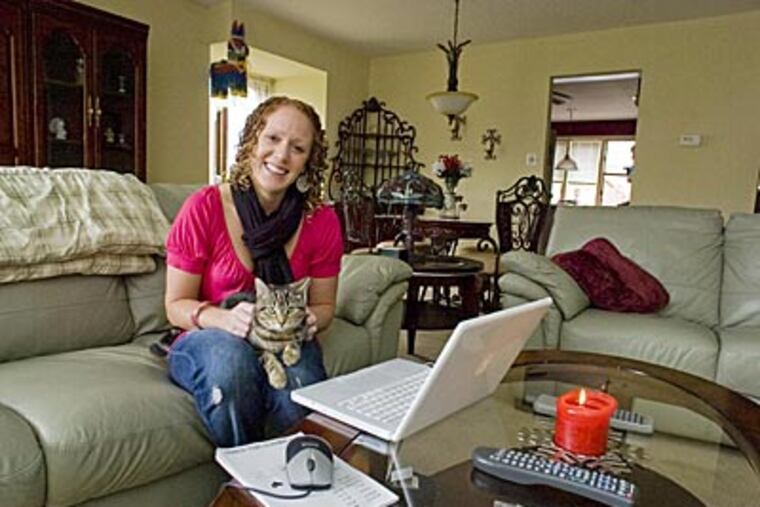
After searching nearly three months, Aglira, 28, found a roommate on Craigslist. The guidance counselor for a Philadelphia charter school moved in two weeks ago.
Through its off-campus housing office, the University of Pennsylvania offers to students a list of housing options - including rooms for rent in surrounding city homes. Yet in the last six months, the service has experienced an influx of new subscribers, many first-time landlords who decided to clear out an extra bedroom or third floor. And now requests for boarders are coming from houses as distant as the Philadelphia suburbs.
Renting out part of the family house was a common practice in the late 19th century. One in four homes involved some form of boarding in 1900, says Richard Harris, an urban geographer at McMaster University of Hamilton, Ontario. The host family often provided cooking and laundry for the guests, which sometimes included whole families. But as more Americans moved into single-family homes, the arrangement waned in the early 20th century. By 1950, boarders and roomers were largely out of the picture.
Now that it's making a comeback, those who feel compelled to take on a boarder should make the most of it, says Farley, the Temple psychologist. "You're not just making money, but getting to know someone else. Every family can become a little insular - here you might have an opportunity to bring someone else in who has a different outlook and experience and, we hope, is a likable and decent person."
Taking on a roomer won't be too difficult for Susan Martino, a laid-off hair salon manager, who grew up with boarders living in her home. Her Irish great-grandmother began the family tradition by lodging boarders in the family house in Germantown. Now Martino, who lost her job in December, is looking for someone to live in the three-bedroom home she and her husband, John - also a hairdresser, also laid off - bought in Aston two years ago.
Like her great-grandmother, Martino keeps an open-door policy. Her home is often filled with relatives and friends - her mother lives there, as did an uncle who passed away a few months ago. They have keg parties by the backyard pool on holidays, and everyone in the house, it seems, is trying to quit smoking. "I had a friend of mine living with me for two years - he was just part of the fixtures," says Martino, 44. "My girlfriend lived here, then her boyfriend moved in. We've had every stray imaginable. It's not like we're not used to it."