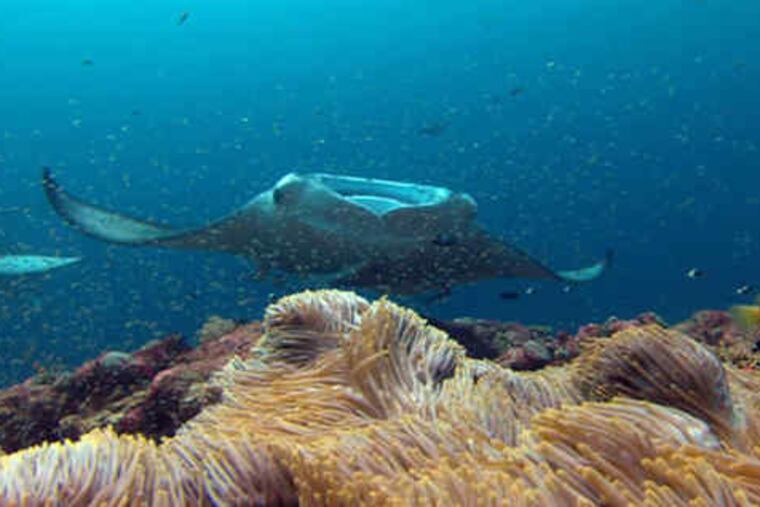
Take a deep breath and dive in. Beginning Monday you can experience the universe beneath the surface of the waves while taking an "Ocean Odyssey" at the Academy of Natural Sciences.
"Ocean Odyssey" is a high-definition film made by ocean conservationist Feodor Pitcairn, 74, who traveled the far reaches of the globe to make it. From diving with sea lions in the kelp forests of California to filming a massive school of hammerhead sharks in the Galapagos Islands as they swam above him, Pitcairn brings the depths of the ocean to the big screen.
"The thing that has always intrigued me about the ocean," said Pitcairn during a recent visit to the Academy, "is that it still retains its flavor of wilderness."
For example, "we went to one of the most beautiful coral reefs in the world called Raja Ampat, which is way over on the Eastern end of Indonesia where there were just miles and miles of beautiful pristine coral with one of the richest fish and marine populations I've ever seen."
Pitcairn, a Bryn Athyn native, fell in love with the ocean as a kid and became interested in photography shortly thereafter, acquiring one of the first high definition cameras in the country.
He pursued filmmaking as a hobby until 1991, when he left his family's business to devote all his time to underwater exploration.
"It's a very interesting kind of job. I'm one of those lucky people that really have a hard time distinguishing between work and play."
Pitcairn's "Ocean Odyssey" is part of his contribution to a permanent exhibition in the Smithsonian Institution National Museum of Natural History's Sant Ocean Hall, which opened last year.
The exhibit is one of the largest ocean displays in the country. Pitcairn's images are projected onto the architectural medallions of the renovated hall, creating 225 linear feet of ocean images.
The effect is amazingly life-like. "I love the response - people were asking how they could feed the fish up there," said Pitcairn. "You feel like you might be walking and looking through the windows of the ocean."
This sense of awe is replicated in Pitcairn's film. One of the most remarkable moments in "Ocean Odyssey" is rare images of a mother humpback whale and her calf.
"We very cautiously approached that mother and calf," said Pitcairn.
"The mother, during the early days when we were diving with her, she'd take her giant flippers and slowly spread them out, like fighting language.
"We would respect that and actually day by day we got more into the confidence of this mother until actually, by the last week we were there, we were able to approach the calf while it was nursing from the mother."
David Mattila, the Science and Rescue Coordinator of The Hawaiian Islands Humpback Whale National Marine Sanctuary, told Pitcairn it was the first footage he'd ever seen of a calf's tongue wrapping around the whale's mammaries.
All of Pitcairn's footage is clean ocean blue.
"It was interesting because when we were doing the Smithsonian project, some of the staff members said 'Well, maybe we're showing the ocean too beautiful.' I said 'Well, I don't film old tires and green algae.
"The good thing is, I think everybody came to the consensus that what we're trying to do is inspire people with how beautiful a really wild ocean and beautiful ecosystem can be. That's the starting place I think for anything. Unless you inspire people and create affection for this wonderful ocean, who will care?
"This is making people care by showing them the excitement and the wonder of this ocean."
Pitcairn and his team worked with film shot over 10 years to create "Ocean Odyssey." The 57-minute film includes footage from the Galapagos, Raja Ampat, Maldives, Azores, French Polynesia and Belize. *
The Academy of Natural Sciences, 1900 Benjamin Franklin Parkway, will screen "Ocean Odyssey" at 2 p.m. Monday-Friday, 2:30 p.m. Saturday-Sunday, beginning Monday through April 19. Free with museum admission.