Galleries: Expanding on China's venerable ink painting
Contemporary Chinese art is everywhere you turn these days, from Gagosian and PaceWildenstein galleries to Princeton University, not to mention China. It has now arrived in West Philadelphia, too, courtesy of Drexel University and its Antoinette Westphal College of Media Art & Design, which have brought "Ink Not Ink," a sprawling traveling exhibition organized by China's Shenzhen Art Museum, to three buildings on Drexel's campus.
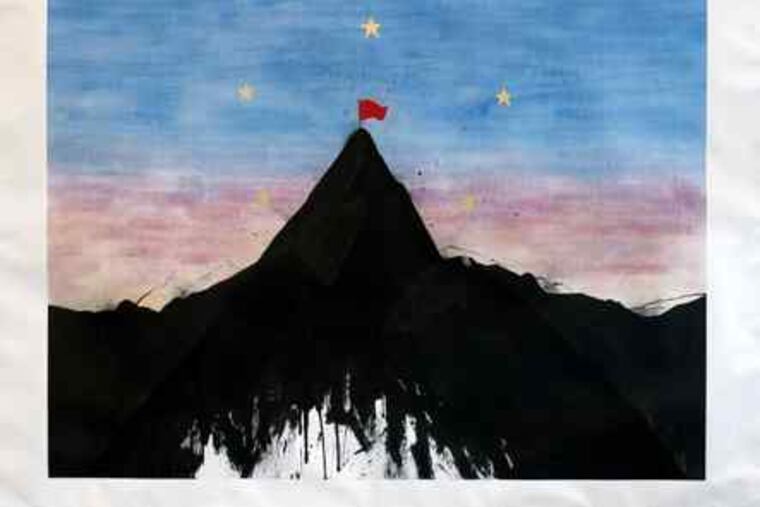
Contemporary Chinese art is everywhere you turn these days, from Gagosian and PaceWildenstein galleries to Princeton University, not to mention China. It has now arrived in West Philadelphia, too, courtesy of Drexel University and its Antoinette Westphal College of Media Art & Design, which have brought "Ink Not Ink," a sprawling traveling exhibition organized by China's Shenzhen Art Museum, to three buildings on Drexel's campus.
"Ink Not Ink" was not intended as an overview of cutting-edge contemporary art in China, though it claims a few stars in its midst. But the idea behind the 40-person show was radical enough in its own way, which was to present a selection of living artists who were expanding on Chinese art's most venerable and well-known medium, ink painting.
If that sounds like a strange development - haven't artists always eschewed the old stuff? - consider that contemporary American artists have been silhouetting, embroidering, pin-pricking, paper-cutting, and working with mammoth cameras during the last 15 years or so. The Chinese are doing the same, more or less, by reinventing and subverting ink painting.
None of these artists has approached the freedom and explicitness of a Kara Walker silhouetted narrative, truth be told, but you sense that some of them would if they were working outside China.
Zheng Qiang's ink paintings of Chinese women posing provocatively (think Kate Moss in the current Longchamps ads) travel about as far from traditional ink painting in subject matter as you can imagine, but have the format and techniques down pat.
The same could (sort of) be said of Cao Baoquan's disturbing paintings of naked men lined up in rows at a bath house - I'm sure I'm not the only person who has immediately thought of concentration camps, not a relaxing swim - and Li Xiaoxuan's similarly haunting images of naked and partially disrobed homeless-looking people in otherwise everyday urban scenes, which in both cases read instantly as ink paintings, too.
At the same time, there are pieces here that seemingly borrow very little from ink painting, but that add to the open-minded character of the exhibition. Among them are Tao Aimin's solemnly beautiful The Female Characters, an installation of garment-washing boards and thread-bound books whose rice-paper pages are printed with the ridges of the washboards like gravestone rubbings, or Peng Wei's mannequin sculptures dressed in hemp-paper confections.
Wenda Gu's bannerlike piece suspended in the lobby of the I.M. Pei-designed Bossone Center and made of nothing more than hair and glue is the show's most spectacular contribution. As the sun filters through it, you realize it's a gigantic drawing in the air. Every work in this show is masterfully constructed, by the way, no matter its medium.
After seeing the works in the Bossone Center and the Paul Peck Alumni Center, walk a block west and across Market Street to the university's Leonard Pearlstein Gallery, which has the fewest works of the exhibition's three venues, but a memorably quirky and melancholy ink-painting animation by Qui Anxiong.
That alone should tell you how far Chinese ink painting has come.