Dire dance, upbeat creator
Martha Clarke's sinister "Sandman" creeps in to Phila. starting tomorrow.
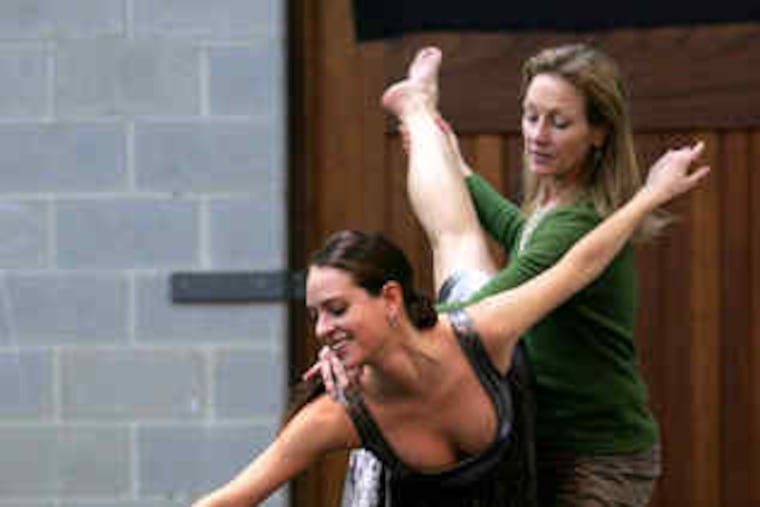
As the early-April closing of her New York hit
Garden of Earthly Delights
loomed, choreographer/director Martha Clarke was bringing a new work to life in Philadelphia with Jeanne Ruddy Dance.
Clarke's Sandman is the last piece in Ruddy's three-year guest-choreographer project (the others were by Jane Comfort and Suzanne Linke). Its sinister spareness will contrast starkly with Ruddy's lighthearted Lark in the program that runs from tomorrow through April 26 at the Performance Garage, Ruddy's dance space on Brandywine Street.
Clarke says emphatically that she based her imagining of Sandman on the dark photography of Diane Arbus - but visions of Marat/Sade or Ken Russell's The Devils can just as easily invade a viewer's mind. Her work restores the medieval through the surreal; she's drawn to fairy tales and imaginative reveries.
"Dreams are the sandbox I play in," she said one rainy afternoon after rehearsal in the apartment Ruddy maintains for artist residencies, where her Pomeranians Sofie and Pie settled in for a nap as we spoke.
It was hard to reconcile Clarke's lurid, vivid imagination with the unassuming person sitting there - like finding out Salvador Dali's works were in fact created by the nice lady next door.
A founding member of Pilobolus, Clarke, 64, now independently choreographs and directs dance, theater and opera. In person, she's an upbeat woman who loves to garden, watch films, and ride her 19-year-old Percheron, Mr. Gray, around her tranquil Connecticut property with its lovely, sparely furnished cottage.
Examples of the visual arts - photography, film, and particularly painting - have always driven Clarke to animate them into staged works that could be called not performance art but performed visual art. Although some say this isn't dance, only dancers - used to expressing ideas and feelings with the body - can do it.
As a theater artist, her dark, primal works look eerie, even creepy, evoking the theater of Tadeusz Kantor or the paintings of Hieronymus Bosch or Goya. She drew inspiration for her 1984 triumph Garden of Earthly Delights from the Bosch triptych of the same name; her re-envisioning of the piece opened in November to critical raves - "beautiful and horrifying . . . phantasmagorical," "utterly spellbinding," "eerily hypnotic" - and earned her a Lucille Lortel Award nomination for outstanding choreographer.
Now she was grieving like a mother over a lost child at Garden's impending April 5 closing, in part because her son, jazz pianist David Grausman, is one of its producers. "I love his humor and he's my best friend," she said, "and I'll miss the time with him when it closes."
The updated piece had daring aerial work created by San Francisco's theatrical specialists Flying by Foy. Aerial work has been part of many of Clarke's past works - her Hans Christian Andersen, A Midsummer Night's Dream, and others.
But it won't be happening in Sandman because "Jeanne's flyspace isn't high enough," Clarke said. "And there isn't a lot of electrical power," she added, "so we'll put gels on the windows and send light streaming in from the outside - like moonlight."
Our long conversations covered many topics and people. Clarke's resumé includes productions on the great stages of the world and associations with giants of experimental theater - Peter Sellars, Robert Wilson, Charles Mee. "I am such an admirer of all the people I've mentioned. Yeah, they've laid skin on me."
Clarke herself has won numerous grants and awards, including a 1990 MacArthur "genius" award. What did she do with it? "Fixed the top floor of my house, and then I tried opera," she said, breaking up at the absurdity of the sentence.
And how did she meet Ruddy? Their mutual costumer, Jeffrey Wirsing, "was kind of the marriage broker between Jeanne and me. I met Jeffrey when I worked at Graham," Clarke said. Ruddy and Clarke both danced with Martha Graham (after whom Clarke is named), though in different periods. And she was taken with Ruddy's Performance Garage.
"When I saw the space, I loved it, it's beautiful," and changing venues so often "keeps me fresh," she said.
On another gloomy afternoon just after Lark's first run-through with costumes, Ruddy and Wirsing sat down in the studio's office to talk. The piece is completely non-narrative, a departure from Ruddy's often story-structured works. Yet a subtle storyline emerges as its five dancers explore the space between them and, as Ruddy put it, "it opens into a mature expression of longing and connection."
Ruddy's love of Haydn's music and 18th-century fashion inspired her, but she didn't want a period piece. "The Haydn" - his String Quartet No. 5 in D major - "had enough space in it, but I wanted something more contemporary," she said. So in August she asked Ellen Fishman-Johnson, a former collaborator, to "enhance" the piece.
"She stepped off the Haydn, creating something new. In the actual Haydn the third movement is a very fast minuet," she said. "But Ellen's version had this bouffon kind of feel to it. So there I put more whimsy into it."
As for costumes, "Jeanne did have something very specific," Wirsing said. "She wanted me to update the 18th-century fashion into something modern and pretty, but cool." He shopped for fabrics that would "have just the right swirlability, and, for the coolness, shades of silvery gray."
Back down in the studio Ruddy and I watched Clarke working with the company of six, some of whom were wearing masks - another departure for Ruddy's dancers. I remarked that Sandman had evolved from the week before, and Ruddy said, "Yes, but Martha says it's like watching grass grow."
PBS made a documentary on Clarke in 1981, called Light and Dark; Ruddy calls this new program "Juxtapose," for its contrast between her light and Clarke's dark.
While Ruddy left her earlier dark-themed works for this more abstract, springlike work, Clarke must heed surrealist Andre Breton's dictum, "Leave the substance for the shadow." In the theater, that's where she lives.