Galleries: In abstract painting, a discussion of lines, color, edges
Since her last show at Locks Gallery, in 2006, Pat Steir's abstract paintings have become even more allusive to the work of Barnett Newman, and she's also paying homage to Ellsworth Kelly. This is not to say that she is in any way appropriating the minima
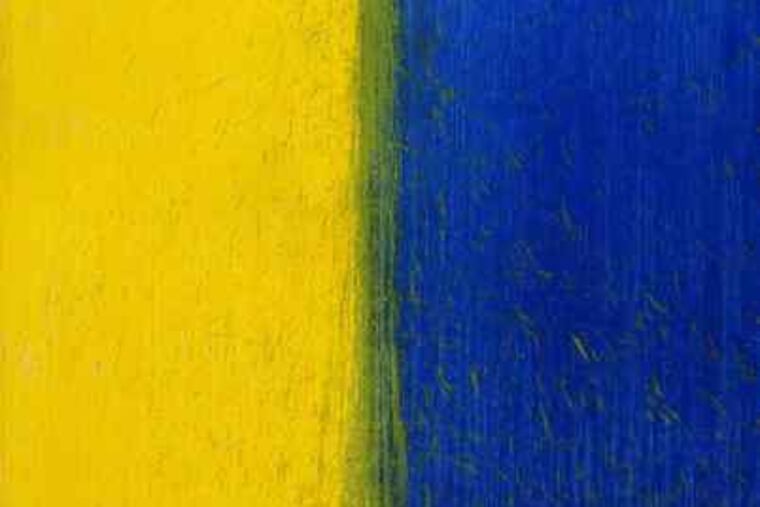
Since her last show at Locks Gallery, in 2006, Pat Steir's abstract paintings have become even more allusive to the work of Barnett Newman, and she's also paying homage to Ellsworth Kelly. This is not to say that she is in any way appropriating the minimal abstraction of these 20th-century masters. Instead, you might say that Steir, who has had a very recognizable style of her own for more than two decades, is having a conversation in paint on canvas with Newman and Kelly. To simplify matters, she's divided all her new canvases in half, an organizing principle deployed by both artists at various times.
Steir has been referencing Newman and his "zips" - those vertical stripes of color that divided his monochromatic canvases - for some time now, though she keeps the edges of her stripes soft, splashy and blurry. Kelly's more recent influence on Steir seems to have encouraged her to pursue a starker contrast between her combination of grays and blacks and bright reds and yellows - canvases that can bring Mondrian to mind as well.
In Spectrum Painting, Red and Blue, and Yellow and Blue, three paintings composed entirely of colors, Steir puts vivid reds, oranges, yellows, blues and greens through her own blizzardy paint application - as organic a handling of paint as Kelly's is chaste (Newman was a little less tidy than Kelly is). In color, the splattering effect she has achieved so memorably in white on black and silver - and which can, in fact, bring to mind a snowstorm - suggests a meditation on the blurred line between colors, compositions, and artists' signature styles.
The Helenic era
Those who've kept up with Philadelphia's gallery scene over the years know of Helen Drutt and the contemporary crafts gallery on Walnut Street that bore her name for several decades. (In fact, Helen Williams Drutt English has won recognition throughout the United States and abroad for her expertise in modern and contemporary crafts.)
What they may not realize, however, until they see the Clay Studio's current exhibition, "A Passionate Observer: A Tribute to Helen Drutt," is that Drutt, who now organizes exhibitions for various venues, has championed the careers of most of America's best-known ceramic artists.
The 48 gathered here include some of the pillars of American ceramics. The late Robert Arneson's Chief Executive Officer/Rapist & Drug Dealer (1989), comprising two glazed ceramic portrait busts, says everything there is to be said about stereotyping and shows the father of funk art at his controversial best. The late Peter Voulkos, who brought the energy of abstract expressionism to ceramics, is remembered with one of his rough-around-the-edges, gestural wood-fired plates from 1993.
Ruth Duckworth, a sculptor and ceramicist who is now 90, and whose modernist style is the polar opposite of Arneson's and Voulkos', is represented by her elegant porcelain Candelabra from 1973. Betty Woodman, Richard DeVore, Rudolf Staffel, David Gilhooly, Paul Soldner, Jun Kaneko, and Toshiko Takaezu round out this group.
The younger artists' standouts include Michael Lucero's whimsical, suspended, figure-like Untitled (1982); Jill Bonovitz's delicate porcelain vases; Lizbeth Stewart's gigantic painted-earthenware rendition of a pair of human feet with birds on and near them; Sun Koo Yuh's glazed porcelain hippie figures; and Chris Berti's charming, outsiderish birds and animal carved from antique bricks.
Cut-paper constructions
Seemingly everyone has taken to cutting paper these days, but Stephanie Beck's cut-paper constructions at Rebekah Templeton Gallery reference the human-built landscape more than they do domestic practices of the past. You think first of architectural design and technology, in other words, not of doilies and Mexican Day of the Dead decorations.
You also sense that Beck's constructions are based on aerial views of the topography of developed landscapes, though to look at a piece like Museum Complex, you have to wonder if she had access to architectural models for a real museum. Her all-white paper pieces of raised areas of housing are clearly painstakingly crafted and made me think of Braille and what a sightless person's fingertips would make of such surfaces.
Her colorful, circuit-inspired pieces are more Day of the Dead in hue and style, and their complex overlays of city-based designs resonate with a sense of terror and havoc.