New Recordings
Pop He's been making well-received albums since the '80s, but Willie Nile hit a career peak in 2006 with the epic Streets of New York. It would seem he'd have a tough time topping that achievement, but Nile pulls it off with House of a Thousand Guitars.
Pop
Willie Nile
nolead ends nolead begins House of a Thousand Guitars
nolead ends nolead begins (River House ****)
nolead ends He's been making well-received albums since the '80s, but Willie Nile hit a career peak in 2006 with the epic Streets of New York. It would seem he'd have a tough time topping that achievement, but Nile pulls it off with House of a Thousand Guitars.
From the hard-rocking title track that opens the set with its conjuring of a musical pantheon (Hendrix, Robert Johnson, Hank Williams, John Lennon, etc.), House of a Thousand Guitars possesses a grand sweep while remaining firmly grounded. There are plenty of bracingly loud, fast rockers, but Nile's incredibly rich vision also encompasses sweet, melodic pop ("Her Love Falls Like Rain") and stately piano ballads ("Touch Me"), just as his heart-on-his-sleeve romanticism is tempered by clear-eyed reality ("Now That the War Is Over"). They don't make 'em like that anymore? Well, Willie Nile just did.
- Nick Cristiano
nolead begins Depeche Mode
nolead ends nolead begins Sounds of the Universe
nolead ends nolead begins (Mute/EMI ***1/2)
nolead ends With Depeche Mode's 12th studio CD, baritone vocalist and recently flourishing songwriter David Gahan, principal songwriting instrumentalist/angelic singer Martin Gore, and, um, the other guy do something odd in comparison with the band's recent bombastically rocking albums.
Depeche returns to the tone, texture and electronic instrumentation of its early '80s incarnation while maintaining its lustfully potent and moving songcraft. Other than the manically cocksure "Wrong," there's a lulling subtlety to the proceedings - low-key yet epic, in a manner akin to what U2 did with their newest album, No Line on the Horizon. While "In Chains" stews quietly to allow Gahan a charming falsetto break, tinny drum machines and antiquated synths grumble along with a brand of minor majesty. That meeting of mechanical nuance, noise, and Gahan's youthful ebullience fills "Fragile Tension" and "In Sympathy," too. By the time they hit upon "Perfect," they're very nearly plinking. Yet, Sounds doesn't near retrospection, unless you count ruminations like "I'm leaving bitterness behind/ this time I'm cleaning out my mind," from "Peace."
From the Killers to Coldplay, bands good and bad are acknowledging the 30-plus-year-old Mode and talking up the influence of Britain's divine synth mopes. Remember: Johnny Cash covered the Mode. Take that, Spandau Ballet.
- A.D. Amorosi
nolead begins Paleface
nolead ends nolead begins The Show Is on the Road
nolead ends nolead begins (Ramseur ****)
nolead ends The singer-songwriter known only as Paleface has had a career littered with lost shots at fame. But along the way he influenced his old roommate Beck and fell in with New York City's turn-of-the-millennium anti-folk scene. Now that he's finally on a reliable label, this umpteenth album sees Paleface mostly graduating from rickety folk to sturdy Americana, thanks to drummer/singer Monica Samalot and frequent collaborators the Avett Brothers. From the full-band bounce of "You're the Girl" to the bluesy scratch of "The Cheatin' Song," these tunes feel less like outsider art than lost classics scrubbed shiny-clean. It also takes guts to write a new song called "New York, New York," but Paleface has done it and it's the best track on this terrific disc, a deserving breakthrough disc.
- Doug Wallen
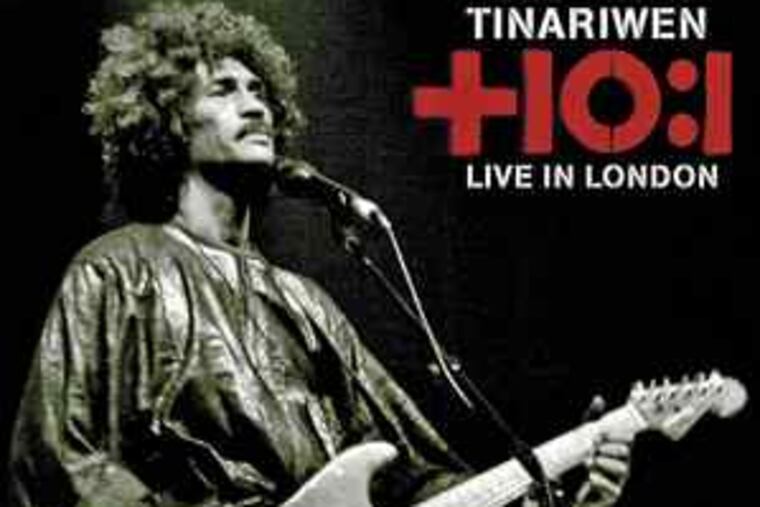
nolead begins Tinariwen
nolead ends nolead begins Live in London
nolead ends nolead begins (World Village ****)
nolead ends As predicted, the masterful Mali-based Tuareg ensemble Tinariwen dropped jaws at the Coachella Festival last weekend. LA Weekly hailed the sunset performance of their Sahara nomad blues in the California desert as "transformative" - and the three-day festival's best set.
This 12-song December 2007 concert DVD nicely conveys Tinariwen's magical allure, a mesmerizing blend of percussion and handclaps, dusty lead vocals aspirated with soul-cracking melisma, keening/cooing back-ups, and, most intoxicatingly, those signature spidery guitar lines.
Ibrahim Ag Alhabib, a.k.a. "Abaraybone," is the septet's focal point, celebrated creator of the blues-rockish Tamashek (Tuareg for "Tuareg") electric-guitar style. Added features include a Tinariwen mini-documentary and a 50-minute fireside interview with Abaraybone relating the story of the wandering group's early '80s founding in Algerian and Libyan refugee camps. But what closes the deal is the unhurried groove of cuts like "Cler Achel" and "Assouf," the latter propelled by deeply bewitching guitar work.
- David R. Stampone
Country/Roots
John Rich
nolead ends nolead begins Son of a Preacher Man
nolead ends nolead begins (Warner Bros. **)
nolead ends John Rich opens his new album with its best and most-talked-about song. "Shuttin' Detroit Down" may be short on nuance, but it powerfully taps into the national anger over corporate excess and the dire consequences for regular folks. It's well known that Rich comes from the right - he was a vocal McCain supporter - but "Detroit" maintains a nonpartisan thrust.
The rest of Son of a Preacher Man is earnest but pedestrian mainstream Nashville fare. Rich hits bottom with the cliche-driven "Trucker Man" and the dim-witted country-rocker "Turn a Country Boy On," while faring better with ballads such as "Preacher Man" and "Why Does Somebody Always Have to Die." In the end, he is more appealing on his own than as part of Big & Rich, which gives an idea of how little we think of that hit duo's off-putting blend of forced hilarity and mawkish sentimentality.
- Nick Cristiano
nolead begins Scott Miller
nolead ends nolead begins For Crying Out Loud
nolead ends nolead begins (F.A.Y. ***)
nolead ends Since his days leading the V-Roys, an excellent roots-rock band that was signed to Steve Earle's now-defunct E-Squared label, Scott Miller has been a stubbornly independent and hard-to-pin-down troubadour.
On For Crying Out Loud, the Knoxville-Tenn.-based Miller again displays a vibrant mix of smarts and down-home directness on a stylistically diverse set that reflects his background as a farm-raised Virginia boy with a history degree. "Cheap Ain't Cheap (For Crying Out Loud)" opens the album with a rocking blast that both laments and rages against the current hard times, while the breakneck "Claire Marie" seems to channel Jerry Lee Lewis.
Miller and his current band, the Commonwealth, can do more than rock, however. The clever "Sin in Indiana" leans toward country blues, "I'm Right Here, My Love" is a devotional country-folk duet with Patty Griffin, and "Heart in Harm's Way" is a slice of sweet soul. In none of these instances does Miller sound as if he's affecting a pose.
- N.C.
Jazz
Bill Frisell
nolead ends nolead begins The Best of Bill Frisell
Vol. 1 Folk Songs
nolead ends nolead begins (Nonesuch ***1/2)
nolead ends Drink in the cornpone-ness of it all.
Guitarist Bill Frisell projects his unique, metallic sound all over these traditional songs. The feeling could often be categorized as country, but Frisell doesn't stay locked in. He improvises wherever he goes, and even drops in some classical Spanish guitar feeling on "Rag."
And while he's never terribly fast, he could qualify as a lover with a slow hand. The tunes are clear and never busy. Frisell is like Miles in that what he doesn't play is as important as the lines he presents.
The tunes are drawn from eight of Frisell's Nonesuch recordings, going back to 1992's Have a Little Faith. So this is a summary recording for newbies or a fast way to access the vaults for fans.
Frisell revels in the simple arcs of these tunes. "Shenandoah," with guitarist Ry Cooder, is a train full of lyricism with cinematic chords full of ache and grandeur, while "Mr. Memory" is closer to a hoedown that never quite seems to break out. "Poem for Eva" could be a dreamy 1950s teen dance tune.
- Karl Stark
nolead begins The Tiptons Sax Quartet
nolead ends nolead begins Laws of Motion
nolead ends nolead begins (Zipa!/Spoot Music ***)
nolead ends Dip into the Tiptons.
This all-woman saxophone quartet is named after pianist and big band saxophonist Billy Tipton, who hid her femininity for 50 years. Her existence as a woman was not discovered until after her death.
The quartet, with lead composers Amy Denio and Jessica Lurie, gravitates to funk and the bitter edge, using both saxes and voices. The group's diverse experiences are embedded in the set, especially Lurie's Eastern European chops and her 1990s sojourn in Seattle's jam-band scene with the Living Daylights.
Sue Orfield on tenor sax and Tina Richerson on baritone sax and voice traffic in more traditional jazz and blues.
Drummer Chris Stromquist, the lone testosterone rep, helps drive this congregation, which sashays to the snake- charming lines of "Yugo A Go Go," identified here as a traditional Gypsy tune. The tune rocks whatever its provenance. "Anthem" sounds like more traditional jazz, recalling Bobby Watson's 29th Street Saxophone Quartet, while "Mi Yo Mei," a traditional Taiwanese ditty, creates a far mellower vibe.
- K.S.
Classical
Schubert
Piano Sonata No. 20
in A Major, D. 959
and Six Moments Musicaux
nolead ends nolead begins Martin Helmchen, pianist
nolead ends nolead begins (Pentatone ****)
nolead ends Martin Helmchen brings a terrifically polished tone to this popular Schubert sonata. His interpretation is personal without being self-indulgent. Phrases are conceived in long breaths. His tone is crystalline. Yet the German pianist endows all that refinement with a sense of story it rarely gets - not by way of great exaggerations, but through moderate, judicious ones.
Helmchen is adept at telegraphing emotion in two other specific ways. His sensitivity to articulation is a remarkable thing to track. Certain notes, when connected, send a message of sincerity. Others, detached, signal something more lighthearted. His sense of voicing is no less thoughtful. When a particular note in a chord is emphasized, it's because the pianist is drawing attention to something you might otherwise miss, a specific moving voice that's responsible for propelling a harmonic progression. It all makes sense on an emotional level.
I particularly admire the way he parses out drama in the second movement. This stretch of music is Schubert's testimony to insanity, a merely mournful tune that devolves into an abyss so dark it approaches Mahlerian despair. Helmchen plays the opening sad waltz in an absolutely straitlaced tempo. When, about three minutes into the movement, the world begins to fall apart, it is all the more shocking.
He is similarly smart in pacing the last movement, rolling out the main theme, Schubert's great statement of freedom, in successively more liberated iterations.
- Peter Dobrin
nolead begins Daron Hagen
Shining Brow
nolead ends nolead begins Robert Orth, Brenda Harris, Robert Frankenberry, Matthew Curran, Elaine Valby; Buffalo Philharmonic Orchestra and Chorus, JoAnn Falletta conducting
nolead ends nolead begins (Naxos, two discs, ***1/2)
nolead ends Few living American composers have written more operas than Daron Hagen (six, at age 47), and among his most widely performed is the 1993 Shining Brow, about architect Frank Lloyd Wright. Imagining how it would work theatrically is difficult just from hearing the recording, but the ceaselessly inventive score hooks you early on, easily embracing a wide range of predominantly tonal modes of expression, from barbershop quartet to Der Rosenkavalier quotations. The music's theatrical timing and naturalistic sense of language - so problematic in other contemporary operas - feels effortlessly right. Dramatically speaking, the portrayal of the great architect is so unflinching that Wright (played with many layers of irony by the excellent Robert Orth) borders on being too unsympathetic to carry this sizable, two-act opera. Particularly effective is the musical creepiness that sets in as Wright's high-ego world grows refracted from reality. In many ways, this is an artist-as-monster portrait; such things need to be said, and some unstable but text-attentive vocalism in this mostly solid recording doesn't obscure what Hagen and librettist Paul Muldoon have so deftly projected.
- David Patrick Stearns