Preteens, 'Cezanne' show are connecting
Let's just say, it didn't hurt that the two paintings at the start of the Museum of Art's blockbuster exhibition were of guys in their swim trunks, and the people on the audio guide jumped in talking about homosexuality and nipples.
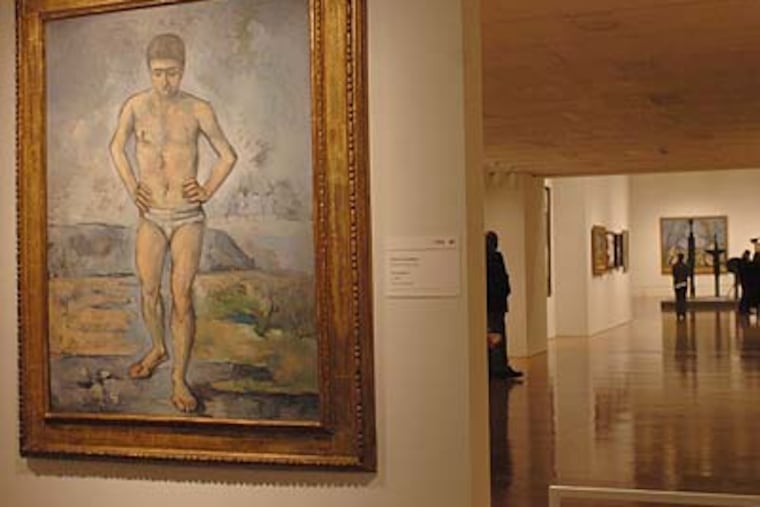
Let's just say, it didn't hurt that the two paintings at the start of the Museum of Art's blockbuster exhibition were of guys in their swim trunks, and the people on the audio guide jumped in talking about homosexuality and nipples.
"Cezanne and Beyond," I salute you. You totally got the attention of my children.
I could almost see the oxygen flooding to the brain of my sixth grader, who pointed out the nipple weirdness of Cezanne's The Bather moments before the guides in her ears did. And I could see the eighth grader punching the numbers into the audio set when moments before she had vowed not to.
Hey, maybe Mom is taking us to something interesting this time? Or maybe they're just getting older.
In any case, this show struck their fancy more than any I'd ever dragged them to (beginning with the last big Cezanne exhibition at the museum in 1996, when my older daughter was just a year old and needed nursing breaks). And they're not alone. The museum says nearly 5,000 students have been through the show, in school groups or with families.
I'd actually stopped taking my daughters to the big shows because between the crowds and the narrow focus, I saw that they were of less interest than an unprogrammed trip to a museum. ("Matisse, Picasso; Picasso, Matisse, we get it, Mom. Can we eat now?")
But "Cezanne and Beyond" gets it right. Because this exhibition focuses as much on the "Beyond" part - 18 other artists, many still living (an outrageously provocative concept in and of itself to a 12-year-old in a museum), whose work was influenced, inspired, or literally extracted from Cezanne's - as on Cezanne himself, the impatience I've encountered elsewhere never materialized.
And when your child walks out of the museum, sits on the steps, stares at the city, and starts talking about abstract artist Ellsworth Kelly like he's next up for a playdate, you know something has gotten through.
In many ways, it's these other artists - Ellsworth Kelly, Jasper Johns, Marsden Hartley (whose provocative Canuck Yankee Lumberjack opens the show), the photographer Jeff Wall - who steal this show (not to mention another dude named Picasso, but we've dealt with Pablo before). This show jumps and darts through styles, periods, artists, perspectives, media, dimensions, and generations, and it pulses with discoveries. Children of all ages see connections; everyone is analyzing form, color, and theme, deconstructing and synthesizing like it was just another app on their iPod Touch.
"It's within most people's abilities to find connections," says museum educator James Stein, who has trained teachers for the school groups, mostly fifth grade and up. "It's not intimidating. Almost anyone can play. And it's kind of true to the way the artists work, they make connections across time."
Works by an abstract artist like Kelly, which would make little sense out of context, light up with brilliance when placed directly next to the Cezanne paintings that contributed the idea.
Kelly's brown, bloblike, figure-8-ish bronze work Untitled might not even slow a kid down were it not directly next to Cezanne's Le Pont de Maincy, painted a century earlier: You see the arch in the bridge, and its reflection is precisely Kelly's now-subtle shape. (Stein tells students entering that room to find the work that most makes them wonder why it's in a museum.)
Similarly, Kelly's abstract Lake II, a triangular blue painted shape, looks like another one of those "I could have done that, Mom" experiences, except that you instantly see how the shape was extracted from Cezanne's The Gulf of Marseilles Seen From L'Estaque. Voila, 100 years of modern art compress into your 14-year-old's brain. (The similarly hued and shaped Cira Centre, visible from the museum steps, awaits, with another layer of discovery.)
Stein says it has been Jasper Johns who has most captivated the school groups, with his three-dimensional paintings of subject matter dealt with by Cezanne, like Johns' Drawer, 1957, with a drawer in the canvas, next to a Cezanne still life with the same drawer. "Students really seem to go for the Jasper Johns," Stein says. "Something about it really intrigues. I had a student ask, 'Is that a painting?' That's a really good question."
A Johns painting of a map of the states, a familiar kid image, is set so its colors and brushwork echo off of Cezanne's Mont Sainte-Victoire landscape.
Johns' Tracings After Cezanne, which he traced from a postcard from a Cezanne exhibition he saw at the Museum of Modern Art, are slyly placed where the original hovers on the edge of a 12-year-old's vision until the moment when it comes into startled focus. "Oh, they are from THAT." Yes they are. And there it is.
The inclusion of Jeff Wall photographs in light boxes also sucks in the kids. A 2006 photo of three women playing cards placed next to Cezanne's The Card Players from 1890-92 lends itself readily to "what's the same, what's different" analysis, in both form and content. Plus, it's an exceptionally cool image.
In the end, these two sisters, who play hearts by the hour, found themselves standing face-to-face with contemporary masters, their lives reflected in both the Cezanne and the Wall, their minds buzzing with epiphany and understanding.
This time, at least, they had earned their post-show meal.
Cezanne and Beyond
"Cezanne and Beyond" has been extended through May 31 at the Philadelphia Museum of Art, 26th Street and the Parkway.
Exhibition hours: Monday, May 11, and Monday, May 25, 10 a.m. to 5 p.m.; Tuesdays, Wednesdays and Thursdays, 11 a.m. to 5 p.m.; Fridays, 11 a.m. to 8:45 p.m.; Saturdays and Sundays; 10 a.m. to 6 p.m.
Information: 215-763-8100 or www.philamuseum.org.
EndText