Secret of the sweet spot
Finding that weirdly empowering, room-commanding place on each stage is part of making the magic of theater happen.
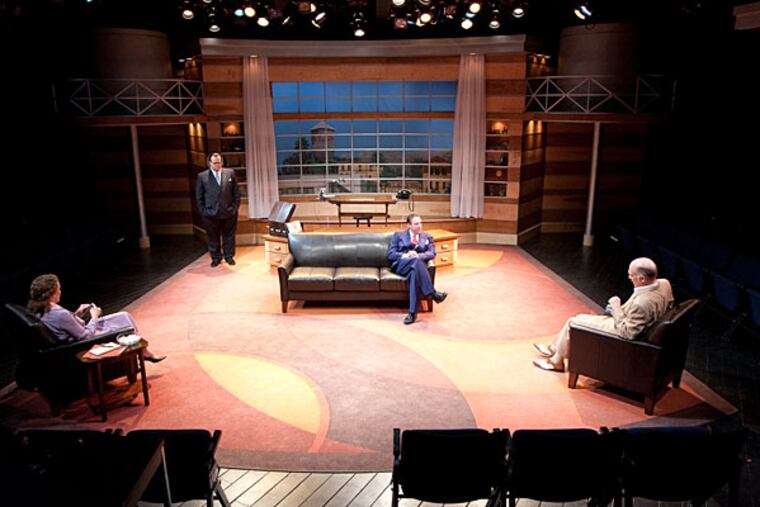
Night after night in Center City, versatile performer Scott Greer gravitates to a spot that may seem the least logical place for power acting - far to one side of the Arden Theatre stage, and back toward the rear. When he's there, though, he's in full command of Something Intangible, the world premiere about two Hollywood moviemaking brothers.
The magic spot, the folks at the Arden call it.
At the same time, eight blocks away, kinetic actor Geoff Sobelle declaims much of his Hamlet on a specific area of a jutting platform at St. Stephen's Theatre, where Lantern Theatre is presenting one of Shakespeare's greatest achievements. On that spot, the Bard surges through Sobelle - and out to each member of the audience.
The power spot, they call it over there.
On Friday, the cast of the forthcoming Philadelphia Theatre Company production of Grey Gardens will move from a cramped rehearsal space to the stage of the company's Suzanne Roberts Theatre on Broad Street. Once the actors rehearse among real sets and real stage dimensions, they'll probably come across them, in two different acts with different sets: the spots.
"It's an instinctive feeling you have," says Grey Gardens director Lisa Peterson, working on a traditional proscenium stage - unlike those that thrust out into the audiences at the Arden and Lantern. On a proscenium stage, the spot can be simpler to discern.
"It's about the magic of the room you're in," Peterson explains. "It involves the audience and the way they're seated and the rake [incline] of the house. You can guess in the rehearsal room - but you can feel it in the theater."
The magic spot. The power spot. For some, the hot spot. Traditionally, the sweet spot.
It's the place, says the Arden's Terrence J. Nolen, a director who seeks it out when he's creating a sense of storytelling, "where you can control the moment."
And there are plenty of moments to control in metropolitan Philadelphia these nights, where sweet spots abound as professional theater has become, even in this economy, its own growth industry - albeit a nonprofit one that depends heavily on personal and corporate contributions along with box-office hubbub.
You may not be aware of a sweet spot, which ultimately is almost always enhanced by lighting design, at any of the Philadelphia region's 34 professional Equity companies - theaters with contracts from Actors' Equity, the national union of pros. But they are there, part of the process of making all that theater happen.
"It's the place where you can most readily achieve a personal relationship with everyone in the audience," says Nolen.
In fact, he says, it's where each seat is equally exposed to the actor on the spot - even though in Something Intangible, the spot puts Greer's back to some audience members.
"But those are the people he's standing closest to, and they really feel him, they get him," says Nolen, who staged the very first scenes on the play's elegantly complex set 10 different times until a bulb flashed on in his head.
"I finally said, 'Stand there! That's clearly the magic spot!' Then, anything that was important in these scenes, we put him there. His major moments of revelation and discovery are there. He ends the play there."
Says Greer, "It's almost a completely different game when you get on the set, with real furniture. Often, what you thought was the strongest position is not, because of the size of a desk, or whatever."
An empty stage, especially a traditional proscenium, has its own sweet spot, usually somewhere toward the mid-front. Actor/clown Bill Irwin, now appearing in Waiting for Godot on Broadway, says he was toeing around the stage with other actors during a gala for the opening of the Suzanne Roberts theater in 2007, and " 'Aha!' We all looked at each other. We'd found the sweet spot."
At the Delaware Theatre Company in Wilmington, the natural sweet spot when the wider-than-usual stage is empty is so far toward the rear, it's "more than often covered by our sets," which, of course, create their own spots, says the company's artistic chief, Anne Marie Cammarato. "It's a very strange spot. If an actor stands there and whispers, it's like they're miked."
Cammarato, like some area directors, says the sweet spot is not a conscious concept for her. Nor does Wilma Theater's veteran artistic leader, Blanka Zizka, direct "in a conceptual way so that I think about it and it's like a magnet," she says. "My focus is more on understanding the text. The [sweet-spot] idea is more subconscious for me."
While the same is true for 1812 Productions' leader, actor-director Jen Childs, even so, a sweet spot eventually emerges. "I don't know that I consider it consciously - and I don't think I'd ever even call it the sweet spot. But you know it when you hit it. You know it's there."
Director David Bradley, who began rehearsals last week in Malvern for the People's Light & Theatre Company's June production of Doubt, doesn't think in sweet-spot terms, "but I'm always looking at what creates spatial relationships that are strong and heighten what's happening in the story."
In his production of Arthur Miller's The Crucible several seasons back, "we started to realize that, wow, this is a very powerful part of the stage, given the orientation [to the audience] and the set. I said, 'This is where it lines up for me.' "
Perhaps the weirdest local sweet spot is at St. Stephen's Theatre, on Ludlow at 10th Street, home of Lantern Theatre Company.
When pointing out the sweet spots for Hamlet - more than one, because of the multitiered playing area - Lantern artistic chief Charles McMahon went to the jutting-out corner of a wall that intrudes into the audience space. On the other side of the wall is the staircase that is the theater's main entrance.
McMahon, a builder and carpenter in another life, thinks in terms of sweet spots (which he used to call power points until the phrase was usurped). He put his back to the sharp right angle of the wall, which divides the audience on two of three sides of the thrust stage. He seemed far from the playing area - a first baseman, bent knees at the ready, but over by the right-field stands.
"Look at the way you can command everything over here," he beckoned, "and you're almost a part of the audience - but the focus is all on you.
"I know," he said, as if sharing a private treasure he'd discovered long ago, "it doesn't seem right. But it's a place of power. It works."
Contact staff writer Howard Shapiro at 215-854-5727 or hshapiro@phillynews.com.