Supernal sounds from 'odd' choir
Music as sophisticated, ethereal, and accomplished as that made by the choir called the Crossing doesn't often arise from singers who like being under the radar.
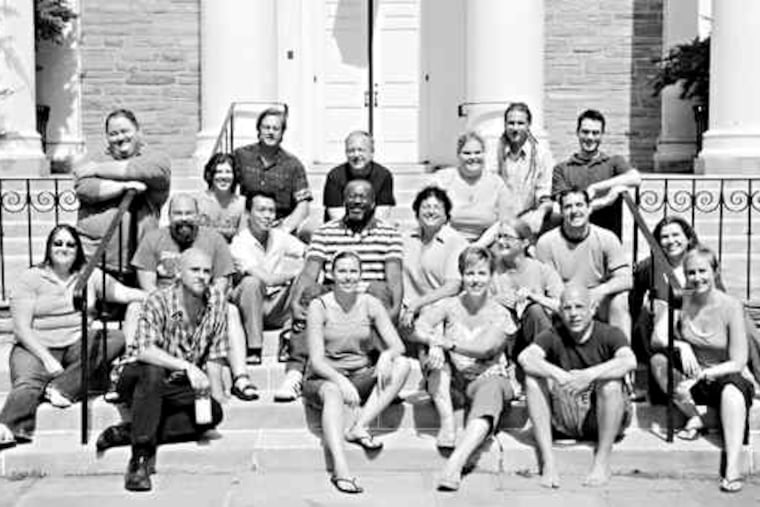
Music as sophisticated, ethereal, and accomplished as that made by the choir called the Crossing doesn't often arise from singers who like being under the radar.
Having come out of nowhere in 2005, the Crossing is now launching an ambitious "Month of Moderns" festival Saturday, with composers unknown to Philadelphians, at the Presbyterian Church of Chestnut Hill. But it probably would sing whatever the exterior circumstances - in a choir whose singers are there as much for their openness to adventure as their voices.
"Ordinarily, it's quite hard to do what you want, but it's been easy here because everyone is on the same plane," says founder/director Donald Nally on why the Crossing exists, however sporadically and without support staff. "It's an odd group."
The closest thing to a central office is a Web site, www.crossingchoir.org, and publicity is minimal. In other words, there's nobody who will pressure Nally into programming Mozart. But concerts are usually full anyway, partly because there's nothing remotely similar in the community, partly because Nally, 48, has a following and a reputation for commissioning viable new works.
He lived in Philadelphia between 1992 and 2004, conducting the Choral Arts Society, the Opera Company of Philadelphia choruses, and the St. Mark's Church Choir. Now, he has one of the most prestigious choral jobs in the country: chorus master of Lyric Opera of Chicago.
Still, he sleeps on other people's sofas when here; he looked for a small apartment for himself and his partner but is constantly sinking his personal finances into the operation. Just one of the new pieces in the festival cost $657 to rent parts - not counting shipping from Amsterdam. Nally's rationale is this: "When I die, I'll know that I did music I wanted to do."
"That's admirable!" said a slightly stunned Bo Holten, the eminent 60-year-old Danish composer who is a focal point of the current Crossing season. He'll visit in a few weeks to check out these newfound devotees.
What he'll find: Ages range from 21 to 51 in a nucleus of 23 singers. Hair ranges from dreadlocks to none at all. Pay was as low as $100 a concert in the beginning, so, lucky for them, some singers were changing into concert tails after last Saturday's rehearsal to sing The Damnation of Faust with the Philadelphia Singers Chorale at the Kimmel Center. Others sang the Opera Company of Philadelphia's L'Enfant et les Sortileges performance at the Academy of Music. Singing church services is their living - as far away as Scarsdale, N.Y. With all the crisscrossing, is its name any surprise?
Most of that conventional choral work, though, is light-years from the Crossing's repertoire. The group's first recording is Kile Smith's Vespers, which is probably the only new choral work accompanied by a Renaissance wind band. Path of Miracles by British film-music composer Joby Talbot, which opens the Crossing's festival Saturday, is inspired by a 12th-century manuscript of Spanish music titled Codex Calixtinus. Talbot's brand of miraculousness doesn't always feel happy: The opening chantlike drone of voices rises with excruciating intensity.
Tenor Jeffrey Dinsmore doesn't hesitate to describe the music as "extreme," though the first day of rehearsal may well start at a level many amateur choirs don't reach until performance time. Explaining the music, Nally has poetic flights, comparing Talbot's sense of spiritual hesitation to "you want to meet Jesus but you don't want to die." More technical directions are in shorthand: "You're doing that thing again." Pace is fast. A two-rehearsal day with Nally, says baritone Dan Spratlan, is like eight hours of physical labor in the hot sun.
"I never have to worry about how I speak to them. 'The vowel is wrong. Fix it,' " says Nally, who likes to rehearse barefoot and can be as informal as he is intense. "It's not like working in the U.K. where you have to say, 'Would you please consider ...?' I say correct the f- problem and move on!"
Though atypically progressive among Philadelphia choruses, the Crossing is part of a larger zeitgeist of small, handpicked choirs often not based in great urban-culture centers. In part, they're inspired by Europe's subsidized superchoirs (like the Swedish Radio Choir) or U.S. early-music groups like Chanticleer and Anonymous 4, which branched out to modern and ethnic music. Among their eclectic descendants are Conspirare in Austin, Seraphic Fire in Miami, and the Esoterics in Seattle.
What came first, choruses or new repertoire? Both.
Only 20 years ago, choral composers were marginalized, writing in a conservative idiom easily encompassed by amateur groups. In the 1980s, new harmonic possibilities came from unlikely places in Europe, such as the Bulgarian Women's Choir, whose folk-based music with vertigo-inducing harmonies enjoyed an international vogue. In their wake, Baltic figures such as the holy minimalist Arvo Part and folk-based Veljo Tormis had international followings.
Now, youngish composers become overnight sensations - Morten Lauridsen with astonishingly lush harmonies and Eric Whitacre with his magical 3-D descriptive effects. Choirs follow them into the limelight. When British composer Tarik O'Regan, 31, was asked to record a disc of his music, he turned to Conspirare, resulting in The Threshold of Night, which spent four weeks on Billboard magazine's Top 10 classical chart and was nominated for a Grammy. Now, Conspirare's TV special, A Company of Voices, is making the rounds on PBS.
The 2008 Pulitzer Prize in music went to precisely the kind of piece the Crossing champions - David Lang's The Little Match Girl Passion, just released on Harmonia Mundi. Though Copenhagen-based Holten has moved on to opera (his The Visit of the Royal Physician is now a hit at the Royal Danish Opera) he won't leave choral music behind. "I think it's the closest trigger to the human heart," he said in a phone interview.
Nally habitually spends an hour a day tracking down little-known new works. Unusual as that is, he doesn't consider his return to Philadelphia the deciding factor in the Crossing's formation: "It's not me that came back. We came together."
Nally would seem to have had an effortless career arc: Born in Hilltown in Bucks County and educated at the Cincinnati Conservatory among other places, he cut a wide swath through Philadelphia before going to the Welsh National Opera and then Lyric Opera of Chicago. He wasn't always patient - or beloved. From memory, Nally recites a letter he received from one of his Philadelphia singers: "You could get these people to sing like gods, and all you do is stand in front of them and get angry. . . . You chose this life, now either do it or get out."
Getting out was strongly considered. Even at the prestigious Welsh National Opera, he felt that his personality was all wrong and retreated to a remote cabin in Maine for 15 months. During this time, the Crossing was formed, its nucleus coming from his singers at St. Mark's Church.
By then, Nally's attitude toward his singers had changed radically. When he sees conductors at Lyric Opera acting the way he once did, his tolerance is zero: "I look at them and say, 'Grow up. You're a 60-year-old man acting like a 4-year-old because you're really talented and people let you act that way.' I don't let anybody act that way."
With the Crossing, Nally knows that even his most loyal singers can't take so little money forever: The world all but insists that the group get on the grid, which has happened with a $25,000 Philadelphia Music Project grant for next season. Nally is grateful but nervous about the possibly diluting effects of an overbearing administrative staff. One never knows how sturdy the Crossing's artistic ecosystem may be.
"There's discovery of something that these singers find within themselves when we work together," Nally says. "I think that's why the audience comes."
The Crossing's Month of Moderns festival continues on May 22 and June 5, at 8 p.m. at Presbyterian Church of Chestnut Hill. Tickets: $15-$25, available online or at the door. Information: www.crossingchoir.com.