When a minnow turns into a whale
Once upon a time, on an island far away, people fished just for the hell of it. Martha's Vineyard back then, like all coastal vacation destinations in the Northeast, said goodbye to tourists and summer-homers on Labor Day. This was perfectly fine with the locals, a large proportion of whom regarded the off-season as their possession, and they returned to serious fishing, hunting, and drinking absent those annoying calls to repair plumbing, mow lawns, or shingle roofs.
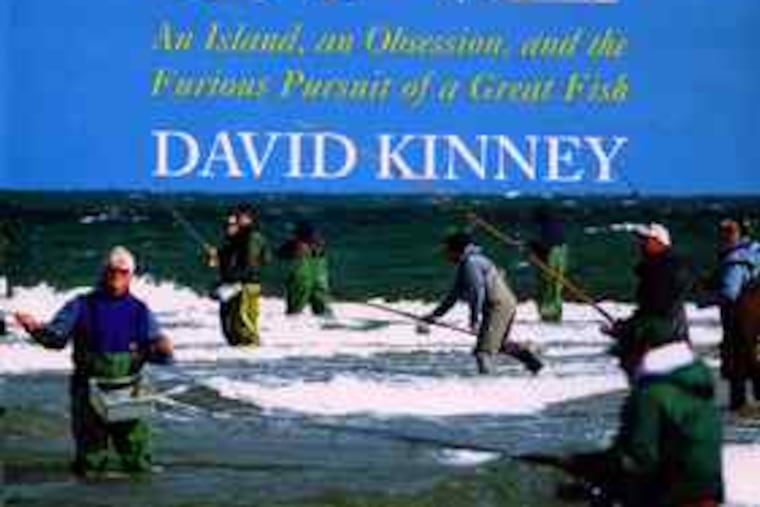
An Island, an Obsession,
and the Furious Pursuit
of a Great Fish
By David Kinney
Atlantic Monthly Press.
276 pp. $24
nolead ends nolead begins
Reviewed by M.R. Montgomery
Once upon a time, on an island far away, people fished just for the hell of it.
Martha's Vineyard back then, like all coastal vacation destinations in the Northeast, said goodbye to tourists and summer-homers on Labor Day. This was perfectly fine with the locals, a large proportion of whom regarded the off-season as their possession, and they returned to serious fishing, hunting, and drinking absent those annoying calls to repair plumbing, mow lawns, or shingle roofs.
The only people really unhappy with the deep and dreamless somnolence that set in each September were the stockholders of the Massachusetts Steamship Lines whose meager dividends depended on the tourists and summer folk riding the ferries.
The solution came in 1946 from the company's public relations firm, a one-man operation run by a World War II veteran, Nat Sperber of Marshfield, Mass., and the answer was a fishing derby that would begin on Sept. 15 and end on Oct. 15, with dollar-bringing anglers competing for modest prizes.
As recently as the 1970s, when I covered the derby for the Boston Globe, it was semi-serious, good-natured fun. Economically, it provided a little extra income for the ferry line (now the "steamship authority") and the island's lowest-key businesses. It was said then, not entirely in jest, that the derby contestants came to the island with a clean shirt and a $5 bill and didn't change either one.
That was then, and proposing a wildly sad, funny, weird, compelling, repelling book like David Kinney's remarkable The Big One would have been certifiable evidence of authorial megalomania. It was hard enough to squeeze a short sports-pages column out of the old Martha's Vineyard Striped Bass and (eventually) Bluefish Derby. This is now, and there is a rich history of triumphs, tragedies, and obsessions that rival Ahab's pursuit of that white whale.
Sadly, or marvelously, what made the derby a rich case history worth Kinney's attention, and yours, was simply money. With the gradual inflation - grand prizes of boats and SUVs worth tens of thousands of dollars, and hundreds of thousands of dollars in daily awards - what had been amusing became a craze. Worse, islanders got their own derby division and set of prizes. Small islands seem to magnify hurt feelings. One is reminded of Pogo Possum's declaration: "We have met the enemy and he is us."
As will happen in groups of struggling equals (think a playground, or a prison), small alliances of two or three anglers will arise and can last a lifetime. Larger groups of otherwise unbonded individuals will actively defend territory (think crows vs. owls, blackbirds vs. crows). From Kinney's telling, thinking about fishing off the Menemsha harbor jetties is preferable to actually doing it:
"I try to fish the channel [from the Lobsterville jetty] but somebody on the Menemsha side keeps casting over the rocks at my feet. . . . I want to go over there and beat the serial snagger senseless for his transgressions."
He finds that the most obsessive off-islanders in the derby are people staving off serious addictions. The derby adds a 13th step to their 12-step program. Brad and Skipper, two recovering addicts and fishing buddies, understand this. Brad explains:
"Me and Skipper, our axis is thrown out of kilter if we don't come back here to realign, get our chi back in line for the year. If I didn't come down here I'd be in Norristown State Hospital."
When Kinney tells them he thinks that "the derby is a safe alternative to traditional addictions, that feeling a fish strike reproduces the high they got from drugs and alcohol," they do not disagree.
"For anglers and addicts, it's all about the next hit," Kinney concludes, using the fisherman's term for a fish taking a lure.
There are few heroes in The Big One. Spider Andresen, the former editor of Salt Water Sportsman magazine, qualifies.
In the 1980s, when extreme fishing pressure on juvenile striped bass had reduced populations to a straggle of aging lunkers, Spider took on the derby, and lobbied hard for laying off the large bass and restricting the derby to bluefish (and eventually bonito and false albacore) until the striped bass population recovered.
Against all odds, he succeeded, and the bass population recovered and became fair game again. It is a testament to his charm that he didn't lose a friend - permanently, anyway.
Much of The Big One revolves around instances of alleged cheating, a common occurrence at all fishing contests with large prizes. Kinney, part of a Pulitzer Prize-winning team at the Newark Star-Ledger in 2005, is a master at reporting and narrating the complicated matters involved in these dismaying events in which no one really wins, when victory is shallow and loss is grievous.
It is a fascinating, crisply written book, and if, at the end, you would like to visit an island in Vineyard Sound after Labor Day and pursue gigantic striped bass, to lift up those leviathans' heads with a hook but not get involved with a maniacal mob, it is still possible.
Fishermen should not tell people about secret shores easily reached by ferry, rich in fish, and unpopulated by people seeking therapy or fame or hard cash, so I will only say that its initials are Cuttyhunk Island.