Exhibition honors an evolutionary pathbreaker
"Dialogues With Darwin" uses books, letters, Post-It notes, and blogs to offer insight into the man who published "On the Origin of Species" 150 years ago.
There was no one great moment of clarity, no flash of brilliance. It was gradual, the result of decades of observations and experiments. He reached his conclusion by building upon or toppling the ideas that preceded him.
Charles Darwin's theories, in other words, evolved.
In 1859, when he published On the Origin of Species, it was the fruition of a meandering intellectual journey of more than 20 years that forever changed our understanding of who we are and how we got here.
Throughout the world this year, hundreds of events mark the 200th anniversary of Darwin's birth and the 150th anniversary of his publication of Origin.
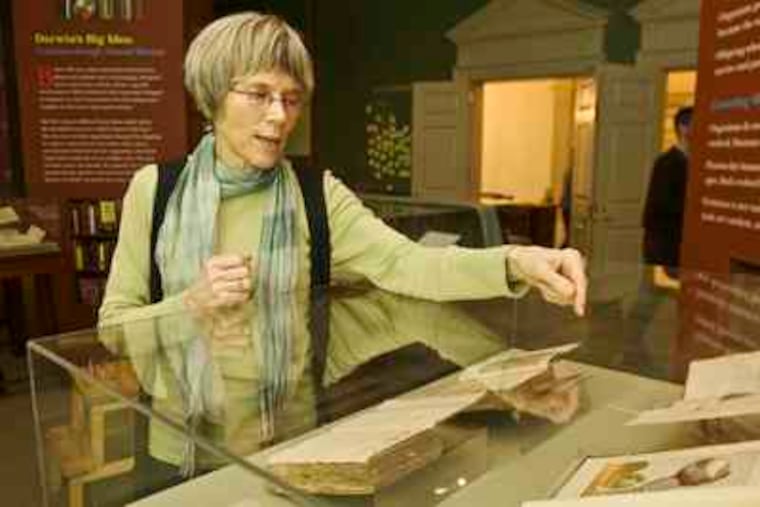
Here in Philadelphia, the American Philosophical Society has opened "Dialogues With Darwin," an exhibition of books, letters and manuscripts from the society's own collection, the largest outside Cambridge, England; commissioned artwork; visitor responses on Post-It notes; and a unique online community of "diablogs" led by scholars, supplemented by images of the exhibition's objects.
The Philosophical Hall gallery requires only a slight swivel of the head to survey in its entirety. Absorbing the details of the text-heavy presentation takes considerably longer.
The big draws for many rest on tables in the center of the room: a handwritten draft of Origin's title page; a manuscript page from the book, whose first edition was just 1,250 copies; the first U.S. edition; two letters to friends with whom Darwin discussed his work. (His penmanship was notoriously ragged and often illegible.)
But the exhibition is not all Darwin. Its strength lies in the context it provides - 32 other voices, scientific and theological, carry the discussion from Darwin's earliest influences through the 1940s, when his work became the basis of all life sciences.
"What impresses me about Darwin are the questions he asked," said Sue Ann Prince, APS director and exhibition curator. "Everybody else could observe these things. Darwin didn't come up with the idea of evolution at all. His big idea was evolution through natural selection. It was the process by which it happens."
His theory was set forth by 1844. But Darwin wasn't satisfied. He wasn't ready to divulge his theory and the research that supported it.
"He was a humble man," Prince said. "He wanted to have tons of evidence . . . before he published. So he was sitting on this manuscript, and only a couple of his closest friends and confidantes knew about it."
Nonetheless, Alfred Russel Wallace, a young natural scientist who had traveled the world (much as Darwin did for five years on the HMS Beagle), in June 1858 sent Darwin a 20-page manuscript and asked Darwin to forward it, if deemed significant, to Charles Lyell, whose Principles of Geology had in part inspired Darwin's theory of evolution.
Darwin read the piece and was shattered to realize that the work to which he had dedicated his life was in jeopardy of being surpassed. "I never saw a more striking coincidence," he wrote. "If Wallace had my M.S. [manuscript] sketch written out in 1842 he could not have made a better short abstract! Even his terms now stand as Heads of my Chapters."
Lyell had Wallace's paper published, preceded by abstracts of Darwin's forthcoming book.
Darwin's meticulous search for proof of his theory, along with his internal struggles as he weighed it against biblical accounts of creation, had slowed Origin's publication. Fearing public censure, he wrote to the botanist Joseph Dalton Hooker: "It is as if one were confessing to a murder."
The word evolution appears nowhere in Origin's 500 pages. The closest he came was in his closing paragraph:
"There is grandeur in this view of life, with its several powers, having been originally breathed by the Creator into a few forms or into one; and that, whilst this planet has gone cycling on according to the fixed law of gravity, from so simple a beginning endless forms most beautiful and most wonderful have been, and are being, evolved."
Darwin considered himself agnostic, regarding theology as a futile pursuit. He wrote to the American botanist Asa Gray that "a dog might as well speculate on the mind of Newton," and he later regretted inserting "the Creator" in the second edition of Origin. The term, he said, was meant to refer to the unknown.
The exhibition's organizers haven't seized on modern clashes of religion and science, but neither have they shied from the subject.
"I didn't want to hide [the edition with 'Creator']," Prince said. "I thought that it was important to have this discussion in the gallery here about this question."
A true back-and-forth envelops the exhibition. Darwin is known to have written or received roughly 16,000 letters, aided by rapid development of the Victorian postal system: Mail came and went up to 12 times a day. It was, in effect, the e-mail of his time.
Joseph Carroll, a professor of English who specializes in literary Darwinism at the University of Missouri at St. Louis, in 2003 published an unabridged edition of Origin including appendices with selections from other works of Darwin and from those of his sources and contemporaries. Its attention to context is remarkably similar to that of the APS exhibition.
"Having the correspondence . . . being able to adopt the perspective of people before it's a done deal - it's sort of like trying to imagine what it's like to be in a war at the beginning, before anybody knows how it's going to turn out," Carroll said. "The actual experience of it is that everybody is almost always surprised. . . . There's a kind of drama, a creative energy, a tension, an anticipation, a suspense. You have a sense of how ideas become meaningful to individuals."
That accounts for part of the dialogue that the exhibition's title promises; the rest happens on the Web.
Sylwester Ratowt, a research associate who has worked on the project since joining the museum last year, says the online components help bring to life dialogues of the past with an eye on contemporary discussions. Even the Post-It notes visitors slap onto the bulletin boards just inside the gallery doors are scanned and posted online.
Image galleries and the accompanying texts provide links to the full versions of many of the featured books. Darwin's scratchy entries also are transcribed.
The "diablogs" potentially can expand the exhibition's reach worldwide. Three are live, though barely touched thus far by anyone other than administrators and participating experts. "Would Darwin Blog?" features a lengthy entry by each of three guests, including an evolutionary paleobiologist and a professor who studies scientists' information-seeking behavior in electronic environments.
Ratowt anticipates launching a new blog monthly. The APS asks each expert to commit a week or two; beyond that, administrators will let sites live or die in an appropriately Darwinian fashion.
"Bringing in the blog element, it's sort of the way science works," Carroll said. "You put all these pieces together."
The larger scope of the exhibition will include poets, workshops with young composers, commissioned music, and a performance artist who in October will share his one-man play in the gallery.
"The textbook view of science is that there are neat theories laid out as if they had been delivered by the hand of God," Carroll said. "The reality of that is very different. Theories develop, and people stumble around and find things they didn't expect to find. . . . They find bits and pieces. They're making a mass, collective effort."