Art:
As an art student in the mid-1950s, Mel Leipzig was pushed two ways. At the Cooper Union in the early to mid-1950s, he studied with representational painters such as Neil Welliver, Will Barnet, and Morris Kantor.
As an art student in the mid-1950s, Mel Leipzig was pushed two ways. At the Cooper Union in the early to mid-1950s, he studied with representational painters such as Neil Welliver, Will Barnet, and Morris Kantor.
Later, at Yale University, his mentors were two of the foremost abstract painters of the day, the austere and resolutely theoretical Josef Albers and the abstract expressionist James Brooks.
As it developed, Leipzig's aesthetic compass eventually swung back to figuration, particularly to informal portraiture. Over the last 40 years, while teaching at Mercer County Community College, he has produced a substantial body of work that marks him as a master of realism.
The New Jersey State Museum mounted a Leipzig retrospective in 1998. Now it has put up a sequel of 24 paintings made over the last 10 years that extend the artist's dedication to precisely delineating the environments in which his subjects live and work.
None of Leipzig's fundamentals have changed since the earlier show, especially his two most distinctive hallmarks - a red-shifted palette and exploded, wide-angle perspective. But something new, or at least more intense, has been added, at least in my perception.
It's the sense of being enveloped in Leipzig's World, meaning that the paintings as a group produce a holistic viewing experience. Each picture is self-contained and stands alone, yet as one progresses through the show, one senses that the artist has created, frame by frame, an appealing autobiographical album.
Part of this effect is intentional. For years, Leipzig's sitters have been people he knows - initially, family, friends, and students. After 1995, he widened the catchment, adding other artists, teachers, and religious leaders, sometimes with families.
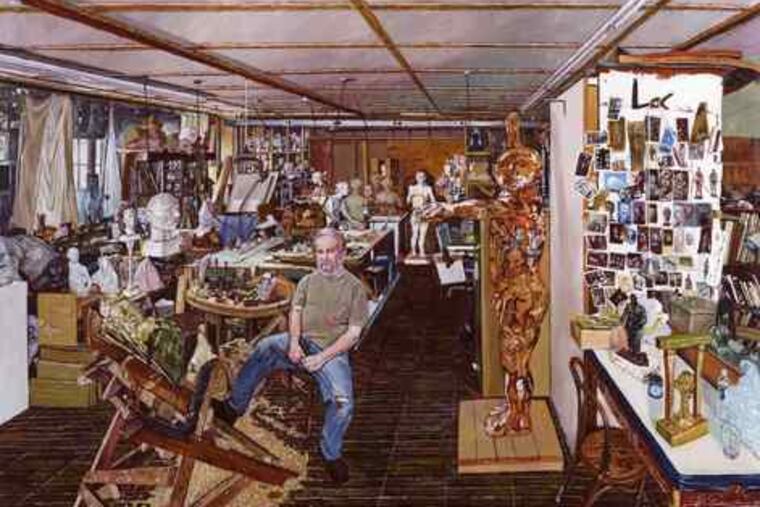
The other component of the Leipzig Effect is his attention to detail and his predilection for complex spatial effects. While his paintings are ostensibly portraits, they are primarily environments that communicate information about the sitters.
Leipzig doesn't develop intense character studies; in many paintings, his subjects pose more or less impassively. Where they pose, and the fidelity with which the artist reproduces their surroundings, determines content.
A prime example is the portrait of sculptor Jonathan Shahn in his studio. Shahn may be the focal point, but he is effectively submerged in a cascade of objects that fills the room, from furniture to finished works to a pile of wood chips at his feet.
Nor does Leipzig set up narrative situations. Instead, he draws our attention to the object-saturated spaces in which we encounter his subjects, and invites us to infer what their lives are like. His mise-en-scene is so comprehensive and persuasive that one comes to feel like a member of his extended family.
Leipzig's ability to build a scene through dozens, even hundreds, of concrete details is prodigious, so much so that a viewer might naturally assume he composes from photographs. Wide-angle perspective reinforces this impression - which, you might be surprised to learn, is dead wrong.
He has never used photographs; he paints from life, or sometimes from sketches, which makes his work all the more impressive. His paint-handling (always acrylics) is fluid and assured, another mark of someone who has mastered not only an aesthetic program but also the technique by which to bring it to life.
The other aspect of Leipzig's method that can cause some unease is the red-shifted palette, which sometimes results in works that look like imperfectly developed Polaroid prints.
Limiting himself to a few colors - mainly red, blue, yellow, and white - represents an arbitrary constraint that he adopted years ago to increase the emotional intensity of his tableaux. I'm not persuaded that the unorthodox palette achieves that goal, but it does emphasize pictorial structure and eliminate the potential distraction of flashy color for its own sake. And it's amazing how close Leipzig often comes to naturalism with such limited means.
Ultimately, though, the bottom line is the way he is able to envelop the viewer in the mantle of his own milieu. The first time I saw his work, in 1998, I thought him a talented and imaginative realist. This time, I was equally impressed with him as a humanist.
To complement the Leipzig show, the museum asked the artist to rummage through its collection and select works that would amplify and perhaps contrast with his paintings. This show, also of 24 works, hangs in an adjacent gallery and achieves its goal superbly.
Turning artists loose in permanent collections has become a staple of museum programming, and results are hard to predict. Constrained by the size of the gallery, Leipzig decided to concentrate on his specialty, figuration. He apparently devoted considerable time and energy to his commission, and has created a show of high quality that is on the one hand focused but on the other expansive in its exposition of figurative painting.
As he explains in an introductory text, his selection breaks down into three blocs - great modernists of the early 20th century (Marsden Hartley, Raphael Soyer, Reginald Marsh, Milton Avery, Joseph Stella, Georgia O'Keeffe); "artists like me who were taught by abstractionists and who developed into non-academic realists" (Fairfield Porter, Philip Pearlstein, Alex Katz, Larry Rivers, Welliver); and a third, more eclectic group that includes academic realists such as Martha Erlebacher, the romantic realist Ben Kamihira, and "realist-surrealist" Hughie Lee-Smith.
All these artists are represented, along with Oscar Bluemner, Horace Pippin, Edward Hopper, Ben Shahn, George Ault, James Valerio, and Max Weber. It's an exceptional lineup of talent and styles that, in only two dozen works, illustrates the multiple paths to realism that developed and coexisted during the previous century.
Several examples are knockouts. Welliver's landscape Final Venus, which anchors one long wall, is one, O'Keeffe's East River From Shelton is another. But the star of the show for me, in part because the artist is a discovery, was The Marvin Family by a New Jersey painter named James Chapin (1887-1975).
It depicts two men and a woman, dressed like farmers in work clothes, grouped around a stove. Leipzig characterizes Chapin's style as "straightforward academic realism," but the painting generates more power and presence than one expects from such a practitioner.
The painting recalls Thomas Eakins at his most intense; it's one painting in the room that follows you everywhere. I hadn't seen anything by Chapin before, but thanks to Leipzig I want to see more.
Art: Master of Realism
"Mel Leipzig: Recent Works" and "Artist as Curator: Mel Leipzig" continue at the New Jersey State Museum, 205 W. State St., Trenton, through Sept. 6. Hours are 9 a.m. to
5 p.m. Tuesdays through Saturdays and noon to 5 p.m. Sundays. Free admission. Information: 609-292-6464 or www.newjerseystatemuseum.
org.
EndText