Galleries: 3 artists in different media share a sense of mystery
The third of the Fleisher Art Memorial's Wind Challenge Exhibitions is the most subtle of its predecessors to date, all of which have presented the works of three emerging artists working in various mediums. This Wind Challenge, which brings together phot
The third of the Fleisher Art Memorial's Wind Challenge Exhibitions is the most subtle of its predecessors to date, all of which have presented the works of three emerging artists working in various mediums. This Wind Challenge, which brings together photographs by Johanna Inman, sculptures and video by Constantina Zavitsanos, and a video installation by Yvonne Lung, is also more of a piece than many earlier iterations. The works of these three artists, though entirely different in concept and subject matter, share a similar quietude and mystery.
Inman, who created her color photographs of ledger books by placing them on a flatbed scanner, is fascinated by books as objects and by the varying states of deterioration they embody. The pages she has scanned are completely blank, free of any sign of the human hand, which unfortunately makes several of her images seem redundant (and this is clearly not a minimalist exercise in serial imagery, since she has made an effort to show different kinds of decay in her pictures).
The most interesting of the photographs are the least mute ones, the books whose crumbling leather covers take precedence over their blank pages.
Lung, as a Mandarin interpreter for the United States Immigration Court, was expected to translate the stories of Chinese people living in the United States into English while maintaining an emotionally neutral delivery, even though she often felt sympathetic toward the interviewee. As an artist, Lung has channeled that experience in her video installation Untitled, which consists of a small room, a wooden bench, a fluorescent light overhead, and a monitor playing a film in which Lung is shown translating the stories of several Chinese immigrants living in Philadelphia (she asked them to participate and concealed their identities by showing only herself in her videos).
Lung's installation is faultless - you feel as though you are in court watching her - and her subjects' tough experiences in this country, as related by the artist in her soft, monotonous voice, are fascinating.
Zavitsanos' sculptures and video projection celebrate imperfect science with humor and wit. You're initially tempted to find a purpose in these puzzling found-object juxtapositions - why does that chair have a holographic image of a compass on clock gears embedded in its seat? - but happily give up trying to match form to function after seeing a few more of these works. Zavitsanos' simplest DIY experiments are the most magical: a film and accompanying audio that may (or may not) be of two small electric fans whirring together, illuminated by a candle (or not), and a piece titled escape patch that involves nothing more than a circular piece of mirrored glass, like a puddle of water, on the floor directly beneath a wooden trapdoor that Zavitsanos has attached to the gallery's ceiling.
As with Inman's photographs of books without words and Lung's anonymous stories, Zavitsanos' pieces are simultaneously revealing and obscure.
Dynamic duo
Few artworks in Philadelphia can inspire the jaw-dropping awe that Tristin Lowe's single, gigantic felt replica of a whale,
Mocha Dick
, at the Fabric Workshop and Museum, does (and will do all summer). By contrast, the two-person show Lowe is sharing with Paul Swenbeck at Fleisher/Ollman Gallery has the feeling of a collaboration, of two friends playing off each other's whims.
Lowe is showing a variety of felt pieces. Some are directly inspired by Melville's Moby-Dick (as, of course, was Mocha Dick), such as a rendition of a broken masthead with Queequeg's head lying on it; others, such as an upside-down trash can and an overturned chair, suggest relics of the urban cityscape.
Swenbeck's resin and ceramic sculptures, in colors so intense they look almost toxic, seem to have sprung from science fiction. There's a 1950s movie that featured one of these pieces in a living room, you think, or maybe it was in a scene in a desert, just after the flying saucer took flight. Strange half-human, half-plant forms grow from pools of Day-Glo liquid (dried resin, actually).
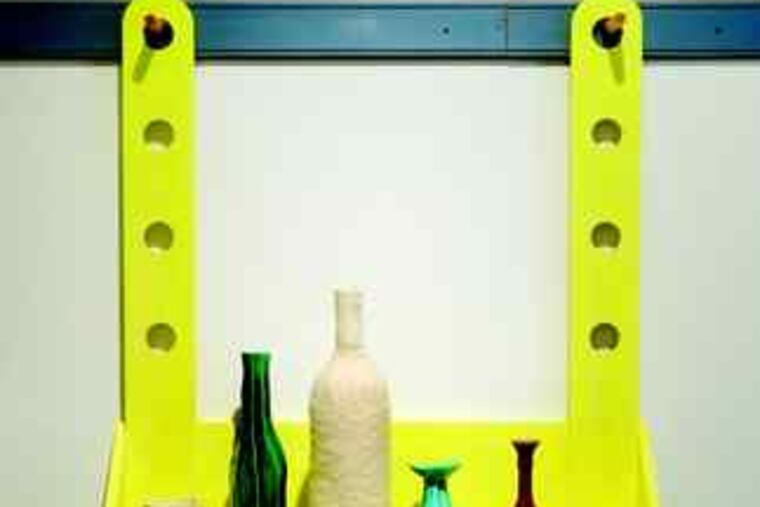
Lowe and Swenbeck have, in fact, collaborated on a few works here. Several lemon-yellow shelves hang from wooden pegs on a strip of molding attached to the wall; on them, Lowe and Swenbeck have arranged cups and bottles (in felt, by Lowe) and variously shaped and colored vessels (in ceramic and resin, by Swenbeck). A colonial tavern meets Giorgio Morandi. Why not?