Focusing on ‘The Regulars,’ drinking alone
Photographer Sarah Stolfa, who once tended bar at McGlinchey's in Center City, has captured introspective images of her former regulars - always by themselves.
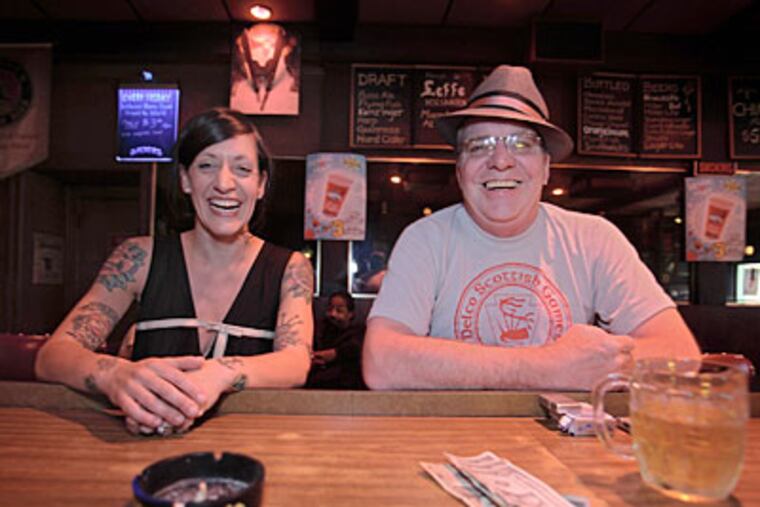
If there is something close to a universal dive-bar experience in this city, McGlinchey's may be it.
A windowless neighborhood bar set along 15th Street near Latimer in Center City, with oddly cheap prices and an enigmatic duck-decoy hunting scene pasted on one wall, McGlinchey's is a bar that seems to have crossed the radar of most people in this town at some point, some much more so than others.
Sarah Stolfa, 34, did more than duck into McGlinchey's for its $1.35 mugs. She tended bar there for 10, maybe 11 years ("I can't quite remember"), fostering an attitude somewhere between ennui and contempt toward her regulars and a reputation as a surly but fast bartender.
Then she started photographing. The result is The Regulars (Artisan Books, $15.95), an evocative book of dark, formal portraits of solo drinkers at McGlinchey's that Stolfa says she modeled after the 16th-century portraits of the Dutch Masters (in part because of the brown and red hues of that old duck-hunting scene on the north wall that provides the backdrops).
"It's not a documentary of McGlinchey's," she is saying one afternoon recently in a booth there, a couple of beers (not hers) on the table in front of her, the puckered decoy scene within reach, the regulars, including two who are in the book, around the bar.
"I was definitely interested in photographing people alone," Stolfa says. "You get a very different reaction if you photograph them with their friends. In that is embedded a certain degree of loneliness, but there's a certain amount of wanting to engage socially."
Stolfa, a Drexel grad whose photographs won her entry into a master of fine arts program at Yale University and the New York Times photography contest for college students, says she didn't want a collection of Cheers-like shots, but more introspective pictures. It's harder for people to hide themselves when they are captured alone, staring at the camera, a little fidgety.
Stolfa identifies her subjects by name, as befitting a formal portrait, but gives no other information other than what can be gleaned from the photographs, which covers what they're drinking, reading, or smoking. Which is pretty much all a bartender needs to know - or at least one like Stolfa, who did not go for the chitchat bartender style and was not going to pretend to be your friend.
McGlinchey's was merely "my theater, my stage" for taking the portraits, Stolfa says. And never in black and white. "For me, it was important that they be color. I didn't want it to be nostalgic. I wanted it to be current. They are current, but they feel timeless."
In an essay in the book, she writes of McGlinchey's: ". . . it has everyone: from the 10:00 a.m. Banker's Club gin drinker, to the construction worker having a Bud for lunch, to the lawyer sipping Jameson's at 5:05 p.m. to the Jersey suburbanite weekend warrior slugging back Miller Lites and the art student chugging a lager after class." (Not to mention a surprisingly excellent selection of craft beers on tap.)
"One of the things portraiture can do is be about the person," she says, "but de-reference the person from everyday life."
A little bit like walking into a bar, maybe. What do you really know about the person sitting beside you, or two stools over, day after day, night after night, or, in this case, morning after morning? As Andrea Walker wrote on the New Yorker's Web site, Stolfa's photographs "capture the strange mix of intimacy and distance that can come with serving drinks."
But place the book in front of McGlinchey's comically nonchalant owner, Ron Sokol, and bartender Alia Burton, and the missing details are quickly filled in, in eccentrically McGlinchey's style un-de-referencing:
"Look at Artie, ha-ha."
"Trevor, he died."
"Sheldon, that's my brother."
"Mike's a trombone player. Meghan, she goes to Temple."
"This one was murdered two months ago."
"This guy was here when Anne Marie worked, he was in love with the Irish girls."
"This guy is a real freak. Is this the foot-fetish guy?"
"That's the guy who used to work for the Bulletin. He's dead now."
"Anyway," Sokol sums up, "what's the difference, the book's about Sarah."
Maybe so. Stolfa, who used to be in a rock band in Washington and has the de rigueur shoulder tattoo of the creative indie type, already has a lot of buzz around her. In addition to the Times award, she snagged blurbs by Jay McInerney and Richard Ford for the book and was provided (courtesy of her publisher) with a cranky but notable introduction by novelist Jonathan Franzen, who, it turns out, hates bars, doesn't hang in them, hated Philly when he lived here, was a failure during his time here, thinks it's still the '90s in Philly, and didn't like Stolfa's photographs the first time he looked at them. With intros like that, who needs critics?
In any case, on this weekday afternoon, McGlinchey's is, as ever, up to the job. Cigarette lighters are still more likely than cell phones to be pulled out of a pocket and placed on the bar next to the mug.
It is filled with its daytime regulars, including two from the book: the fedora-ed David Scott Smith, 57, who calls the book "charming" over his Camels and Rolling Rock, then vanishes without anyone seeing him leave, and lawyer William Spearing, whom Stolfa wanted to photograph mostly because he wore a suit. "I think it captures a fairly wide swatch of life," says Spearing, not now in a suit.
In the book, Stolfa describes the weird pricing - 90 cents for a mug of cheap beer, $2.15 for a pint of the better stuff, $2.65 for fancy beer when she worked there - as illogical, and says, "I really think the owner sets the prices for the amusement of watching the staff try to cope with odd numbers."
But owner Sokol, whose family bought the bar from Mrs. McGlinchey in 1967 and changed virtually nothing about it except raising prices about 45 cents over a few decades, says the prices are simply to squeeze change out of even the stingiest tipper.
Sokol said he doubted the book would be passed around much at the bar - not that kind of place - and refused to be impressed by the artistic overlay Stolfa has put on his joint. Or by much of anything.
And, really, his bar is not the kind of place to be impressed with itself, which is, of course, part of why you go there. It's not a self-consciously anything place, not a place where anyone ends up doing much of anything notable besides drinking. (Says one regular not photographed in the book: "I'll put it this way, I was never arrested outside McGlinchey's.")
As for Stolfa, who has brought along an intern from her new business, the Philadelphia Photo Arts Center, Sokol will say only this:
"She's the first person to come back to McGlinchey's with an assistant."