Galleries: Bicycles put art in motion at the Moore College gallery
Remember the Guggenheim's "Art of the Motorcycle" exhibition in 1998, that was dissed as egregiously populist - and that sent the museum's attendance levels soaring through its Frank Lloyd Wright skylight? Now comes Moore College of Art & Design's "Bicycle: people + ideas in motion," a smaller effort, of necessity, but a show that does the Guggenheim's one better: It's got bicycles and art.
Remember the Guggenheim's "Art of the Motorcycle" exhibition in 1998, that was dissed as egregiously populist - and that sent the museum's attendance levels soaring through its Frank Lloyd Wright skylight? Now comes Moore College of Art & Design's "Bicycle: people + ideas in motion," a smaller effort, of necessity, but a show that does the Guggenheim's one better: It's got bicycles and art.
It's also in the right place. Moore gallery director Lorie Mertes, who conceived the exhibition, was convinced that the number of art and design students in Philadelphia's bicycle community - along with Marcel Duchamp's bicycle-wheel-assisted readymade at the Philadelphia Museum of Art a few blocks away - made the Galleries at Moore an inspired venue for her bicycle-themed show. The fact that the bicycle, of European and English descent, was introduced to Americans at Philadelphia's Centennial International Exhibition of 1876, a fact that Mertes learned later, was icing on the cake.
The main exhibition, in Moore's Paley Gallery, features vintage bicycles from Philadelphia collections, including one of Albert Pope's Columbia bikes from the late 1800s, as well as different types of contemporary bikes seen in and around Philadelphia - from folding bikes to touring bikes to hand-built bikes from the Philadelphia-based Bilenky Cycle Works. There's even a bicycle fashion component, including an installation of one-of-a-kind messenger bags designed by local artist-cyclists.
But art has just as strong a presence here. Ryan Humphrey: Fast Forward, an installation that Humphrey, a bicycle motocross semipro-turned-New York artist created for the Queens Museum of Art's "Queens International 4" biennial in the spring, has been remade in Moore's Levy Gallery. As he did in Queens, Humphrey has transformed a gallery space into a BMXer's paradise, replete with wooden ramps, pedestals bearing BMX trophies, a gigantic wall-mounted carpet of an abstract pattern (made with designer Todd Oldham), and rows of BMX bikes hung from the ceiling.
You might assume that Humphrey's abstract paintings, though graphic - they depict constructions of geometric shapes painted in camouflage, wood veneer, and other everyday patterns - would get lost in this funhouse of image, three-dimension and color, but they're carnivals in their own right.
Lee Stoetzel is a Chester Springs sculptor known for his impeccable recreations of industrially produced objects - among them a life-size, '60s-era VW bus and the "Captain America" chopper from Easy Rider - in naturally degraded wood, such as pecky cypress or mesquite. He is showing his Big Bike (2008-2009) in Moore's "Window on Race" gallery. Modeled on a track bike but twice its size, Stoetzel's all-mesquite bicycle is a gorgeous work and an irresistible invitation to come inside.
Stay tuned: Related bike-centric exhibitions will open through the summer, among them "Steven and Billy Blaise Dufala: Toilet Trikes," (July 11–August 30), which is already in residence, but not in its final destination, and "Dan Murphy: Style Points."
What he likes
Singer-songwriter Will Oldham, who records and performs as Bonnie Prince Billy, was invited to curate an exhibition for Fleisher/Ollman Gallery by its director, Amy Adams. Oldham accepted with pleasure, and the result is "Frenz," a show that unites a diverse group of 11 artists, many of whom know Oldham, including his collagist mother, Joanne Oldham.
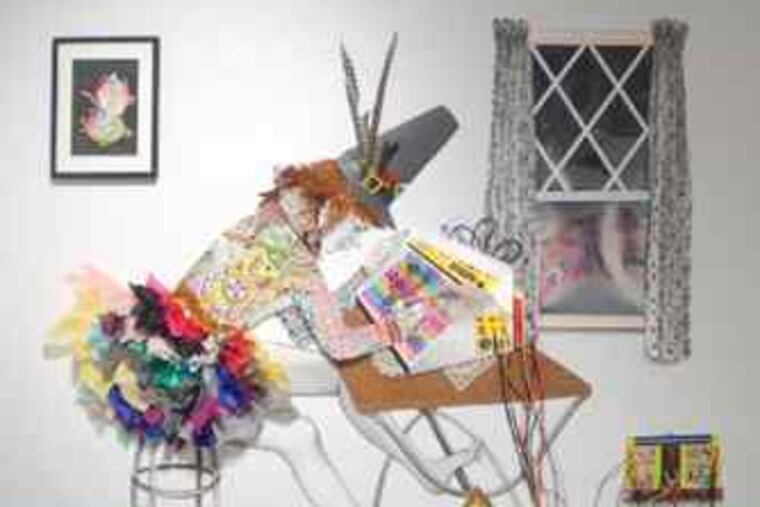
A few of my favorite things: Shary Boyle's elaborate mixed-media wall piece, Moon Hunter (2009), that wraps around two walls, and shows an androgynous female figure in 17th-century dress (tights, bodice and Pilgrim hat) designing bargello on a computer with a quill pen and printing out the result on the moon, with tiny blinking lights throughout, wired to a primitive-looking, exposed circuit board; Leslie Shows' four inkjet prints in four different colors on rice paper, whose central image looks like a cross between a nuclear explosion's distinctive mushroom cloud and vomit - one is called "Karen (black bile)" and another "Phoebe (yellow bile)"-and the wonderful zines, strips, and drawings of Sammy Harkham, known for his comic series "Crickets" and "Poor Sailor," and the comic anthology he publishes and edits, "Kramers Ergot."