A show called "City of Nutterly Love."
Second City, Quaker City comics unite to mock Philly
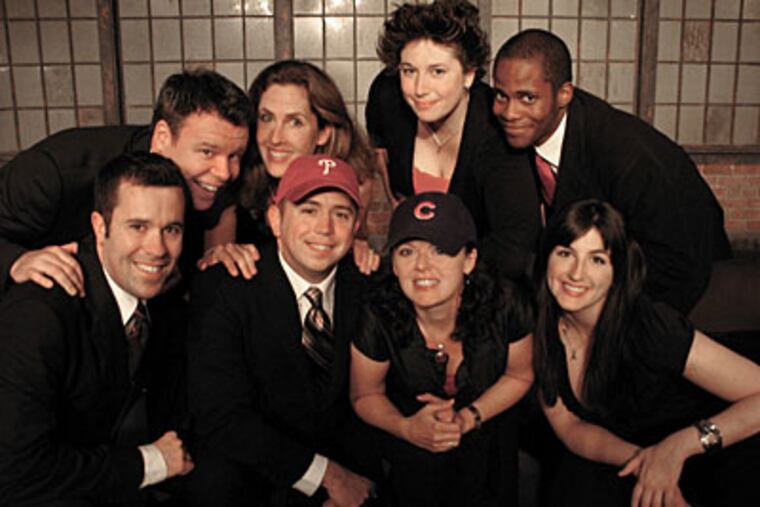
Are we not enough, Philadelphia? Isn't this city's smartly sophisticated clutch of sketch comedians and improv troupes prepared to entertain and enlighten - at least to the extent that we don't need an out-of-town company to instruct us in our own amusing peculiarities?
Surely I jest.
And they jest.
That's the whole point of the uncomfortably titled sketch comedy show City of Nutterly Love: Funny as Bell!, a coproduction of Philadelphia Theatre Company (with several top local improv specialists) and Chicago's renowned Second City. It opens this week at the Suzanne Roberts Theatre.
This chuckleheaded tale of two towns was written by Second City writers TJ Shanoff and Ed Furman after an April fun-fact-finding mission here, with aid from Philadelphia laugh lady Jen Childs of 1812 Productions. It stars Katie Rich, Rachel Miller, and Edgar Blackmon (Second City vets) and Mary Carpenter, Eoin O'Shea and David Dritsas of Philly's ComedySportz.
With all our local improv muscle and multitude of sketch troupes, couldn't we have handled the heavy lifting ourselves? Carpenter and Dritsas say yes: Philly's comic sketch and improv community is burgeoning.
"For a while, ComedySportz was the only gig in town," says Carpenter, a 17-year Sportz vet. "But with long-form groups like LunchLady Doris, the Rare Bird Show and PHIT [Philly Improv Theater], there's been a real growth spurt."
Dritsas, who has nine years with Sportz and is a member of Bad Hair Sketch Comedy, adds that younger troupes are getting into the game, and says "the newer people are very dedicated to growing this scene."
Improv is often pigeonholed as a parlor trick, while sketch comedy is dissed as derivative of Saturday Night Live and the Chicago stage where most of its greats began - the Second City.
But daring sketch comedy is provocative, and great improv is a unique form with, by its very nature, limitless possibilities. Says Carpenter, "It's not just about being funny or clever. It's about shared collaboration between audience and performer. . . . It's a celebration of the possibilities of creativity and surprise."
That's not funny; then again, comedy is serious business.
Ask Kelly Leonard, a Second City vice president and president of Second City Theatricals whose recent creation, Rod Blagojevich Superstar, is a smash at its Chicago home theater. "Improvisation is still a baby art form," he says. "The contemporary theatrical application of this work only started 50 years ago with the debut of the Second City."
Leonard was an aspiring theater writer when he got a foot in the door as a dishwasher in 1988: "David Mamet had been a dishwasher here, and since I had playwriting ambitions washing seemed somehow noble. It wasn't."
Mike Myers, Jeremy Piven and Bonnie Hunt were in the cast when Leonard started. Their predecessors included Alan Arkin (class of 1960), Fred Willard ('65), Peter Boyle ('67), John Belushi ('71), Bill Murray and Dan Aykroyd (both '73), Eugene Levy ('74), Andy Dick ('85), Chris Farley ('89), Steve Carell ('91), Amy Sedaris ('92), Stephen Colbert ('93), Tina Fey and Amy Poehler ('96) and hundreds of other famed alums who applied scholarship and intellectual rigor to improv-based arts.
Second City cofounder Bernie Sahlin famously said, "Once you've seen all Second City shows, you've seen one of them." Today, the scenes are shorter, the language edgier, visual elements more stimulating, and the range of topics broader.
"In the early days, there was time to roll around a scene - around 17 minutes, something no audience would sit still for now," Leonard says. Still, this is a grown-up Second City, "theater that uses a specific improv-based process to create original satirical content."
The Chicago troupe has done citycentric humor bouts in Denver, Pittsburgh and Atlanta, and has a touring division directed by Jenna Deja, a former Arden Theatre executive. So Leonard knew how ripe Philly was for the theatrical picking and how ready it was to be picked on.
"Philadelphia has a rich theatrical community that can tread the boards with anyone," he says. "We went after PTC, not the other way around. We knew Sara Garonzik's work and reputation - this is the company we want to keep." For her part, Garonzik, PTC's producing artistic director says, "Hip, political improv comedy has never been hotter, and Philly's never been riper for a spoof."
So in came Second City writers Shanoff and Furman to experience Philly's larger-than-life politicians, sports-obsessed fans, and elements of blue collar and white collar side by side in a city steeped in historical importance. "Comedy works very well in places where the lowbrow clashes with the highbrow," says Leonard, who also notes that the writers didn't really get, say, the comic possibilities of Ben Franklin impersonators until their visit. ("By the way," he laughs, "tell your Franklins to stop calling us. We're not hiring.")
The writers' quick immersion in the Quaker City worried the Philadelphia sketch/improv actors, but Carpenter, O'Shea and Dritsas got the script in advance of their two weeks of rehearsals in Chicago and found Second City's authors and actors amenable to tweaks.
"I was surprised how well they understood our city and was glad to see they knew exactly what jokes would be too typical," says Dritsas of the inevitable hoagie-cheesesteak-scrapple shtick. "You may see it in there, but it's applied in a very smart way."
As for rehearsing at the famed Chicago theater, the Philly actors weren't intimidated. But impressed? Yes. Dristas mentioned meeting directors responsible for bringing Gilda Radner to Second City. Carpenter was psyched about the backstage area - "it's pretty cool to walk into the bathroom and see Catherine O'Hara's signature on the wall."
Leonard finds Chicago and Philly simpatico because of their shared blue-collar work ethic, corrupt politicians, and loathing of Manhattan. And Carpenter says Second City's take on the already done-to-death - a la the Pat's/Geno's cheesesteak wars - is exceptional. Neither she and Dritsas nor Leonard would reveal more. They want audiences to be surprised.
Not to get crabby, but they have their work cut out for them if they're still trying to say something unique about cheesesteaks. Think Philly's sports fans are tough? Wait till they get a load of our comedy aficionados.
Still, Dritsas is confident. Echoing Carpenter, he says, "The meat of the comedy was already good" when they first saw the script. "Comedy is more universal than you think."