Art: Shedding light on an obscure artist
A Woodmere show focuses on John Pierce Barnes, better known for the GE logo than for his paintings.
If you recognize the General Electric Co. logo - an ornately cursive, capital GE inside a circle - you've seen the work of John Pierce Barnes (1893-1954), although you probably didn't know it was he who has been credited with creating one of the world's most ubiquitous commercial emblems. Chances are, too, that you have never seen any other creation by this Philadelphia artist.
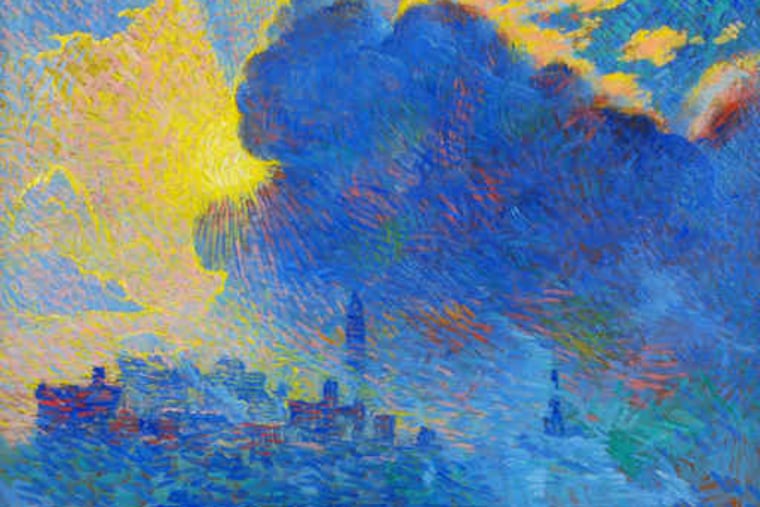
The Woodmere Art Museum has put together a small exhibition of paintings and pastel drawings that it hopes will rescue this forgotten Pennsylvania impressionist from obscurity. It's far from definitive, but it's fascinating in the way it reveals an artist first mastering impressionism in his youth and then trying to move toward a more modern style.
Barnes is obscure in part because he earned his living as a graphic designer, not as a painter. He was solidly grounded in both disciplines, however - first at the forerunner of the University of the Arts and, during the early and mid-1920s, at the Pennsylvania Academy of the Fine Arts.
The academy awarded him two Cresson travel scholarships, which allowed him to spend two years painting in France, Belgium, and the Netherlands. After his European interlude, he went to work for RCA Corp. in Camden, where he designed an early version of that company's logo.
Daniel Garber, a prominent Pennsylvania impressionist, was one of Barnes' teachers at the academy. This is abundantly evident in the exhibition's largest and most accomplished work, an oil landscape of lawn and trees that could pass for a Garber.
In contrast to many of the other oils and pastels in the show, the picture is constructed of tiny, pointillist-like strokes in a muted palette.
Most of the works are far more intense chromatically; some, in fact, are so vivid as to qualify as garish. Several pastels are drawn on sheets of fine sandpaper, which accentuates the force of their coloring.
Barnes wasn't consistently beholden to Garber, though. Several snow scenes are closer to Edward W. Redfield, another New Hope impressionist, and there even are occasional allusions to van Gogh and Monet.
This isn't surprising given that all the works in the show are dated 1920 to 1930, the years during which Barnes was either in art school or painting in Europe.
What makes this show interesting, besides the fact that it introduces Philadelphians to a new talent, is the evidence that Barnes was trying to develop a path away from Garber's impressionism.
Not all the works in the show are impressionist in character, and in fact the brilliant, fauve-ish coloring of some suggests that Barnes was exposed to modernism in Europe and was taking his first steps toward adapting its conventions.
The majority of the images are landscapes, which are most amenable to impressionist interpretation, but the show also includes a dozen portraits and a few still lifes. What it doesn't contain, though, is equally intriguing.
Mainly, it doesn't tell us what kind of painter Barnes became in middle age, or even whether he continued to paint much after he began working for RCA. Could his career as a fine artist have been compromised by the demands of his day job?
All we have here is the foundation of a career that showed promise, through both his accomplished technique and his responsiveness to new aesthetic ideas.
We probably shouldn't expect more than that in the case of an artist being rediscovered more than a half-century after he died. One hopes that this show provokes further scholarship that will in turn lead to exhibitions revealing more of what Barnes achieved.
Erlebacher gift. When Walter Erlebacher died in 1991 at age 57, he was the leading figurative sculptor in Philadelphia. His graceful bronze figure of Jesus breaking bread, at the Cathedral Basilica of SS. Peter and Paul at 18th Street and the Parkway, confirms that distinction.
As both artist and teacher at the University of the Arts, Erlebacher was renowned as an expert on human anatomy, very much in the tradition of Thomas Eakins. Like Eakins, he mastered anatomy so he could create figures with natural presence and structural integrity.
Woodmere is becoming the place to see how he achieved this, thanks to a major gift of 19 small sculptures from the artist's widow, painter Martha Mayer Erlebacher. The figures comprise a narrative tableau called A Mythic History. Several are either bronze or Plasticine, but Erlebacher cast most of them himself in a lead-tin alloy similar to the metal once used in newspaper typesetting machines.
The figures, which are 10 to 12 inches high, represent four major stages of human life - birth, growth, love, and death. Some are gods from the classical pantheon such as Vulcan, Pan, Venus, Mercury, and Hera, engaged in symbolic actions.
Woodmere director Michael Shantz said that A Mythic History, now in storage, would become the centerpiece of a planned gallery devoted to Walter Erlebacher's work. This gallery will be created in the museum's Victorian mansion after an addition designed by Robert Venturi and Denise Scott Brown is completed. The museum hopes to open the wing in the spring of 2012.
Martha Erlebacher said A Mythic History was not a commission, but a concept to which her husband was deeply committed. "His dream was to put it on the Mall in Washington, D.C., but he died before it was finished," she said.
The tableau isn't Martha Erlebacher's first gift to Woodmere in her husband's memory. In 1993, she donated the plaster models for the figures that he created for a sculptural installation called Dream Garden in the ARA Tower at 1101 Market St. These plasters also are in museum storage, but also will be permanently displayed in the Erlebacher gallery.
Four years later, she gave the metal maquette for a figure of St. John Neumann being greeted by citizens of Philadelphia.
Martha Erlebacher confirmed that she planned to donate other works by her husband in the future, including the maquette for the Jesus figure at the cathedral.
Shantz said the museum had a long-standing relationship with the Erlebachers, and that Walter had participated in discussions about a gallery devoted to his work. He said that Martha Erlebacher chose Woodmere for this tribute because "she wanted his legacy to be placed at an institution sensitive to the talents of local artists. This gift is spot-on for us because it speaks directly to our mission."
Art: Another Barnes
"The Art of John Pierce Barnes" continues at Woodmere Art Museum, 9201 Germantown Ave., through Aug. 30. Hours are 10 a.m. to 5 p.m. Tuesdays through Saturdays and 1 to 5 Sundays. Free admission. Information: 215-247-0476 or www. woodmereartmuseum.orgEndText