Returning to her roots
Chloe, 7, was born in Guatemala. This summer, she and her adoptive mother traveled from Philadelphia to her homeland in search of connections.
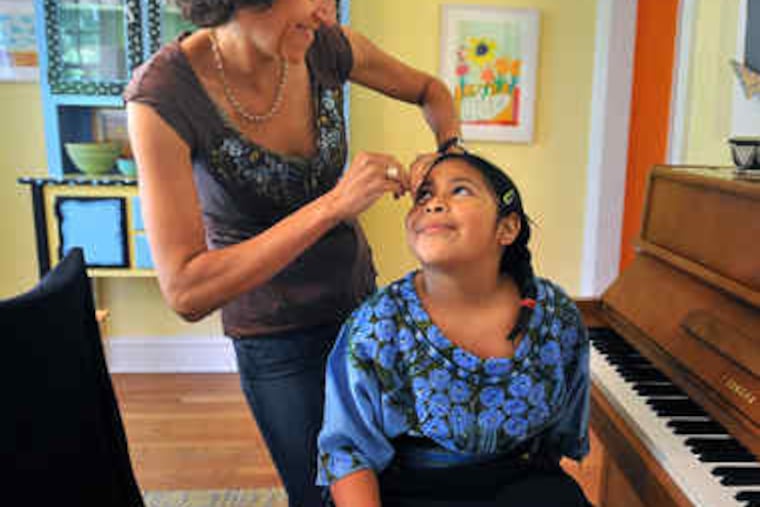
Chloe Cohen, 7, has a really big "how I spent my summer vacation" story to tell her friends.
Visit-your-birthplace-and-meet-your-foster-family big.
The Germantown Friends School student returned this month with her adoptive mother, Amy, from a nearly two-week trip to Guatemala. Not that Chloe remembers her homeland: She left there as a 7-month-old when the Cohen family of Mount Airy adopted her.
The point of the trip - and the group that organized it - was to connect her and other foreign-born adoptees of U.S. parents to their birth countries. Chloe seemed to get that point.
One of the things she liked best about Guatemala, she said the day after her return, was that Guatemalans "look different from people here - except me."
The journey took off thanks to a mighty convergence of curiosity and restlessness at the Cohen household this year. Chloe had been asking more questions about Guatemala.
"I was thinking about it because I never saw it," Chloe said. "I knew I came from there; I knew I had foster parents from there."
At the same time, Amy Cohen, a world geography teacher at Julia R. Masterman Middle and High School in Spring Garden, yearned to travel again. She had been abroad years earlier, including as a Peace Corps volunteer in West Africa, but hadn't used her passport much since the birth of her and husband Michael's first child, Eliza, now 11.
Cohen looked online and found a group called the Ties Program, headquartered in a Milwaukee suburb, which arranges adoptee and family trips to 12 countries.
Becca Piper, 50, started Ties in 1994 after a job organizing international travel for professional groups and corporations.
She had just adopted a child within the United States when some of her contacts - who had adopted from overseas - suggested that she use her talents to arrange travel to their children's homelands.
The for-profit business' first trip was to South Korea. A need existed in the 1990s for homeland-cultural programs for children born there because it was one of the countries involved earliest in overseas adoptions. Piper also could look to support groups in the United States to find participants.
"My vision on this, though, was to open this up to families who had adopted kids from countries where there were fewer numbers of adoptions," Piper said. "There weren't as much post-adoption programs or cultural clubs available for them."
Piper witnessed a jump in interest for her program in 1997 and has seen steady growth since then.
She is starting a nonprofit to raise money for families who can't afford the full price of these journeys, which cost about $3,000 to $4,500 per person (airfare may be included, depending on the destination country).
"We encourage families to stay very much connected to their birth country, culture, and heritage," said Susan Soonkeum Cox, vice president of policy and external affairs for Holt International, one of the oldest intercountry adoption agencies, with headquarters in Eugene, Ore. "They are tourists, but there's a uniqueness about them going back that's deeply profound."
That's why organizers of these trips need to be thoughtful about the journeys' purpose.
While having fun is important, children who come from developing countries are likely to witness extreme poverty. If they've been wondering about their birth parents - Chloe has not yet asked to find hers - children may worry whether they have enough to eat and what conditions they are living in.
Before Ties' inaugural trip, Piper spent three years talking to social workers, adoptees, and their families about what sort of travel experiences would be healthy for children.
She learned that children get more out of the experience if they are traveling with peers who share the same nationality, rather than with their family alone.
It was that way for Chloe.
"I think for her, it was mostly about making friends" with other Guatemalan adoptees on the trip, Amy Cohen said.
Having other children around also can ease awkward moments, Piper said, such as when the kids might go shopping and fail to understand something said to them in their birth language. Social workers or adoption specialists accompany each group to offer advice to the families.
"It's not about travel. It's about identity-building," Piper said.
And that can be intimidating - especially for younger children, who may not be able to process their experiences abroad.
Chloe never seemed intimidated, Cohen said. But neither did she act as though she were learning deep lessons about life - her life.
She enjoyed visiting tourist sites. Riding a zip line past monkeys in the rain forest - Chloe was the youngest to do it - was great.
Chloe loved the colors of handmade tapestries, the music and dance she took in, the souvenirs (especially the souvenirs) she bought. Her favorite? The slingshot. No, wait, the red wooden flute. Well, maybe the beaded necklaces - except have you seen the little wooden acrobat between two sticks?
There is no confusion about which day of the trip was the most momentous: It was toward the end, when Cohen and Chloe met the foster family who had raised her until she left for the United States. Cohen had visited the Hernandez family before, to pick up a little baby then named Elsa Isabel.
The family - mother Hilda and daughters Valeria and Vivian - came to the hotel in Guatemala City where the Cohens and the other Ties travelers were staying.
"They recognized me," Chloe said.
Her foster mother, she said, "gave me a big hug and squeezed me."
The older daughter, now 24, was pregnant - the family told Chloe she was going to be an aunt. The younger daughter, 20, is studying to be an English teacher and served as the interpreter.
At first, over Pepsis and snacks, they caught up on the intervening years, with the Cohens showing a photo album of Chloe they made for the Hernandez family.
When the conversation slowed, Chloe suggested they play a card game she had brought. Then, the Cohens gave the Guatemalans Phillies' T-shirts and a picture book of Philadelphia. The foster family gave Chloe a gold bracelet and earrings, and a bracelet for her older sister, Eliza.
The teary-eyed moment for Cohen came when Hilda Hernandez pulled something out of her purse.
"She showed me that she had Chloe's picture still in her wallet from when Chloe was a baby," Cohen said.
Adam Pertman, executive director of New York's Evan B. Donaldson Adoption Institute, expects that these kinds of programs will continue to grow, as those who are adopted get older and indicate what they want.
"Which, no surprise, is what everyone wants . . . to know where they come from."