Planning real-to-reel on small-town Pa.
Georgie Roland went to L.A. to learn moviemaking, but he came home to small-town Pennsylvania to finish his film education.
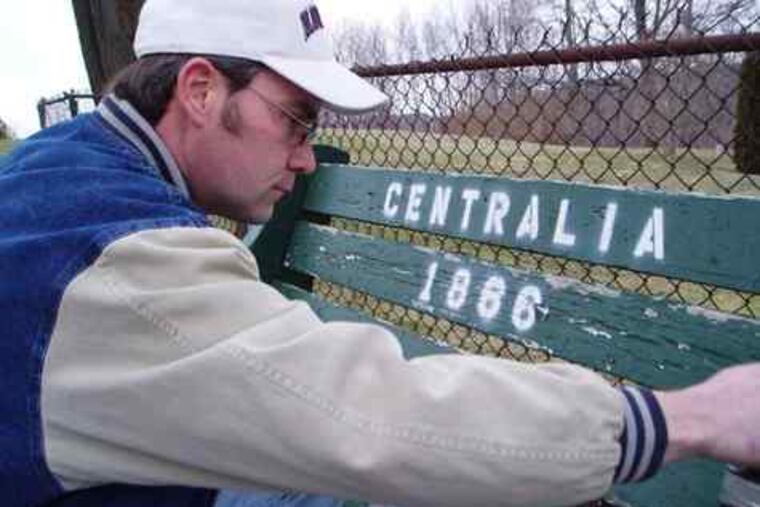
Georgie Roland went to L.A. to learn moviemaking, but he came home to small-town Pennsylvania to finish his film education.
In the hardscrabble hills of northeastern Pennsylvania, Roland would shed the influence of Hollywood and teach himself how to tell stories about the way people really live.
The result was The Town That Was, a documentary about the strange history of Centralia, Pa., a once-thriving mining town in Columbia County that sits atop an underground coal fire that has smoldered since 1962.
The film, which Roland co-directed with Chris Perkel, generated buzz at the 2007 Philadelphia International Film Festival and has been released on DVD by Cinevolve Studios.
Roland, 34, a native of Dunmore in Lackawanna County ("it's a tiny town of 14,000 about five minutes outside Scranton"), made the film half a dozen years after dropping out of the graduate film program at the University of Southern California to return home.
Why did he come back? He felt he could acquire the education he needed only in northeastern Pennsylvania.
"I always felt I was a regional filmmaker," says Roland, who attended Cornell University, where he played football, and pursued postgraduate studies at the London School of Economics. "The region isn't simply the background to a . . . sitcom like The Office. Once you scratch the surface, you find there's a lot of unique and fascinating individuals here."
In film school, Roland was surrounded by would-be Spielbergs who lacked an "authentic sense of people's actual lives," he says. He felt that like them, he "wasn't prepared to write something that would give my background justice."
He says he became fascinated with Centralia in 2001, when he read that 18 of its 3,000 residents had opted to stay despite the town's death.
The film is told through the eyes of the youngest of these die-hards, John Lokitis, who was 33 when Roland and Perkel started filming in 2001.
"We talked to the sociologists, geologists, the professors, and historians - everybody who could provide a context to the story," Roland said on the phone from Scranton. "But we wanted to . . . put a human face to it."
Roland, who met codirector Perkel at USC, says, "what drove us to this story was [Lokitis'] passion," a passion, he adds, which has fueled Lokitis' years-long "quixotic quest . . . to keep his hometown alive."
It's been a losing fight: By the time Town was edited in 2006, only 11 residents remained.
Lokitis' story, Roland says, is representative of a region where people "have been suffering economically for the last 45 years" because of the loss of the state's manufacturing base.
Now down to eight, all of the residents will soon be relocated, Roland says, because of continued pressure from state and federal authorities, who have helped residents relocate since the mid-1980s.
These are the same authorities who let the fire rage on because of budgetary constraints, according to several political leaders and experts interviewed in the film. The fire "could have been stopped for a couple of thousand dollars" in 1962, Roland says. "By the 1980s, they estimated it would cost $650 million. It was cheaper to move everyone."
Roland notes that geologists predict the region's huge anthracite coal reserves will keep the fire going for millions of years.
Roland plans to continue working with Perkel, a Bronx native whose sensibilities match his, to make a series of films about the region.
He aspires to make them "as visually touching as the album Nebraska from Bruce Springsteen." (Roland is a big fan of Sean Penn's The Indian Runner, which is based on a song by the Boss.)
"We're currently working on The Most Depressing Bar in America," Roland says with a chuckle. "We want to shoot it right here in Scranton." Roland says the film will have a Charles Bukowski vibe, referring to the famed writer who captured blue-collar life in Los Angeles. "It will chronicle the sort of locals who go to this depressing bar," he said.
The bar story is one of hundreds rolling around in Roland's head, he says, most of which came from his post-film-school work experience in and around Scranton.
And what work experience. Roland's resumé itself could be the basis for a great movie.
Roland, who earlier had tried his hand as a day trader on Wall Street, a congressional aide in Washington, and a teacher in the South Bronx, left USC with a plan: "I wanted to have as many blue-collar jobs as possible."
He worked on the production line of a local factory, then spent two years as the night-shift supervisor in the kitchen at Lackawanna County Prison. Now, he works as a veterinary technician. By the time he was 30, he had had more than 25 jobs, and his experiences had yielded a handful of unproduced screenplays and enough notes for an epic novel.
These experiences, he says, will enrich his art. "The greatest compliment I can get is for someone who grew up in northeastern Pennsylvania to say, 'Yeah, that's how it is,' " Roland says. "Or for a factory worker to get that I've been there myself."
Roland plans to move back to Hollywood in the next few months to be closer to production crews and money for his future projects - and, hopefully, no more odd jobs.
But he vows he'll always return home to shoot his films: "The aesthetic of this region is almost impossible to duplicate anywhere else."
For information about "The Town That Was," visit www.thetownthatwas.com or www.cinevolvestudios.com.