On Movies: That's funny - director says 'Big Fan' is no comedy
Before there was The Wrestler, there was Big Fan. Back in the early oughts, Robert Siegel scripted what was then called Paul Aufiero - a dark, oddball character study about a Staten Island garage attendant whose sole passion in life, his obsession, was the New York Giants.
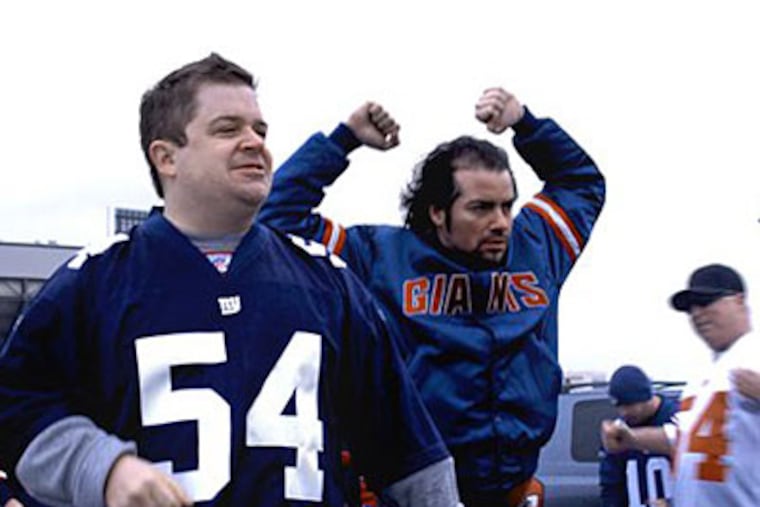
Before there was The Wrestler, there was Big Fan.
Back in the early oughts, Robert Siegel scripted what was then called Paul Aufiero - a dark, oddball character study about a Staten Island garage attendant whose sole passion in life, his obsession, was the New York Giants.
Although Siegel's background was comedy - he was editor-in-chief of The Onion, the parody newspaper and Web site, and had done screenplay work for the likes of Judd Apatow - this movie, in Siegel's mind, wasn't funny ha-ha.
"I didn't think of it as a comedy, I always thought of it as a sort of 1970s Scorsese kind of movie," says Siegel. "You know, Mean Streets, The King of Comedy, Taxi Driver."
In 2003, director Darren Aronofsky read Paul Aufiero and saw it pretty much the same way. He met with Siegel and was close to making it his next project, but the timing wasn't right. Instead, Aronofsky asked Siegel if he would consider doing a script set in the world of hard-core, body-slammin' pro wrestling.
Siegel wrote The Wrestler, Mickey Rourke was nominated for a best actor Oscar, and the Aronofsky/Siegel collaboration became one of the runaway indie hits of last year.
And so Siegel decided to make Paul Aufiero, redubbed Big Fan, himself. The film - which pits the Giants obsessive played by comedian Patton Oswalt against a Philadelphia Eagles fanatic (Michael Rapaport) - opened Friday at the Ritz at the Bourse. (The big climax takes place in a Philadelphia sports bar - actually, a Staten Island sports bar made over with posters of Eagles and Phillies stars.)
As he was getting ready to shoot, Siegel hung around on the set of The Wrestler in New Jersey and Philadelphia (the Alhambra Arena, the wrestling venue), but he wasn't taking notes on how to direct.
"I should have been, of course," he says, laughing, "but I was too busy stealing crew members. I'd ask everybody what they were doing next, or, if I couldn't afford them, if they had recommendations - the lighting people, the sound people, costumes."
Siegel says that from Day One, he was comfortable in the director's chair.
"Although, technically, there was no director's chair," he deadpans. "We all stood. . . . This was low-low-budget, no trailers for the cast, no anything. . . .
"But I found directing to be a lot like being editor of The Onion - you know, delegating, collaborating, getting your ideas across. Directing is the opposite of writing. It's reactive. And it's easier. There's nothing scarier than a blank page."
As for Oswalt, who was the voice of Remy in the animated hit Ratatouille (and who can be seen as an FBI guy in Steven Soderbergh's forthcoming The Informant!), Siegel suspected that the stand-up comic had a well of weirdness to draw from.
"As a general rule, comedians are actually pretty dark and strange people," notes Siegel. "And when I met with Patton, he had this perfect sense of the character, of who Paul was. I thought he could play this 35-year-old who still lives at home with his mother, this strange guy, and at the same time come across as likable, as sympathetic, to the audience."
Big Fan premiered in January at the Sundance Film Festival. In the festival's program guide, says Siegel, the film was described as "hysterical."
And that takes Siegel back to the comedy vs. drama dilemma. "Big Fan is not a comedy," he insists. "It's a drama, with some dark comedic elements, perhaps. . . .
"And it's deadly for an audience to go into a theater expecting to see a comedy and then it's not. . . . It's like describing GoodFellas as a comedy. Imagine the shock, the horror, the disappointment."
Shorts. Wall Street 2: Money Never Sleeps, Oliver Stone's follow-up to his 1987 greedhead epic, begins shooting in a few weeks. Shia LaBeouf is the young trader apprenticing under Michael Douglas' financial-world guru, Gordon Gekko. Frank Langella is on board, and Susan Sarandon has signed to play LaBeouf's character's mother. . . . Speaking of sequels, District 9, the South African aliens-among-us sci-fi hit, is looking to spawn. Director Neil Blomkamp is telling folks that the studio - Sony's TriStar - is keen to order a follow-up about the bipedal, crustaceanlike E.T.s, derogatorily dubbed "prawns" by the human Johannesburgians they unhappily coexist with. This is only District 9's third weekend of release, and (as of Thursday) it had already earned close to $80 million. The Peter Jackson-produced sleeper, shot in a faux documentary style, cost about $30 million to make. . . . Director Sam Mendes, the Brit-turned-New Yorker (he lives there with his wife, Kate Winslet, and their brood), is trying to get Joseph O'Neill's Netherland - the beautifully written novel about a Brit-turned-New Yorker - to the screen. Mendes has enlisted Christopher Hampton, playwright and Academy Award winner (Dangerous Liaisons), to adapt the book, set in post-9/11 New York and revolving, plotwise, around a bunch of British Empire expats and their shared obsession for the sport of cricket.