Sob stories: Why some films have us yanking hankies before the credits roll
WE WERE about to leave the house to go see "My Sister's Keeper" when my wife handed me a box of Kleenex and advised me to stock up.
WE WERE about to leave the house to go see "My Sister's Keeper" when my wife handed me a box of Kleenex and advised me to stock up.
I just assumed she wanted me to tuck a wad of tissues in my pocket to have ready whenever her girlie tear ducts succumbed to the ruthless big-screen weepfest about a teen suffering from leukemia.
But, no, the crying rags were for me.
"I've read the book. I'm prepared," she explained. "You're not."
Turns out she was right. We went. We saw. I wept . . . And then I cursed her for dragging me to the stupid film.
Apparently, I have all the emotional stability of Paula Abdul. But it seems to be a mysterious and highly random thing. For example, Diane, a sensitive mother of two, used to lose it every time an episode of "ER" featured an injured or endangered child. Me? My eyes would remain as dry as the desert heat.
On the other hand, "Friday Night Lights," a bighearted TV drama about the triumphs and tribulations of a high-school football team, has repeatedly made my eyes glaze over in a fine mist - or, as I prefer to call it, retinal perspiration.
Go figure.
It's a phenomenon that long has piqued my curiosity: Why do certain movies and TV shows provoke tears? More importantly, why are some of us affected and others not?
"For many people, the themes and scenes depicted in the cinema are evocative of all kinds of poignant experiences in their own lives," says Steven Freemire, a Walnut Creek, Calif., family therapist. "It's a deeply personal thing."
Apparently so. I recall a review of a "Lord of the Rings" movie by a former colleague in which she wrote that she cried for the entire last half hour. So I went into the same film braced for the worst but emerged tear-free. Apparently, hobbits just don't jerk my tears.
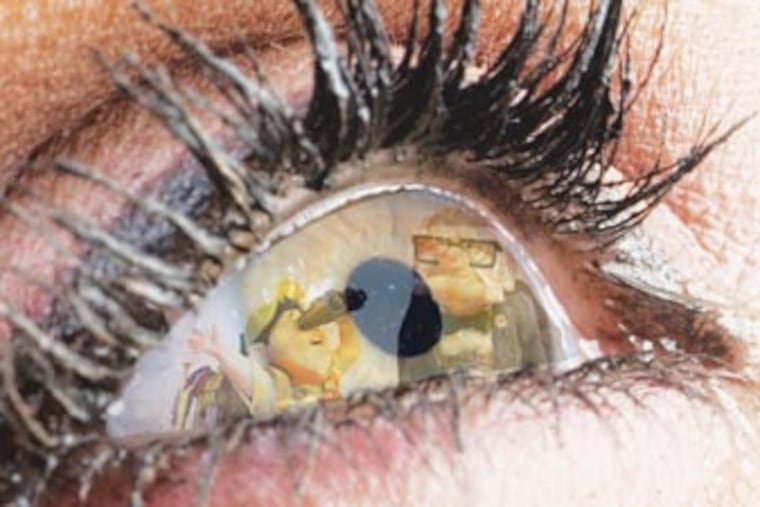
Then again, animated codgers do. Earlier this summer I heard so much advance buzz about the emotional opening sequence of Pixar's "Up," that I thought I'd be immune to it. There was no way this film would get to me, I reasoned. Not a computer-generated cartoon, for crying out loud.
But when I saw the lovely montage of scenes that encapsulated a lifelong love affair between an elderly widower and his spouse, I became a blubbering wreck. A pox on those crafty Pixar geeks!
"The scenes [in 'Up'] obviously speak with issues of love and loss, connection and separation," says Judith Kay Nelson, a Berkeley, Calif.-based teacher and therapist, and author of "Seeing Through Tears: Crying and Attachment." "Those are universal issues and a good film that taps into them in a skillful way will always bring on the tears."
Still, it's not easy for a guy to admit that TV shows and movies occasionally make him soggy. Even worse is when your reputation for tissue dependency precedes you. To wit: Last winter, I went with a male and female co-worker to see "The Curious Case of Benjamin Button." When we emerged from the theater, the guy gazed into my eyes and asked if I'd cried.
I didn't know what ticked me off more: The fact that he targeted me instead of our female friend, or that Mr. Button (Brad Pitt) actually did get under my skin. Just a little.
Of course, we have been conditioned to regard crying as a sign of weakness. But Nelson - bless her soul - insists there is power in crying: "The simple act of shedding tears is a powerful signal calling attention to our pain, disturbing others and, under ideal conditions, bringing them to us when we most need help," she says.
Nelson refers to our cinematic waterworks as "vicarious weeping." And she points out that, in our society, public ritualistic crying is a very rare thing that typically happens only at funerals, weddings . . . and movies.
"During a film, we're cloaked in darkness. So that makes it socially more comfortable and private," she says. "Plus, the images we're watching are larger than life. So you're really inducted into the feeling state."
What we feel, of course, varies from person to person. There are dozens of so-called "chick flick" weepies along the lines of "Steel Magnolias" and "Beaches" that will trigger flash floods in our wives and girlfriends. If guys cry at these films, it's usually only because they've been dragged to them kicking and screaming.
But men have their cinematic soft spots, as well. Several critics and cultural observers over the years have produced lists of officially sanctioned male weepies - films where it's perfectly OK for dudes to slip into super-soaker mode. Said Freemire of these efforts, "It's an attempt to rationalize things that aren't rational."
The canon of male weepies is littered with movies about dying - dying soldiers ("Saving Private Ryan"), dying fathers ("Big Fish"), dying athletes ("Brian's Song"), and even dying dogs ("Marley & Me").
Also sure to tug at male heart strings - besides an artfully depicted explosion of an enemy spacecraft - is a reconciliation between an estranged father and son. The standout film in this genre is, of course, 1989's "Field of Dreams."
To be honest, the Kevin Costner baseball flick is filled with starchy dialogue and is more than a little lame. A bunch of ghosts emerging from the great beyond to frolic in a cornfield? Just what kind of hallucinogens was that poor writer on?
But somehow it works - at least on guys. As film critic Roger Ebert pointed once wrote, "Field of Dreams" reminds us of a "good and innocent time."
And when Costner finally gets to play catch with his long-dead father at the end of the film? Well, you might as well take me out to the bawl game.