British Museum gives Montezuma's image a boost
A new exhibit offers the Aztec leader, reviled as a tyrant and military failure, more balanced treatment.
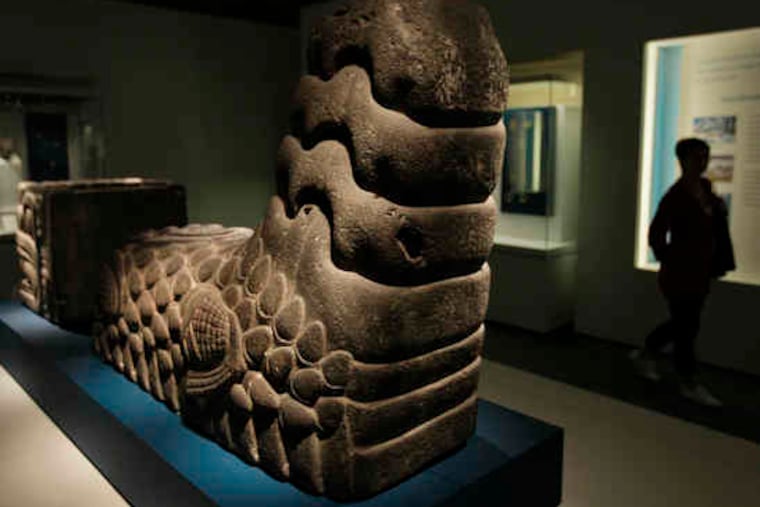
LONDON - The world-famous British Museum, home of the contested Elgin Marbles sought by Greece, is leaping into another controversy with a special exhibit reexamining the life of Montezuma, the doomed last ruler of the Aztecs.
The Montezuma exhibit, which opened yesterday, is the fourth and final British Museum show devoted to the use of political and military power through the ages. Earlier exhibits dealt with the first emperor of China, the Roman emperor Hadrian, and the Iranian ruler Shah Abbas.
Montezuma, who reigned over the sprawling Aztec empire from 1502 to 1520, let Hernando Cortes and the Spanish conquistadors into the Aztec capital, giving them jewels and other gifts while they plotted to murder him and subjugate his people. Cortes destroyed the Aztec capital and built what would become Mexico City there, ushering in a new era in the Americas.
Now museum curators want viewers to realize that much of what they know about this flawed ruler - including the claim that he was killed by his own people - may be based on versions told by the Spanish, making it, in effect, history as written by the victors.
"A lot of the perceptions of Montezuma and these tumultuous events of the Spanish conquest are seen through a Western lens," curator Colin MacEwan said. "The challenge is to try to tell the side of the story that isn't usually told. It's personalizing history and establishing a more direct connection with one person's footprint in history."
He said Montezuma was much more complicated and skilled than generally has been recognized.
"Montezuma was a multifaceted individual - he was a skilled administrator, a politician, he reordered the court to rid himself of certain advisers and keep tighter control," MacEwan said. "He was a warrior, a battle-hardened military commander, but he was also the head of the priesthood, directly responsible for the well-being of his people, seen as a semidivine being."
MacEwan said Montezuma should have been able to repel Cortes' advance "by sheer force of numbers" but was outmaneuvered by the Spaniard, who enlisted the Aztecs' enemies as he marched toward Tenochtitlan, the magnificent island city that has been transformed into modern, polluted Mexico City.
Erica Segre, professor of Latin American studies at Cambridge University, said the exhibit took the Aztec ruler out of the "imaginary frame" of European perception of the indigenous world and evaluated him instead as the last emperor of a pre-Hispanic empire before the conquest.
"It restores him in contemporary terms to an appreciation of the entirety of what Aztec power entailed," she said.
But Segre said Montezuma was not a popular figure in Mexico or Latin America, where those who resisted the colonizers often are celebrated.
"He's been a difficult figure to appropriate for nationalism because on the one hand he was a tyrant and on the other hand his own judgment was called into question," she said, referring to Montezuma's disastrous tactical decisions. "He is seen as a tragic figure who conspired in his own undoing."
Miguel Pastrana Flores, a history professor at the National Autonomous University of Mexico, said Montezuma's reputation had improved somewhat inside Mexico in recent years.
"There was a very strong tradition of criticizing him," Flores said. "He did not fit well into the heroic, national vision of Mexico. But there is another perspective, putting him in his context as a historical figure who had to confront an unimaginable problem. He confronted a problem of enormous magnitude, the European presence, that was for the Meso-American world something simply unthinkable."
He said Montezuma and other figures from the conquest era still played an important role in Mexico's national life as Mexicans grappled with the origins of their deeply unequal society.
The museum has not shied away from controversy in the political- and military-power series, using its global clout to tackle the great geopolitical issues of the past. The museum has been equally unapologetic about the history of its own collection, a significant portion of which was built up when Britain's empire spanned much of the world.
The most enduring example is the Parthenon Marbles, also known as the Elgin Marbles - 2,500-year-old sculptures and friezes removed in the early 19th century by the British diplomat Lord Elgin. The British Museum repeatedly has rejected calls for their return to Greece.
The new exhibit, including many masterful examples of Aztec art that are rarely allowed to travel outside Mexico, tells the story of Montezuma's life from a generally sympathetic point of view. Among the spectacular pieces are a haunting turquoise mosaic mask and a turquoise double-headed serpent, plus some unusual gold jewelry and body ornaments.
There is no effort to gloss over the use of human sacrifice that was prevalent in Aztec society. Some of the finest sculptures on display contain basins where human hearts were placed after sacrifice.
But there is no doubt the exhibit is revisionist in tone. A news release announcing the show says it will "attempt to rehabilitate Montezuma."
Visitors are greeted with a prominent sign announcing that the term Aztec is incorrect when referring to the people who inhabited the Mexican highlands and that they instead should be called the Mexica people.
In the same vein, the common spelling of Montezuma is changed to Moctezuma in a bid for historical accuracy - MacEwan said the spelling Montezuma represented a Western corruption of the leader's name.