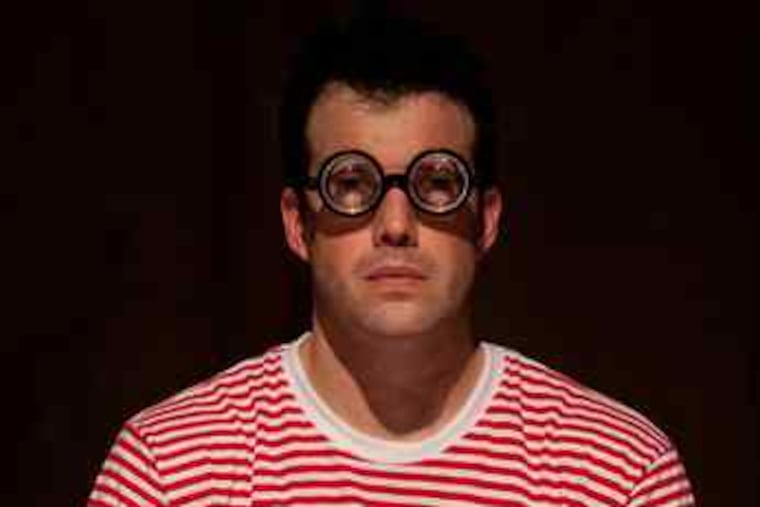
From the age of 6, Lorenzo Pisoni was locked every day in a wooden trunk stuffed with helium-filled balloons and strapped to the back of his father, Lorenzo Pickle.
But he wasn't alone. Little Lorenzo, who was dressed to look exactly like his clown dad, red nose and all, lay next to littler Lorenzo, a wooden dummy that was the spitting image of Lorenzo the boy (who was the spitting image of Lorenzo the man).
That's the opening of one of the seriously humorous, slightly bizarre, and always fresh and surprising tales told by circus performer-turned-actor Pisoni in Philadelphia Theatre Company's Humor Abuse, an award-winning autobiographical one-man show about his circus childhood now in previews at the Suzanne Roberts Theatre.
Lorenzo Pickle, alter-ego of Pisoni's father, professional circus clown Larry Pisoni, wasn't practicing some form of post-Dr. Spockian child care. He was schooling his son in the art of being funny, which he took very seriously.
Perhaps too seriously, Lorenzo Pisoni says in the course of the show.
So serious, so rigorously demanding was Dad, that in a Bizarro World version of every kid's fantasy, young Lorenzo used to fantasize about running away from the circus.
The slim, handsome Pisoni, 32, who has the rugged yet slightly boyish face of a matinee idol, begins the show with a lie: "I'm not funny," he insists.
Mimicking his father, he paces the stage with a trunk strapped to his back. Setting it down and opening it with the exaggerated moves of a Buster Keaton or Harold Lloyd, he produces his dummy/buddy.
The crowd guffaws - but the laughter undergoes a strange mutation as Pisoni explains how his father named his son after his clown character's dummy, not the other way around.
And lately, he adds, his dad prefers being referred to as Lorenzo.
Freud would have a field day with this. Pisoni and his cowriter and director, Erica Schmidt, bank on it.
At turns side-splitting, serious, melancholy, and surreal (picture Pisoni wearing swimming goggles and diving flippers trying to climb a 10-foot ladder), Humor Abuse tells the story of Lorenzo's not-so-typical childhood as a performer in the Pickle Family Circus, which was founded in 1975 by his father and his mother, Peggy Snider, an accomplished juggler.
Based in San Francisco, the Pickle Family Circus was part of the New American Circus movement, which focused on characters and storytelling rather than mere spectacle.
"We weren't doing high art, but we did take it seriously, and there was an art to it," Pisoni said in an interview. "There were no animals and there was only one ring, not three as in the traditional circus" - the same model adopted by Cirque du Soleil, for which Pisoni has worked, as emcee of the Canadian circus' Mystere in Las Vegas.
By 1978, when he was 2, little Lorenzo was entertaining audiences with a faux-juggling act. When he was 6, he turned pro, signing a contract with the circus.
"When he was a kid, Lorenzo was learning back flips, not learning to throw a baseball," Schmidt said, but the father-son dynamic was "the same kind."
Punctuated by spectacular acrobatic feats - pratfalls, double-takes, juggling, a bit where Pisoni repeatedly falls down a staircase - Humor Abuse delves into the complex relationship between the boy and his caring, if emotionally remote, father.
Pisoni worried that the show would upset his father, who saw it on its New York opening in March.
Instead, there was nothing but support.
"He is very proud of the show," Pisoni said.
And since then, things have changed for the better. "He's been more and more concerned with the very small things in the show," Pisoni said. "I'll get calls from him and he'd ask about certain routines and certain moves."
This is an improvement?
"That's his primary way to connect - through the technique. He's certainly more proactive than he has been in years past."
Pisoni said some of his best years were spent on the road with his father. (By 1986, his parents had split up.) But as he entered his teens he discovered, as all children do, that his father was fallible; Larry Pisoni was a deeply unhappy man.
"I think in general he is happier" now, Pisoni said. "Back then, he would repress any kind of contentment."
Schmidt cut in with a laugh. "Right - he's nothing like you, Lorenzo." Pisoni parried with, "[My father and I] are not similar in any way."
The two, who met more than a decade ago at Vassar College, have an easy, teasing rapport.
"We had art history together," Schmidt said. "We had this very young, beautiful [teaching assistant] and she would call on him all the time. And he had this phrase - 'This painting has a certain je ne sais quoi' - he used all the time," she said with a chuckle.
Pisoni, who graduated in three years ("but I'm not smart") with a degree in film theory, said college helped him fulfil his childhood fantasy: to run away from the circus.
"In college, you kind of start to see what the rest of your life could hold," he said. "And I started to realize that I didn't want to be a circus performer all my life. It was the first time I thought that way."
In 1999 - at 23, after 20 years in the circus - he retired. Since then, he has amassed an impressive resumé as a stage, film, and TV actor. In his highest-profile role, he played the man-horse opposite Harry Potter star Daniel Radcliffe in last year's Broadway production of Equus.
Still, the circus taught him valuable lessons, which he hopes he imparts in his show.
"The line between tragedy and comedy is so thin. That's the line the clown has to walk," he said. "We laugh [at him] because we want so badly not to fall. . . . Not to be hit. Or fail.
"That's also what Larry, what my father, always was hinting at."