Art: Two toasts to Phila. photography
Art Museum salutes '60s and '70s; Woodmere's Triennial surveys current work.
Photography is making waves in Philadelphia this fall, which is as it should be, given the city's contributions to the medium over the decades.
Two museum exhibitions directly address the city's distinguished photography culture. One of these, "Common Ground," hangs at the Philadelphia Museum of Art. The other is the "Triennial of Contemporary Photography" at Woodmere Art Museum in Chestnut Hill.
"Common Ground" presents a cross-sectional sample of how eight local photographers, some of them now renowned, expanded aesthetic boundaries during the 1960s and early '70s. Some of this work looks daringly experimental even today, even in black and white.
Woodmere's third edition of the Triennial, guest-curated by Stephen Perloff, founder and editor of the Photo Review, presents a selective survey of current activity. Its range of strategies is broader but, like "Common Ground," the level of talent and achievement is consistently high.
The exhibitions are linked by the inclusion in each of Bucks County photographer Emmet Gowin, who over four decades has established an international reputation.
At Woodmere, we see his more recent work, delicately toned photographs of particular Western landscapes that have been transformed into moonscapes by testing of nuclear weapons.
In "Common Ground," by contrast, we encounter Gowin at the beginning of his career, through sensitive and sometimes touchingly intimate candid portraits of family and friends.
The juxtaposition of the two phases of Gowin reminds us that no artistic medium stands still for long. Artists evolve and, with photography, so does technology, which enables innovation and helps to simplify sometimes laborious compositional concepts. These two shows demonstrate how much richer photography has become over the last several generations.
Oddly, "Common Ground" seems the more radical of the two. This might be because, as we see at Woodmere, over the last 40 years photographers have revived and refined earlier technologies and points of view such as pictorialism, non-silver emulsions, and large-scale realism.
Granted, digital photography and ink-jet printing are revolutionary, but, as we also see at Woodmere, their aesthetic impact isn't always significant or readily apparent. For that reason, the visual and conceptual qualities of time-honored silver-based imaging have retained their experimental freshness.
"Common Ground," like the Triennial, features eight photographers, selected by Art Museum curator Peter Barberie. Besides Gowin, they are Ray K. Metzker, Will Larson, Sol Mednick, David Lebe, Carol Taback, Catherine Jansen, and Will Brown.
Among them, Gowin, Mednick (who founded the photography department at what is now the University of the Arts), and Brown worked closest to the straightforward realism common at the time. However, Mednick produced wide-angle street scenes that are mildly cubistic, while Gowin deliberately mismatched lenses and camera bodies to create round, telescoped images.
Metzker pushed cubistic fragmentation and multiple imagery the furthest with gridlike composites. Taback achieved something similar, a fly's-eye mosaic, by making portraits in a commercial photo-booth and combining many small prints. Using time-exposure, Larson photographed nudes on a rotating platform, which produced fantastic elongated distortions.
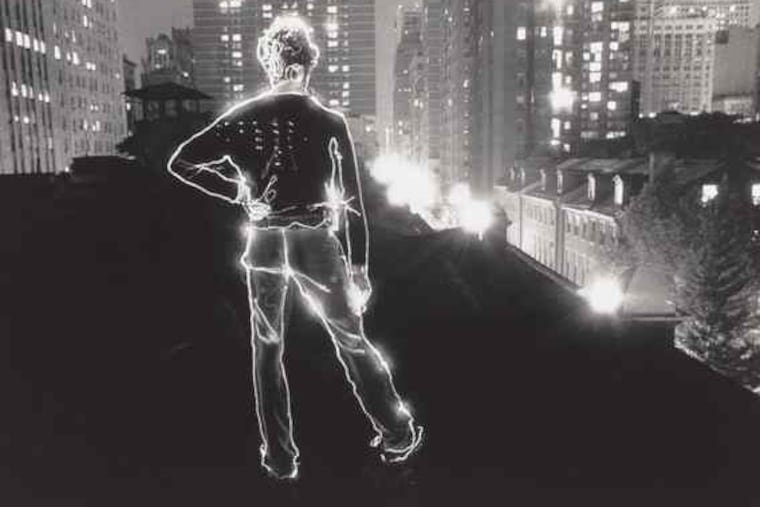
Lebe also used time-exposure for his distinctive "light-drawings" - figures in dark settings outlined with a moving penlight. Jansen made large cyanotype photograms, and also printed objects as color photocopies on cloth to make what are, in effect, three-dimensional pictures of domestic interiors.
Such technical manipulations are less evident in the Triennial. John E. Dowell Jr. uses time-exposure for his large-scale, bird's-eye views of Philadelphia and Chicago at night. Martha Madigan makes photograms using the human body overlaid with botanical motifs such as leaves.
Generally, though, one is less conscious of innovation and legerdemain, except in Ron Tarver's mysterious "astronomical" visions. The exact material nature of these simulations keeps one guessing, although I suspect fruits and vegetables might be involved. In only one case, an image of two seashells mimicking spiral galaxies, is the impersonation evident.
In assembling the show, curator Perloff has achieved a pleasing overall contrast and balance, not only concerning techniques and subject matter but also in terms of artists who are well-known contrasted with those establishing reputations.
Familiar masters like Gowin and Madigan are juxtaposed against up-and-comers such as Zoe Strauss, Daniel Traub, and Andrea Modica. They bracket less-recognized photographers such as Dowell, better known here as a painter and printmaker, and Sarah Van Keuren, whose softly colored, gum bichromate-cyanotype landscapes represent a lush and beguiling application of 19th-century process.
Strauss' color inkjet prints from an extended series on Alaska exemplify a leading edge of current practice, which employs the latest digital technology.
Yet her subjects, some portraits and snowy landscapes disturbed by odd anomalies such as a basketball backboard and a huge roller skate on a pole, are comfortably familiar, like the vernacular oddities featured in pictures by another local photographer, David Graham.
Modica's soft platinum-palladium prints of a lumpy female nude are surprisingly sensual in a formal way. They also feel antique, like a drawing of a seated nude that Thomas Eakins made about 1870.
Traub's selective and superbly detailed scenes of life on the outskirts of Chinese cities, printed in crystalline, large-scale color, reveal an odd combination of documentary precision and theatrical staginess - and also an abundance of litter.
This brings us back to Gowin, who will retire from teaching at Princeton University at the end of this year. (A retrospective of his career will open at the university's art museum Oct. 24.)
Gowin's contribution to the Triennial consists of 16 toned silver prints from his series "Changing the Earth." As noted, these are aerial views taken over nuclear test ground in Nevada, showing features such as subsidence craters that have made the desert look alien.
Much like the Gowin family portraits in "Common Ground," this is traditional photographic thinking with an elegant topical twist. It's contemporary, but also consistent with the way Americans have used the camera to describe and decode the Western landscape since the days of Carleton E. Watkins and William Henry Jackson.
Art: Then and Now
museum.org.
Hours: 10 a.m. to 5 p.m. Tuesdays through Sundays. Admission: $7 general, $6 for visitors 65 and older, $5 for students with ID and visitors 13 through 18. Information: 215-763-8100, 215-684-7500 or www.philamuseum.org.
EndText