Going Soon ... The Spectrum
The decades-old venue where headliners performed and memories were created will itself be just a memory come month's end.
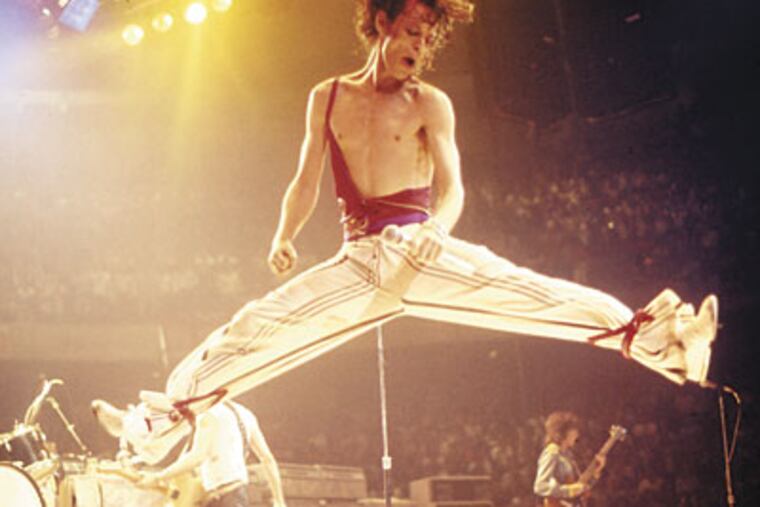
So what's so special about the Spectrum, anyway?
To Bruce Springsteen, it has to do with the musical history of the place where rock and roll came of age in Philadelphia - the first arena he ever played, anywhere, opening for Chicago in 1973.
"These old venues build up a certain degree of soul," the Boss said in April, when he played the South Philadelphia showplace. He'll do four more Spectrum shows before Pearl Jam brings the curtain down on the venue with its fourth and final show, on Oct. 31.
"They don't make arenas like this anymore. And they ended up being ideal for rock shows, without the luxury boxes," Springsteen said, praising the "democraticness" of the venue.
The arena, which opened in 1967, hosted neo-soul man Maxwell last night and will see Canadian bard Leonard Cohen and blue-eyed-soul duo Hall & Oates later this month. "It's a treat to be in this lovely old building before it comes down," Springsteen also said. "So we salute the Spectrum."
Since last year's announcement of the Spectrum's impending destruction - which is scheduled for early next year to make way for a retail complex called Philly Live! - Springsteen has hardly been the only one singing the praises of the gritty old building, which has hosted acts from Moby Grape to Madonna, Miles Davis to Milli Vanilli, Tina Turner to Teena Marie.
The arena, built to accommodate the Flyers and the Sixers (which, respectively, brought home championships in 1974-75 and 1983), has in the last year seen Neil Young, Green Day, Foo Fighters, and the Dead. All have opted to play the cramped building known for its sticky floors and barely-room-to-breathe concourse, and the sight of women braving the men's bathrooms.
The run of headliners recalls the Spectrum's glory days pre-1995, when the capacious, comparatively soulless Wachovia Center opened across the parking lot. The two are close in capacity - the Wachovia Center holds 19,600 for hockey, the Spectrum 17,380. But the Wachovia has 26 bathrooms compared with the Spectrum's 8, and its 1 million square feet could swallow up the Spectrum's 350,000 square feet.
Since the beginning of the modern concert era - around September 1967, when the Spectrum opened with the Quaker City Jazz Festival - Philadelphia has been a particularly robust rock town. And until the Wachovia opened, the Spectrum, once nicknamed "America's Showplace," was where the action was.
"Philadelphia emerged as the No. 4 market in the country early on," says Gary Bongiovanni, editor of Pollstar, which monitors the concert industry. "Everybody plays New York, L.A., and Chicago, and really everybody plays Philadelphia, too. You can't say that about D.C. or San Francisco."
It began in the late 1960s and early 1970s, when Larry Magid and his Electric Factory Concerts partner Allen Spivak, working with Flyers owner Ed Snider, began putting on shows like the July 1969 quintuple bill of Led Zeppelin/Jethro Tull/Al Kooper/Buddy Guy/Country Joe & the Fish. And the Rolling Stones/Stevie Wonder bill in July 1972.
"It didn't happen by accident," says Magid, who still heads Electric Factory and is chairman of the Mid-Atlantic branch of the Live Nation concert promotion empire. "It had nothing to do with the drinking water."
What it did have to do with was a youth culture feeling its oats, just as Snider succeeded in luring an NHL franchise to Philadelphia.
"Philadelphia had no major arena and it was the fourth-biggest city in the country," says Snider, now chairman of Comcast-Spectacor, which operates the Spectrum and the Wachovia Center. "The timing was perfect."
There were some other options for concerts, like the Civic Center in University City, which was torn down in 2005, but none was ideal. "They were interested in the standard headliners of the day," says Magid. "Like Diana Ross, or Herb Alpert & the Tijuana Brass."
Snider, a Billy Joel fan now, wasn't fazed by the longhairs then. "It didn't matter to him who came to the building," says Magid, "as long as people came to the building."
Bongiovanni adds, "A lot of people who managed arenas were frightened by rock and roll. The Spectrum was . . . one of the handful of buildings that really embraced the new music of the time, and helped build it."
It's now second nature for Philadelphians to head to South Philly for big events. But that wasn't the case before the Spectrum, which is the subject of a sentimental documentary called Building a Memory, which features Billy Joel and Mickey Hart of the Grateful Dead, as well as Julius Erving and Bobby Clarke, and debuts on Comcast SportsNet tomorrow at 9 p.m.
In 1967, the Spectrum opened up just north of John F. Kennedy Stadium. But the Eagles didn't play at J.F.K., they did battle at Franklin Field, and the Phillies swung their bats at Connie Mack Stadium in North Philly. "If the Spectrum wasn't successful, there wouldn't be anything else there," says Magid.
"You couldn't build the Spectrum today," says Peter Luukko, president and chief operating officer of Comcast-Spectacor. That's because standard arena practices call for "tread width" - meaning, leg room - of at least 33 inches. The Spectrum's tread width is only 30 inches.
The relatively intimate arena vibe "is about the tightness of the bowl," Luukko says. "That, and the experiences that people had there in various stages of their lives."
As less-than-pretty, airplane-hangar-size rooms go, the Spectrum has always had better sound than most. (Including its next-door neighbor.) "It just worked out that way," says Snider. "We spent months and months to make sure the sound was great at the Wachovia Center, but the Spectrum we didn't spend one minute on."
"There was always more electricity in the Spectrum," says Magid. "Philadelphia audiences always sounded better."
Especially early on, the Spectrum hosted many a multi-act bill. "Give people more than they expect," says Magid. "That's always been my mantra. And not only were these musical events, but they were also social and cultural events." As often as possible, Spectrum shows were seatless on the floor. "We wanted people to move around. It was like a big party."
When pushed to name some of his favorite shows, Magid points to Bob Dylan and the Band in 1974, and George Harrison, Elvis Presley, and Rolling Stones concerts of that era. "It's generational," he says.
He also notes that though the Spectrum was known as a temple of arena rock, it hosted more than its share of great soul and R&B acts, including Marvin Gaye; Curtis Mayfield; Earth, Wind & Fire; and Sly & the Family Stone.
Crowds are also pressed closer to each other at the Spectrum. "I didn't totally recognize it until the new place opened," says Pierre Robert, the WMMR (93.3 FM) DJ who has been on the air since 1981. "But there is most definitely a warmth there. The audience is more compact. And there are fewer distractions. . . .
"The Wachovia Center is inundated with ads. It's, 'I'll meet you at Advil Exit No. 17," and "No, honey, I'm at Tylenol exit No. 10."
Since the 1990s, the Spectrum has had the names of three banks attached to it. Currently, it's officially known as the Wachovia Spectrum. "Quite frankly, that's [nonsense]," says Robert. "Nobody's going to say, 'Let's go to the Wachovia Spectrum.' It's 'Let's go to the Spectrum.' Because its image was embedded in the Philadelphia consciousness from the time it was built."
Since the Spectrum's impending doom was announced in July 2008, baby boomers have been overcome with nostalgia.
"Most people don't like what they do for a living," says Magid. "We've seen the charts and the graphs. But they like a sports team or two, or some form of entertainment."
And whether your favorite act was Garth Brooks or Public Enemy, Aretha Franklin or Rage Against the Machine, Frank Sinatra or Fleetwood Mac, chances are good that if you lived in the Philadelphia area during the last four decades, you saw them at the Spectrum.
"You hear that song on the radio, and you go back to that moment because there's a great memory there," says Magid. "And it was about being at the right place at the right time. And that place was the Spectrum."