Anticipating the Boss' 'Darkness'
On each of the four nights that Bruce Springsteen plays the Spectrum over the next two weeks, he and the E Street Band will uncork one of his landmark albums from start to finish.
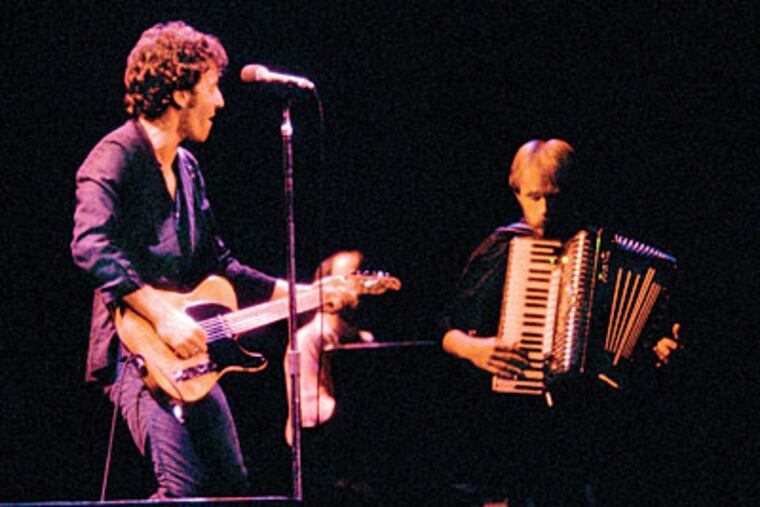
On each of the four nights that Bruce Springsteen plays the Spectrum over the next two weeks, he and the E Street Band will uncork one of his landmark albums from start to finish.
On Tuesday, it'll be Born to Run, the 1975 opus that landed the Boss on simultaneous covers of Time and Newsweek. On Wednesday, he'll do Darkness on the Edge of Town, the 1978 guitar-driven salvo whose shouted exhortations have been cathartic kick-starters at Springsteen shows for 30 years. He'll reprise Born to Run on Oct. 19, and the next night he'll punctuate his final Spectrum show with Born in the U.S.A., the 1984 blockbuster that turned him into a cover-of-People megastar.
I have no doubt that Born to Run will be appropriately majestic. And I'm betting that Born in the U.S.A., despite the album's diminished reputation among the faithful, due to its string of radio hits and big '80s drum sound, will carry the day on the strength of its songwriting.
But the reason that I'm glad that the 60-year-old AARP cover boy has joined the legions of aging musicians who are giving the people what they want - performing cherished albums in their entirety - is Darkness.
Darkness was the first Springsteen LP that got me, the one that slapped me with the shock of recognition in my stultifying Jersey Shore-town formative years back when I was drivin' all night, chasing some mirage. Mister, I wasn't a boy. Nope, I was a man.
Well, not really. But I did spend a lot of time listening to Darkness on the cassette player of my Chevy Nova while flooring it on the Atlantic City Expressway on the way home from high school every afternoon. And there was also that bootleg tape from an August 1978 Darkness tour stop at the Agora Theater in Cleveland that I played as I waited impatiently to see Springsteen live for the first time in December 1980 at the Spectrum.
That's the show that starts off with Eddie Cochrane's "Summertime Blues" and is chronicled in great detail in The Light in Darkness, Lawrence Kirsch's coffee-table book of fan recollections and superb concert photos. (It's available only at www.thelightindarkness.com.)
From my 2009 perspective, in a ranking of favorite Springsteen albums, I'd put Darkness third, behind its '80s successors, The River and Nebraska. Along with the trans-Atlantic clarion call that was The Clash's London Calling, Darkness was an uncompromised gut-punch about holding nothing back in pursuit of who you are - "with lives on the line, where dreams are found and lost," as Springsteen howls in the title track.
What Springsteen will do with Darkness, performing it whole, is what Public Enemy did in June, at the Roots Picnic, with It Takes a Nation of Millions to Hold Us Back. And what Steely Dan will do at the Tower Theater on Nov. 19-20 with The Royal Scam and Aja. And the reason I'm so ready to hear it isn't only because of what Darkness means to me, but what it means to Springsteen.
In many ways, Darkness is the first grown-up Springsteen album. The three that preceded it - 1973's Greetings from Asbury Park, N.J. and The Wild, the Innocent & the E Street Shuffle, and Born to Run - are all about the journey to adulthood. They're street operas and circus stories that teem with wildcat energy and over-the-top imagery. They tell the tale of a Jersey Shore romantic who springs himself from the cages on Highway 9 with a Wall of Sound heroism that culminates with "Born to Run."
I don't want to make those songs sound oversimplified, because they aren't. A lot of Born to Run is remarkably farsighted - if it weren't, it wouldn't have held up this long. I always loved that line in "Born to Run": "Together, Wendy, we could live with the sadness, I'll love you with all the madness in my soul." That's not written by a guy who imagines that pulling out on "Thunder Road" to win is going to put trouble behind him for good.
And sure enough, by the time Darkness rolls around, it's staring him right in the face - much of it, probably, because of the circumstances of Springsteen's own life.
Darkness' release was delayed by a long dispute between Springsteen and his original manager, Mike Appel. By the time it came out in '78, Springsteen was pushing 30.
Springsteen is the guy who broke away from his working-class roots by playing his guitar all night and all day, but on Darkness, he starts to look around and imagine what would have happened to him if he hadn't gotten out. He acquires the crucial gift of empathy: You can hear it in the taut, focused cadences of "Factory," which examines the collateral costs of a lifetime of meaningless work - "You just better believe, boy, somebody's gonna get hurt tonight." And, along with Roy Bittan's elegiac piano, it's there in the sorrowful hymn of "Racing in the Streets," which captures the point of view of the gearhead protagonist, but also the woman who "hates for just being born."
One of Springsteen's specialties as an artist is to harness the power of rock-and-roll as an uplifting force, even when telling stories grounded in despair. See "Lonesome Day," from 2002's The Rising.
Despite the title of Kirsch's book, there's not a whole lot of light on Darkness. Among his rock albums, it contains not only Springsteen's and Steve Van Zandt's fiercest guitar work, but also Springsteen's most grimly focused vision. There's still a Romantic Hero, but now he's hiding out there in the darkness 'neath Abram's bridge, or "heading straight into the storm," with a blaring harmonica watching his back in "Promised Land."
At times, Darkness can get overwrought. But what gives the album extraordinary power is its clenched-fist defiance. It describes a too-familiar world in which greed and lust for power ("Poor man want to be rich, rich man want to be king / And a king ain't satisfied till he rules everything") carry the day, and everything is stacked against the individual.
That's a pretty timeless tale of woe. And by Nebraska (1982), the Springsteenian hero will be so bummed that he becomes downright homicidal. But on Darkness, he - or she, depending on who's punching the air in the Spectrum on Wednesday night - is still stubborn enough to believe that even if "you spend your life waiting for a moment that just don't come," sustaining faith and love are still there for those bold enough to grab it. And after all those years down the road with Springsteen, that's the life-affirming jolt that Darkness still delivers.