Galleries: An evolution from furniture making to the painter's art
When you think of all the various lucrative professions that people have quit to pursue careers in the arts, a switch from the crafts world to the fine-arts one hardly sounds earth-shattering. Moreover, in the case of John Eric Byers, one might logically
When you think of all the various lucrative professions that people have quit to pursue careers in the arts, a switch from the crafts world to the fine-arts one hardly sounds earth-shattering. Moreover, in the case of John Eric Byers, one might logically have assumed that his creative wanderlust was being satisfied by the art furniture he'd been making for about two decades: imaginative, one-of-a-kind painted and gouged cabinets that were winning him critical praise in craft magazines and the New York Times, and honors such as the Louis Comfort Tiffany Award.
It wasn't. Two years ago, Byers gave up his furniture making to become a painter.
His new paintings, which were all made this year and are being shown at Snyderman Gallery, reflect his background in cabinetry. They are painted wooden bas-reliefs, in fact, made by incising grids on a wood panel to form rows of identically sized squares, which Byers then paints with different colors of milk paint. His choices of color combinations change with each work, but his seemingly random color patterns share a similar pulsating effect.
The paintings of Piet Mondrian, Theo van Doesburg, and Myron Stout come to mind, as do old-fashioned toy blocks, game boards, and early-American cupboards. Neo-Plasticism and de Stijl meet Yankee ingenuity. But Byers' subdued colors and the varnish and wax that he applies as a final surface to his works are also reminiscent of Jasper Johns.
Those who've seen Byers' furniture in past exhibitions here undoubtedly will recognize his paintings' spare aesthetic and careful craftmanship. The gallery, which hasn't always offered such a clear boundary between its exhibits, has done well to give Byers' meditative paintings most of its front gallery. It's added a big stroke of style to an already impressive debut.
Girls 4 girls
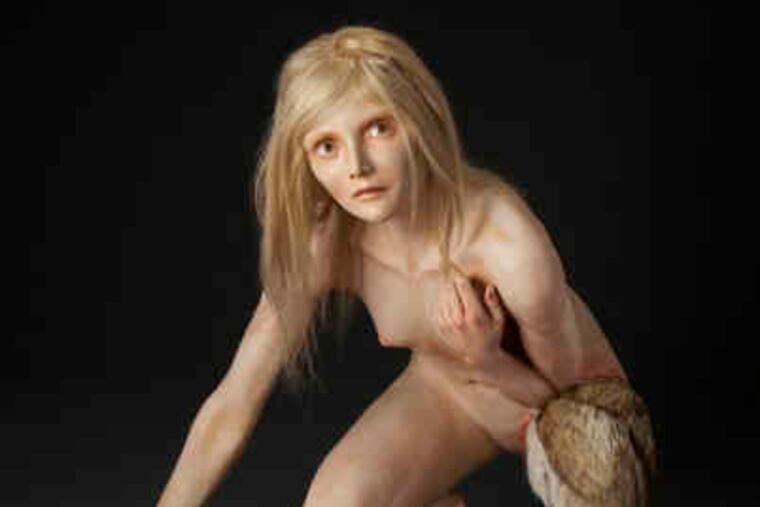
No, those are not naked girls practicing an avant-garde performance in Wexler Gallery. They are the lifesize, remarkably lifelike sculptures of young women that Chicago-based sculptor Dana Major Kanovitz sort of models after her own body - they're built up with layers of paper pulp and topped with real hair - and then paints. While not as startlingly real as Duane Hanson's dressed people, they have their own uncanny presence. (They also have enviably lithe little bodies, distinctly unlike Hanson's types.)
Kanovitz's figures are joined by other surreal, quasi-self portraits by Melanie Bilenker, Monica Cook, and Kiki Smith, in the narcissistically entertaining "The Self & Beyond," organized by Wexler's associate director, Sienna Freeman, herself an artist with a surreal bent.
Smith is represented by one of her tiny porcelain Sphinx sculptures and a small porcelain female figure, the heads of which both resemble Smith; Cook paints amusing oil portraits of herself in rapturous, erotic states, but tangled up with slimy creatures such as squids instead of human beings, and Bilenker is showing her tiny brooches and mini viewfinder, depicting images of a young woman involved in domestic activities, exquisitely "drawn" with hair embedded in resin.
Clearly, Freeman was hoping for a dialogue with the Marcel Duchamp's Etant Donnes at the Philadelphia Museum of Art when she selected these enchantingly offbeat images of women, by women.