Art: Arshile Gorky: Art and Anguish
The powerful paintings from a brilliant, brief life form a masterful, must-see exhibit at the Art Museum.
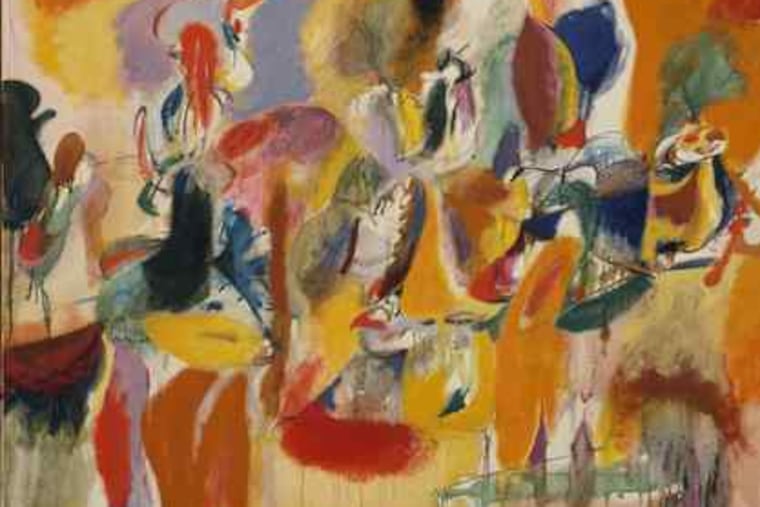
Make the strongest effort to see the spectacular Arshile Gorky exhibition at the Philadelphia Museum of Art. Not only does it contain an abundance of powerful, lyrical abstract painting, it tells a poignant and ultimately tragic story of how a poor, proud immigrant methodically and diligently transformed himself into one of the most influential artists of the last century.
Gorky's transformative role in American modernist art became obscured by the subsequent celebrity of the abstract expressionists and then the pop generation. This magisterial retrospective restores historical balance through a body of work that's both formally stunning and suffused with emotion.
Everyone enjoys colorful stories about tortured artists like Vincent van Gogh, Henri de Toulouse-Lautrec, and Jackson Pollock. But when it comes to a compelling life story at Hollywood scale, no artist tops Gorky.
That wasn't his real name; he was born Vosdanig Adoian about 1902 in a town near Lake Van, the heart of the historical Armenian homeland in eastern Anatolia.
In 1906, his father left for America, and thereafter had little contact with his wife and children. In 1915, the event known as the Armenian Genocide forced young Vosdanig and his mother to become refugees. Four years later, his mother, whom the artist subsequently memorialized in two iconic paintings, died of starvation.
Vosdanig and a younger sister emigrated to the United States in 1920. Shortly thereafter, he changed his name to Arshile (possibly a version of Achilles) Gorky, reportedly a tribute to the Russian writer Maxim Gorky, who supported Armenian nationalism.
After moving to New York in 1924, Gorky methodically schooled himself in art history by reading and visiting museums. With very little formal art training, he taught himself to be a modernist painter by absorbing, through mimesis, the techniques of other artists, particularly Paul Cezanne and Pablo Picasso.
By the 1930s, he was reasonably proficient in the modernist idiom, thanks also to the influence of Henri Matisse, Joan Miró, Piet Mondrian, and his American friend Stuart Davis. He didn't become an original, authentic voice until the early 1940s, when two circumstances provoked a dramatic transformation in his style.
The first was his marriage in 1941 to young Agnes Magruder, whom he called Mougouch. Her parents owned a farm in Virginia, where Gorky, till then a city-bound Manhattanite, discovered nature - or, rather, rediscovered what he had experienced on his father's farm in Turkish Armenia.
The second stimulus, which reinforced the first, was his encounters with leading European surrealists and his inclusion in two important surrealist exhibitions.
This synergy resulted in the paintings, created over perhaps six or seven years, that represent his legacy. Sadly, a series of tragedies stifled his career just as he reached the pinnacle.
In early 1946, his Connecticut studio burned, destroying a number of paintings. Two months later he was diagnosed with rectal cancer, which was treated surgically.
Then, in the summer of 1948, further catastrophe descended. His wife had a brief affair with his friend and fellow painter Roberto Matta. His neck was broken in an automobile accident. His wife left him, taking their two children. In mid-July, he hanged himself. He was only 46.
Such a biography quickly metamorphoses into legend. Yet ultimately we want to know, does his art transcend the soap-opera pathos of his life?
The answer, as Art Museum curator Michael R. Taylor demonstrates brilliantly in this masterly exhibition, is that Gorky is bigger than his tragic story. Not only the later paintings, monumentally composed and lushly colored, but his drawings, similarly intricate and precisely calculated, reveal an intuitive, finely honed, and persistent artistic intelligence.
At nearly 180 oils and drawings, this is a large, dense, and at times emotionally febrile collection - too much for one viewing. Plan at least two visits. It covers Gorky from alpha - a 1924 impressionist-style study of a Boston church - to omega, the aptly titled Last Painting of 1948, which is unfinished.
Thankfully, Taylor doesn't dwell on Gorky's prolonged infatuation with Cezanne or his later tutorial with Picasso. Some critics have cited both these phases as evidence that Gorky was essentially a pasticheur, but when this early work is considered in the context of the whole career, that accusation doesn't hold up: He was simply following the example of countless generations of artists who liberated their individuality by dissecting the work of established masters.
Once past the 1920s, when Gorky was still absorbing and experimenting, the show breaks into two general sections. In the first, the 1930s, Gorky is painting structurally. He's still influenced by cubism and, in paintings such as Organization and the Newark Airport murals (two of the original 10 are on view), also by Mondrian. The paintings tend to be linear, geometric, and heavily worked; some surfaces are stuccolike. Picasso's presence is palpable.
One senses that these works do not express either Gorky's experience or his essential spirit, that they are formal responses to, or variations on, what his contemporaries in New York are doing.
Two paintings, perhaps his most familiar because they're figurative, diverge from this practice. Made from a 1912 photograph, they depict young Vosdanig standing next to his seated mother. Gorky has pushed beyond mere transcription of a neutral document to a profoundly sad evocation of a fractured family and a lost culture.
The inner Gorky begins to emerge in a series of paintings called Garden in Sochi (a city in the Crimea) made in 1940-43. Despite their title, part of Gorky's adopted Russian facade, these paintings refer to his father's garden in Armenia. Miró-esque biomorphic forms, precisely situated, have replaced Picassoid distortions.
Garden in Sochi exposed the romantic surrealism that energizes Gorky's imagination; the paintings also suggest that work to follow will evoke Armenia, albeit in ways not obvious to most observers.
His exposure to the rural Virginia landscape in the early 1940s produced the efflorescence on view in the show's largest gallery, devoted to work of the mid-1940s. This features a stunning suite of seven landscape drawings, all completely abstracted from nature. Gorky always could draw, but these works reveal how much thought and intensity he put into efforts that sometimes served, in an Old Masterish way, as studies for paintings.
The full force of his creative ingenuity emerges in paintings such as One Year the Milkweed and Water of the Flowery Mill. The year 1944 is perhaps the apogee of Gorky's distinctive blend of surrealist form and natural content. His surrealism was rooted not in fantasy or dreams like that of Salvador Dalí or Max Ernst but in observation tempered by memory. It's not an alternative reality but a modified one.
In the last several years of his truncated career, Gorky's paintings become more somber. The Charred Beloved pictures refer to the studio fire, while the elegiac Soft Night, which is dark green, and The Limit can be read as reflecting the deepening depression that led to his death. While quieter and less exuberant than paintings of a few years earlier, these are sublime evocations of a tragic view of existence.
This retrospective, the first for Gorky in America since 1981, substantially enhanced my appreciation and understanding of this marvelous talent and conflicted soul. I hope it affects you similarly.
Art: Gorky Apotheosis
The Arshile Gorky retrospective continues at the Philadelphia Museum of Art, 26th Street and the Parkway, through Jan. 10. Hours are 10 a.m. to 5 p.m. Tuesdays through Sundays and to 8:45 p.m. Fridays. Admission is $16 general, $14 for visitors 65 and older, and $12 for students with ID and visitors 13 to 18. Pay what you wish first Sunday of the month. Information: 215-763-8100, 215-684-7500 or www.philamuseum.org.
EndText