Galleries: Shot on the streets of Phila., 1970-85
South Pacific's a hit again; John Cheever and Julia Child are our touchstones, again. Photography of a certain age is getting its close-up too, and looking surprisingly fresh. This month alone, Philadelphians have had at their fingertips a mini-retrospect
South Pacific
's a hit again; John Cheever and Julia Child are our touchstones, again. Photography of a certain age is getting its close-up too, and looking surprisingly fresh. This month alone, Philadelphians have had at their fingertips a mini-retrospective of George Krause's sublime photographs at the Plastic Club (hurry - it ends today), the Woodmere Art Museum's Emmet Gowin fest (part of its Third Triennial of Contemporary Photography, through Jan. 3), the Philadelphia Museum of Art's survey of Frederick Sommer's marvelously strange images (through Jan. 3), and its "Common Ground: Eight Philadelphia Photographers in the 1960s and 1970s" (through Jan. 31).
None will make vintage Philadelphians more wistful than the Print Center's "Streets of Philadelphia: Photography 1970-1985." This exhaustive blast from the past - 65 photographs by 25 photographers, organized by Print Center curator John Caperton - is more Mummers and MOVE than Mad Men and martinis (as any true local might have suspected), but it succeeds in capturing the city in earlier hard times at its unflappable best.
Its most obvious aspect is the diversity of styles Caperton has brought together. Individual images are brought into even sharper relief when you consider them within the framework of street photography shot in one city over a 15-year period. Here, often side by side, in a nominally chronological arrangement, are classic black-and-white street photography; paparazzi portraiture in the manner of Weegee and Andy Warhol's party Polaroids; the color snapshot aesthetic, and the formal, smaller cityscape precursor to Thomas Struth's gargantuan prints.
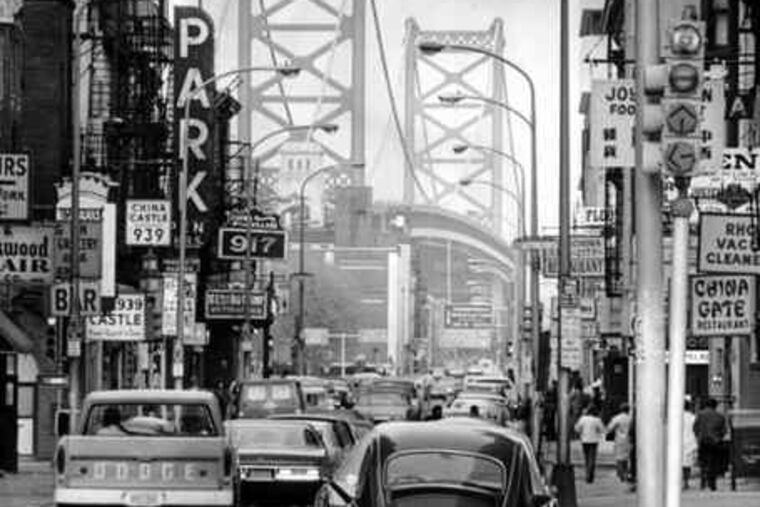
There are so many memorable pictures here, it's hard to pick favorites. On a second visit - and you can easily visit this show twice and still not feel you've done it justice - the works that drew me back for second and third looks included Don Camp's 1973 Chinatown Life, a black-and-white view of Race Street facing east, toward the Ben Franklin Bridge, depicting myriad signs of all kinds (this is the early photojournalistic work of the same Donald Camp who is now making large portraits); Paul Cava's Bicentennial, dated 1976-77, a street shot showing a kiosk with a torn Bicentennial poster on it; Stephen Shore's Twenty-first and Spruce Streets, Philadelphia, Pennsylvania, June 21, 1974, in which the older car models are the only clue to the work's date; and James B. Abbott's Ben Franklin Bridge and Ramp to Nowhere (1983), which shows the I-95 ramp standing alone and unfinished, looking like a ruin of a Roman aqueduct.
Philadelphia Inquirer staff photographer Tom Gralish's Homeless Philadelphia (1985), from his Pulitzer Prize-winning photo essay, in which a snow-covered man huddles against a manhole cover on Rittenhouse Square, is the most poignant picture here (again, as in Shore's image, things haven't changed much). The city looks its most stylish and film-noirish in Ray Metzker's series of eight photographs of figures walking amid cavernous architectural spaces, images whose serial placement together suggests the rhythm of walking.
The belated prize for best picture of a fleeting moment has to go to Paul McGuirk for his 1976 Party Boat, in which a security cop stares open-mouthed at two men in an embrace. His eyes focus on one man's hand grasping the other's rear, and his expression is the essence of stunned disbelief. Meanwhile, the guy doing the groping smiles broadly at the camera. Seen through the lens of the AIDs epidemic to come, this image is fleeting in every sense.
Worldwide web
Also encyclopedic and absorbing, Fleisher/Ollman Gallery's "Back to Earth" is John Ollman's own homage to "Magiciens de la Terre," an exhibition presented in Paris 20 years ago at the Pompidou Center and the Parc de la Villette, and whose curator, Jean-Hubert Martin, intended it as a true global representation of talent (and as rebuke to the business-as-usual, let's-pick-the-hotties mentality of the Paris Biennial).
This redux of inclusiveness boasts perhaps a quarter of the originals, among them Jose Bedia, Alighiero Boetti, John Baldessari, Louise Bourgeois, James Lee Byars, Francesco Clemente, Bowa Devi, the Linares Family, Henry Munyaradzi, Alfredo Jaar, Claes Oldenburg, Sigmar Polke, Nancy Spero (who died last Sunday at 83), and Zush.
This a gorgeous show that has to be seen to be believed, not least for the effort Ollman has put into it, including his own collage of global images, art and otherwise, that takes up most of a wall. It's also an opportunity to acquaint yourself with the aboriginal artist Dick Murumuru (who was not in the original show and whose unassuming painting of kangaroo infants on wood, Two Joeys, circa 1940, is a star of this one); the Indian Bowa Devi, whose brilliantly colored, graphic watercolors of the 1980s borrow look and imagery from the traditional painting of her countrywomen; and the Nigerian Prince Twins Seven-Seven, whose fantastic imaginary worlds on fabric sum up the freewheeling fun.