Galleries: Two outstanding pairings, at Pentimenti and at Locks
It's not often that a two-person show catches both of its artists on a perfect wave - or, rarer still, unites two who make each other shine - but Pentimenti Gallery's pairing of Jackie Tileston and Jedediah Morfit does both. While Tileston envisions the landscape as a place of ever-expanding possibility, Morfit uses it to evoke the inevitable passage of human life on Earth as it was viewed a couple of centuries ago, with some odd goings-on along the way.
It's not often that a two-person show catches both of its artists on a perfect wave - or, rarer still, unites two who make each other shine - but Pentimenti Gallery's pairing of Jackie Tileston and Jedediah Morfit does both. While Tileston envisions the landscape as a place of ever-expanding possibility, Morfit uses it to evoke the inevitable passage of human life on Earth as it was viewed a couple of centuries ago, with some odd goings-on along the way.
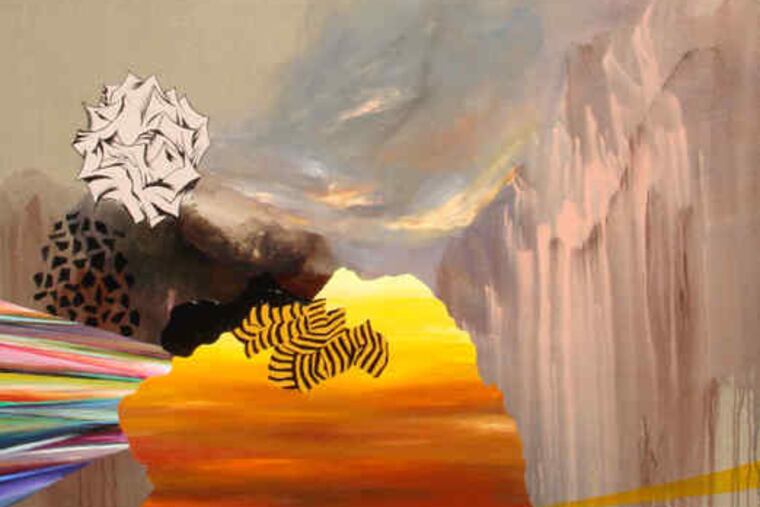
Tileston's new paintings push her visions of kaleidoscopic worlds to even greater dimensions than her earlier works have done. Where her meditative, floating, dissolving landscapes of a few years ago suggested a hybrid of sci-fi and Japanese Ukiyo-e ("pictures of the floating world") or Chinese scroll painting, her new, glitter-sprinkled paintings describe vaster places, sharper geometries, and explosive phenomena - in outer space and the world we know.
Even in the calmest of these new paintings, El Dorado Depot, a meteorlike shape is headed toward a jagged cliff of exposed, rainbow- hued strata. Opposite that cliff a mountain looms, a nicely forbidding perch for a Wicked Witch, but as drippy as any abstract expressionist painting at its base. It's just a painting, after all, melting as the witch did.
An installation of Tileston's photographs from her recent trips to China and India offers insight into the compositions and colors of her paintings. In each one, a dozen coincidental juxtapositions and intersections exist in utter stillness, motionless. In her paintings, the same kinds of coincidences of placement appear, but as in a state of flux: coalescing, breaking apart, attenuating, reuniting.
Morfit's bas-relief sculptures of humans and animals, which compose the smaller of these two shows (he's in the "Project Room"), bring Kara Walker's silhouettes to mind, but his groupings rarely constitute a story or event as Walker's do. Made from cast white plastic, Morfit's exquisitely modeled figures look as if they had escaped from a prim, 18th-century Wedgwood frieze and found themselves unprepared for the perils and excitement of the life of Tom Jones (the foundling, not the singer). Without a narrative to enact, they seem to be trudging along the same path in the same landscape, as if still confined to the contours of the vase they formerly encircled.
Under the same roof
Two of the best gallery exhibitions currently on view in Philadelphia are under the same roof, and they're both group shows. You have to wonder if Locks Gallery planned to have the encyclopedic "Drawing" and "Water Is Best" at the same time, but both are so well done, it hardly matters.
The drawings in "Drawing" are a gathering of uniformly strong, mostly personal statements by each of its 20 artists. Elizabeth Osborne's simply composed Untitled (Portrait of a Young Woman) (1973), is one of the most magnetic works here. In it, a woman sitting near a window at night is illuminated by an electric light on one side of her face and shadowed by the night's darkness on the other. Alice Neel's Bette Fisher (1965) is a similarly intense portrait of a woman, but in Neel's Van Gogh-ish, tightly wound line.
You sense that Osborne identifies with her subject and that Neel, as she was wont to do, is skewering hers.
Some other standouts include an enormous, vertical painting on paper by Suzanne McLelland; intimate works on paper dedicated to friends by Willem de Kooning and Arshile Gorky; and a Warren Rohrer painting in ink and gouache that suggests snow on a field, but also an affinity with Robert Ryman.
"Water Is Best" (the title was inspired by the ancient Greek lyric poet Pindar, who presumably enjoyed more than his share of sun and wrote that water was worth as much as gold) is a celebration featuring paintings by 11 gallery artists.
Ena Swansea's Windy Day, showing a curious seagull on the beach in closeup, looking not unlike an elderly, stalk-legged beach bum, is a charmer; Alex Katz's Black Brook V evokes deeper, elegiac thoughts.
Thomas Chimes' Waterfall looks like our own mysterious Schuylkill as it drops precipitously just before passing below the Philadelphia Museum of Art.